



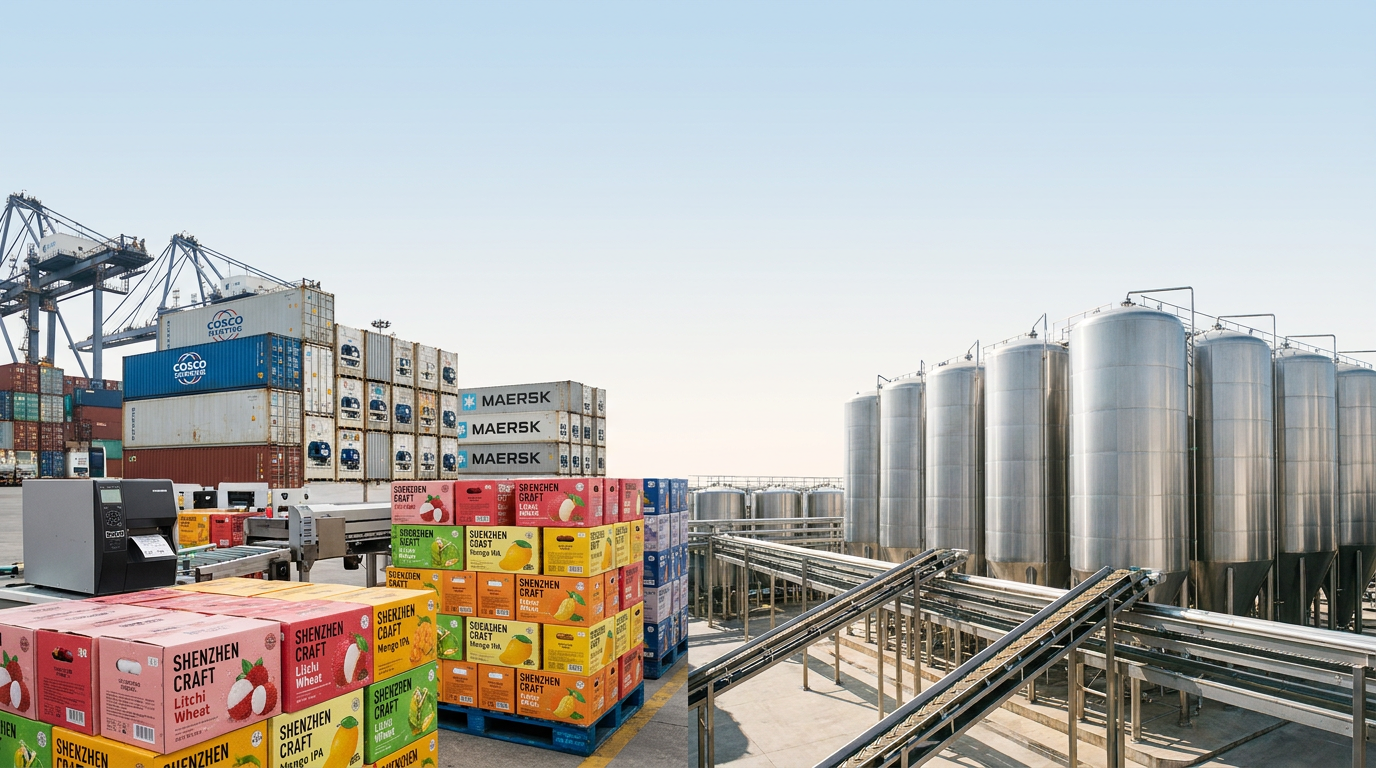
Wondering how long is the lead time for China beer OEM orders? For global distributors and agents, regional logistics hub efficiency—especially between Guangdong and Shandong—directly impacts delivery consistency, inventory planning, and market responsiveness. This article compares how infrastructure, port access, and supply chain maturity in these two key provinces affect Jinpai Beer’s craft beer OEM timelines—covering lagers, wheat beers, low-calorie, fruit-flavored, and functional specialty brews. Understand which hub aligns with your speed, scalability, and quality-control needs.
Why provincial logistics hubs matter for beer OEM lead time consistency
Lead time for China beer OEM orders isn’t just about brewing duration. It’s a composite metric: raw material sourcing, batch validation, labeling compliance, cold-chain readiness, customs clearance, and last-mile dispatch.
Guangdong and Shandong host China’s two most operationally distinct beer OEM ecosystems. One prioritizes export velocity and digital integration. The other emphasizes scale, agricultural proximity, and domestic distribution depth.
Jinpai Beer operates dual-hub production facilities—one near Shenzhen (Guangdong), one near Qingdao (Shandong). Both serve international OEM clients but deliver different consistency profiles across order volumes, formulation complexity, and destination markets.
How Guangdong’s logistics hub shapes fast-cycle OEM performance
Guangdong offers unmatched maritime connectivity. Yantian and Shekou ports handle over 40 million TEUs annually—with dedicated cold-container lanes and pre-clearance agreements for ASEAN, EU, and North American shipments.
For orders under 5,000 cases—especially fruit-flavored or functional specialty beers requiring rapid label approval and temperature-controlled air freight—Guangdong delivers median lead times of 28–35 days.
Key advantages include:
- Real-time customs API integration reduces documentation lag by 60%
- On-site bilingual QA teams accelerate regulatory alignment for EU/US labels
- Digital batch traceability supports same-day lot release for urgent reorders
However, high demand pressure can cause minor variability during Q4 peak season—particularly for sugar-free low-calorie formulations requiring imported enzymes.
How Shandong’s logistics hub ensures high-volume OEM stability
Shandong hosts China’s largest barley-growing belt and three top-tier malt suppliers. Its Qingdao hub integrates upstream agriculture with downstream bottling—cutting raw material lead variance to under ±1.2 days.
For orders exceeding 10,000 cases—especially classic lager or German wheat variants—Shandong achieves 98.7% on-time-in-full (OTIF) consistency at median lead times of 38–44 days.
Critical strengths include:
- Direct rail links to Tianjin and Dalian ports reduce inland transit variance by 42%
- In-house CO₂ capture and reuse systems stabilize carbonation specs across batches
- Regional cold-storage pooling enables staggered dispatch without quality compromise
Its slower ramp-up for new recipes (e.g., novel fruit infusions) reflects deeper sensory validation protocols—not inefficiency.
Comparing lead time consistency by product category & volume tier
Three common misjudgments that extend OEM lead time unnecessarily
- Assuming “faster port = faster total lead time”: Air-freighted samples from Guangdong don’t guarantee same-speed bulk sea shipments if label artwork revisions occur post-approval.
- Overlooking formulation handoff windows: Fruit puree sourcing cycles differ by region—Shandong secures local berries in July–August; Guangdong imports tropical variants year-round but faces longer phytosanitary holds.
- Treating all cold-chain requirements as equal: Functional specialty beers with probiotics need validated -18°C transport lanes—available in both hubs, but only Guangdong offers certified air-cargo reefer options under 72 hours.
Which hub should you choose—and when?
Select Guangdong if your priority is:
- First-to-market launches in Southeast Asia, Europe, or North America
- Orders under 5,000 cases with frequent SKU rotation (e.g., seasonal fruit flavors)
- Need for expedited compliance support—especially for health-claim labeling
Select Shandong if your priority is:
- Stable, recurring orders above 8,000 cases per quarter
- Core lager or wheat beer lines targeting LATAM, Middle East, or domestic APAC distributors
- Long-term contracts requiring batch-to-batch sensory uniformity and shelf-life predictability
Hybrid deployments are also possible: prototype batches via Guangdong, then shift to Shandong once specifications lock in.
Next step: Optimize your OEM timeline today
How long is the lead time for China beer OEM orders? Now you know it depends less on geography—and more on alignment between your product profile, volume rhythm, and market entry strategy.
Jinpai Beer provides free lead time benchmarking for qualified partners. Share your target SKU, annual volume range, and first shipment window—we’ll map the optimal hub, recommend buffer allowances, and outline documentation milestones.
Contact our OEM Solutions Team to receive a tailored timeline assessment within 48 business hours. Global distribution starts with predictable execution—not just promising numbers.
Thank you very much for writing to us. Please leave your message and contact information, we will reply to you within 24 hours.