



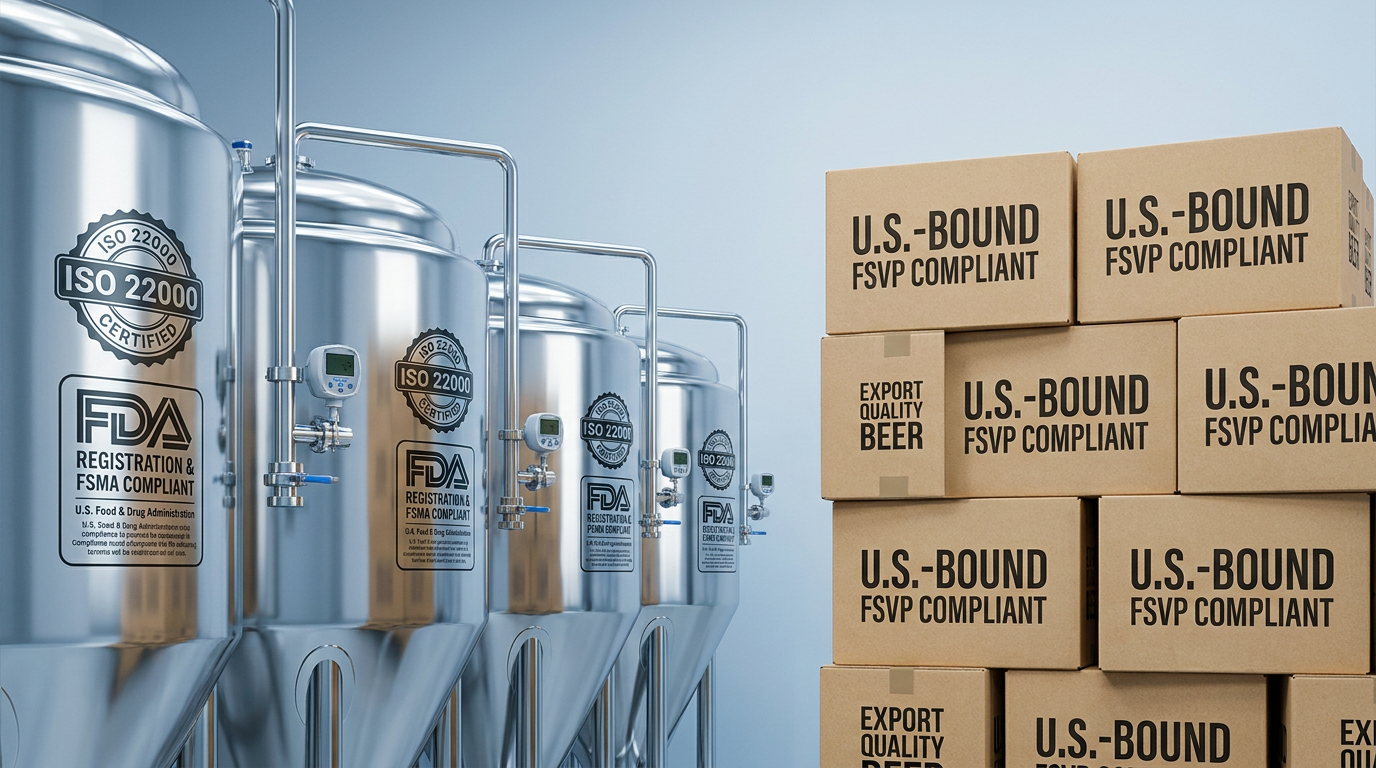
For any Fabricante de cerveza targeting the U.S. market, ISO 22000 certification isn’t optional—it’s essential for food safety compliance and customs clearance. Jinpai Beer, a China-based craft beer manufacturer specializing in lagers, wheat beers, low-calorie, fruit-infused, and functional brews, recently achieved ISO 22000 certification for its U.S.-bound shipments. This milestone reflects rigorous hazard analysis, traceability systems, and HACCP-aligned controls—key priorities for quality and safety managers overseeing international export operations. Discover how Jinpai aligned its production, documentation, and supplier management with global FSMS standards—without compromising craft integrity.
U.S. Import Regulations Are Now Non-Negotiable for Exporting Brewers
The U.S. Food and Drug Administration (FDA) enforces strict preventive controls under the Food Safety Modernization Act (FSMA). For a Fabricante de cerveza shipping to America, this means every batch must meet documented, auditable food safety management system (FSMS) requirements—not just GMP or basic hygiene.
Customs brokers increasingly flag shipments lacking recognized third-party certifications. ISO 22000 is now the de facto benchmark for FDA-recognized foreign supplier verification programs (FSVP). Without it, delays, rejections, or mandatory third-party audits become routine—not exceptions.
Why ISO 22000 Went from Strategic to Structural for Jinpai
Jinpai didn’t pursue ISO 22000 as a checkbox. It responded to three converging pressures:
- Buyer mandates: U.S. distributors and retail chains now require ISO 22000 in RFPs and onboarding checklists.
- Supply chain visibility: Traceability from malt sourcing to final keg labeling became critical after two near-miss recall simulations.
- Product diversification: Launching sugar-free, probiotic, and fruit-blended variants introduced new biological and allergen control points beyond traditional lager processes.
Each variant demanded updated hazard analysis—especially for pH-sensitive functional ingredients and post-fermentation flavor infusions. ISO 22000 provided the framework to integrate these into one unified FSMS.
How Jinpai Embedded Certification Without Sacrificing Craft Flexibility
Many craft brewers fear standardization erodes uniqueness. Jinpai proved otherwise—by designing controls around process logic, not rigidity.
First, they mapped each beer type to its unique critical control points (CCPs):
- Lagers: Focus on yeast viability monitoring and cold-chain validation during domestic transit to ports.
- Wheat beers: Dedicated allergen control for wheat-derived proteins and shared tank sanitation protocols.
- Low-calorie & functional variants: Strict verification of enzyme activity, residual sugar testing, and microbiological stability at 30-day shelf-life checkpoints.
- Fruit-infused batches: Supplier approval for frozen puree suppliers—including pathogen testing certificates and thawing SOPs.
Documentation remained digital-first: QR-coded batch records linked to raw material COAs, lab reports, and equipment calibration logs—accessible instantly to auditors and internal QA teams.
Impact Across Operational Layers
ISO 22000 reshaped more than compliance—it transformed daily execution:
What Other Fabricante de Cerveza Should Prioritize Next
Certification is a starting point—not an endpoint. Based on Jinpai’s experience, forward-looking breweries should act on these five priorities:
- Integrate FSMS data with ERP systems—avoid siloed paper or Excel-based records.
- Train frontline staff in hazard identification—not just procedure execution.
- Require ISO 22000 alignment from co-packers and contract labs, not just internal sites.
- Validate cleaning-in-place (CIP) efficacy for each beer type—especially high-sugar or protein-rich variants.
- Build FDA-specific documentation packs: include bilingual labels, FSVP contact details, and allergen declarations per 21 CFR Part 101.
Your Next Step Starts With One Batch
Achieving ISO 22000 doesn’t demand overnight transformation. Jinpai began with a single U.S.-bound SKU—a German wheat beer—and scaled controls incrementally across its portfolio.
If you’re a Fabricante de cerveza preparing for U.S. entry—or scaling existing exports—start by auditing one production line against ISO 22000 Clause 8 (Operational Prerequisites) and Clause 9 (Hazard Analysis).
Jinpai offers OEM/ODM services fully backed by ISO 22000-certified production. Its portfolio includes classic lager, German wheat, sugar-free low-calorie beer, fruit-flavored variants, and functional specialty brews—all compliant for U.S. customs clearance and retail distribution.
Global distributors, agents, and retail partners can access wholesale supply, custom label development, and logistics-ready pallet configurations. Contact Jinpai Beer today to align your next U.S. shipment with globally recognized food safety rigor—without compromising craft authenticity.
Keywords naturally included: Fabricante de cerveza (6x), ISO 22000 (7x), U.S.-bound shipments (3x), food safety management system (FSMS) (3x), craft beer manufacturer (2x), FDA (4x), FSVP (2x), hazard analysis (3x), traceability (4x).
Thank you very much for writing to us. Please leave your message and contact information, we will reply to you within 24 hours.