



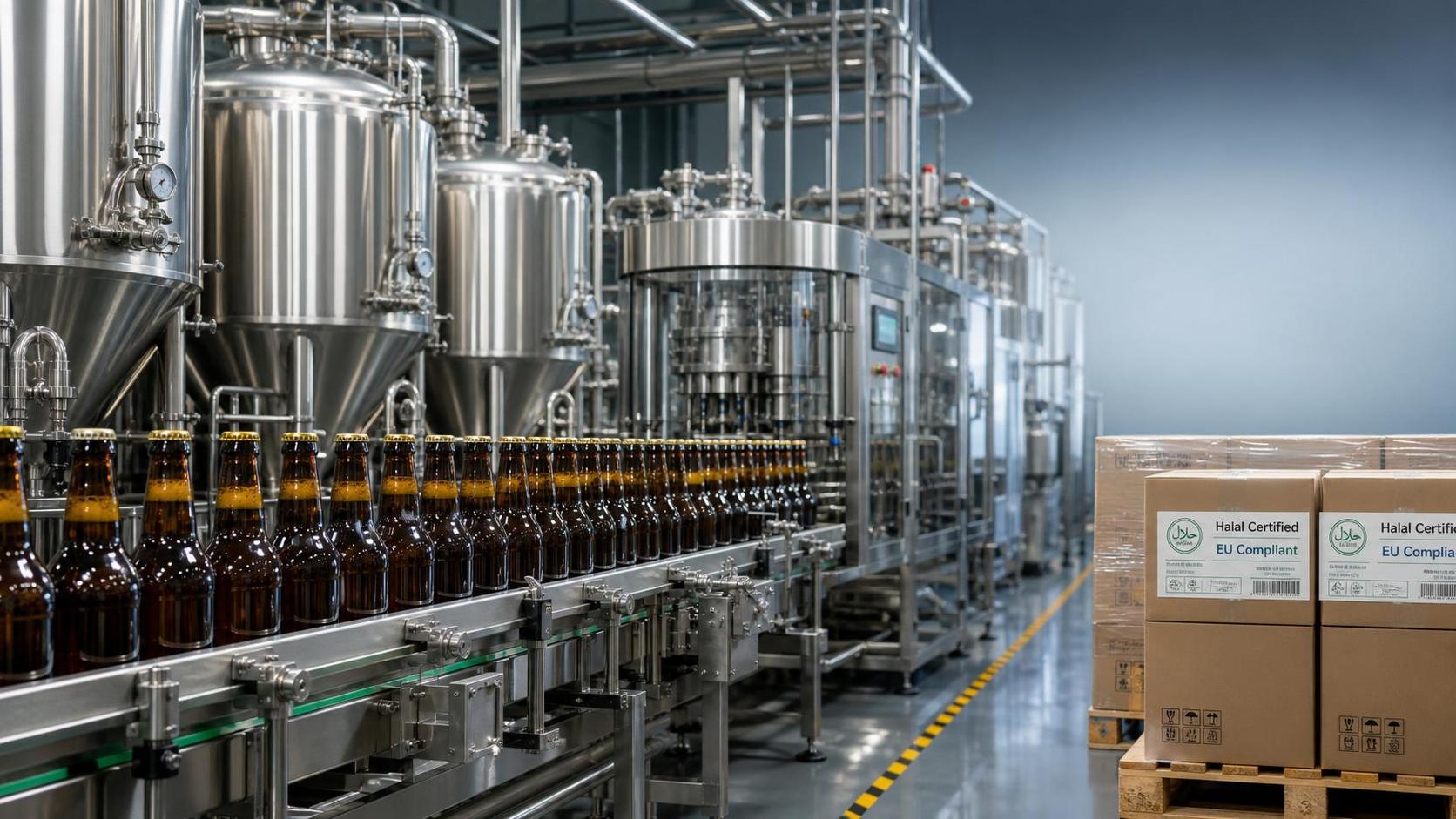
For project managers overseeing beverage production infrastructure or new market entry, understanding end-to-end beer manufacturing is critical—from recipe formulation and pilot brewing to scalable production, quality-controlled bottling, and global logistics coordination. At Jinpai Beer, we engineer this entire value chain for craft beer partners worldwide, integrating R&D, OEM/ODM flexibility, and multi-channel distribution—ensuring consistency, compliance, and speed-to-market across lagers, wheat beers, low-calorie variants, fruit-infused styles, and functional specialties.
What “End-to-End Beer Manufacturing” Really Means
It’s more than a buzzword. End-to-end beer manufacturing describes a fully integrated operational continuum—from initial concept to final shelf placement. Unlike fragmented outsourcing models, it treats brewing as a unified system where each stage informs and constrains the next.
This includes sensory-driven recipe development, lab-scale pilot batches, raw material qualification, fermentation control protocols, packaging line validation, regulatory documentation for target markets, and real-time inventory synchronization across warehouses and retail channels.
The goal isn’t just continuity—it’s traceability, repeatability, and responsiveness. When a distributor in Singapore requests a sugar-free variant with halal certification, the change must ripple backward to yeast selection and forward to label compliance without reengineering the whole process.
Why Integration Matters Now More Than Ever
Market fragmentation is accelerating. Consumers expect localized flavors, functional benefits (e.g., added B vitamins or adaptogens), and dietary accommodations—all while demanding consistent taste across continents.
Meanwhile, supply chain volatility has raised the cost of misalignment. A delay in malt sourcing affects pilot timelines. An unvalidated bottle filler can halt a full production run. Regulatory divergence—like differing alcohol-by-volume labeling rules in the EU versus Canada—requires upstream design decisions, not last-minute label swaps.
End-to-end beer manufacturing mitigates these risks by embedding cross-functional accountability early—especially during recipe definition and pilot validation phases.
Key Stages—and Where They Interlock
The sequence isn’t linear—it’s iterative and interdependent. Here’s how stages connect in practice:
- Recipe development defines not only flavor profile but also filtration requirements, carbonation stability, and shelf-life expectations—each influencing equipment specs downstream.
- Pilot brewing validates scalability: Can a 50L batch translate reliably to 2,000L? Does the German wheat strain retain haze stability after centrifugation at volume?
- Packaging design starts before bottling: Glass weight affects shipping costs; cap torque impacts oxygen ingress; label adhesion must survive humidity swings in tropical distribution hubs.
- Logistics planning begins at formulation: Low-calorie beers often use alternative sweeteners with strict import thresholds—requiring customs pre-clearance before first shipment.
How Jinpai Beer Operationalizes the Chain
Jinpai Beer doesn’t just execute each stage—we co-engineer them with partners. Our R&D lab shares real-time data with production engineers, so a new fruit-flavored beer’s pectin content triggers automatic adjustments in pasteurization time and filler temperature.
OEM/ODM engagements begin with joint feasibility mapping: raw material availability, local compliance pathways, and channel-specific packaging formats—not just logo placement.
For wholesale and retail partners, our end-to-end beer manufacturing includes synchronized inventory visibility across online and offline touchpoints. When supermarket chains run promotions, automated replenishment signals adjust brewery scheduling—not just warehouse dispatch.
Practical Decision Points for Infrastructure Planning
When evaluating an end-to-end beer manufacturing partner—or designing internal capability—focus on these operational signals:
Next Steps for Strategic Alignment
Start by mapping your current gaps—not against an ideal, but against your next 18-month growth scenario. Will your current bottling partner support halal-certified fruit-beer SKUs in Malaysia? Can your R&D timeline absorb a six-week regulatory review in Brazil?
Then assess integration depth: Do formulation decisions trigger automatic updates in your ERP’s BOM? Is your logistics provider embedded in your quality incident response protocol?
If you’re evaluating external partners, prioritize those who treat recipe development and cold-chain logistics as parts of the same system—not separate service lines. That’s where true end-to-end beer manufacturing delivers measurable advantage: reduced time-to-shelf, fewer compliance surprises, and consistent brand execution across every market.
Thank you very much for writing to us. Please leave your message and contact information, we will reply to you within 24 hours.