



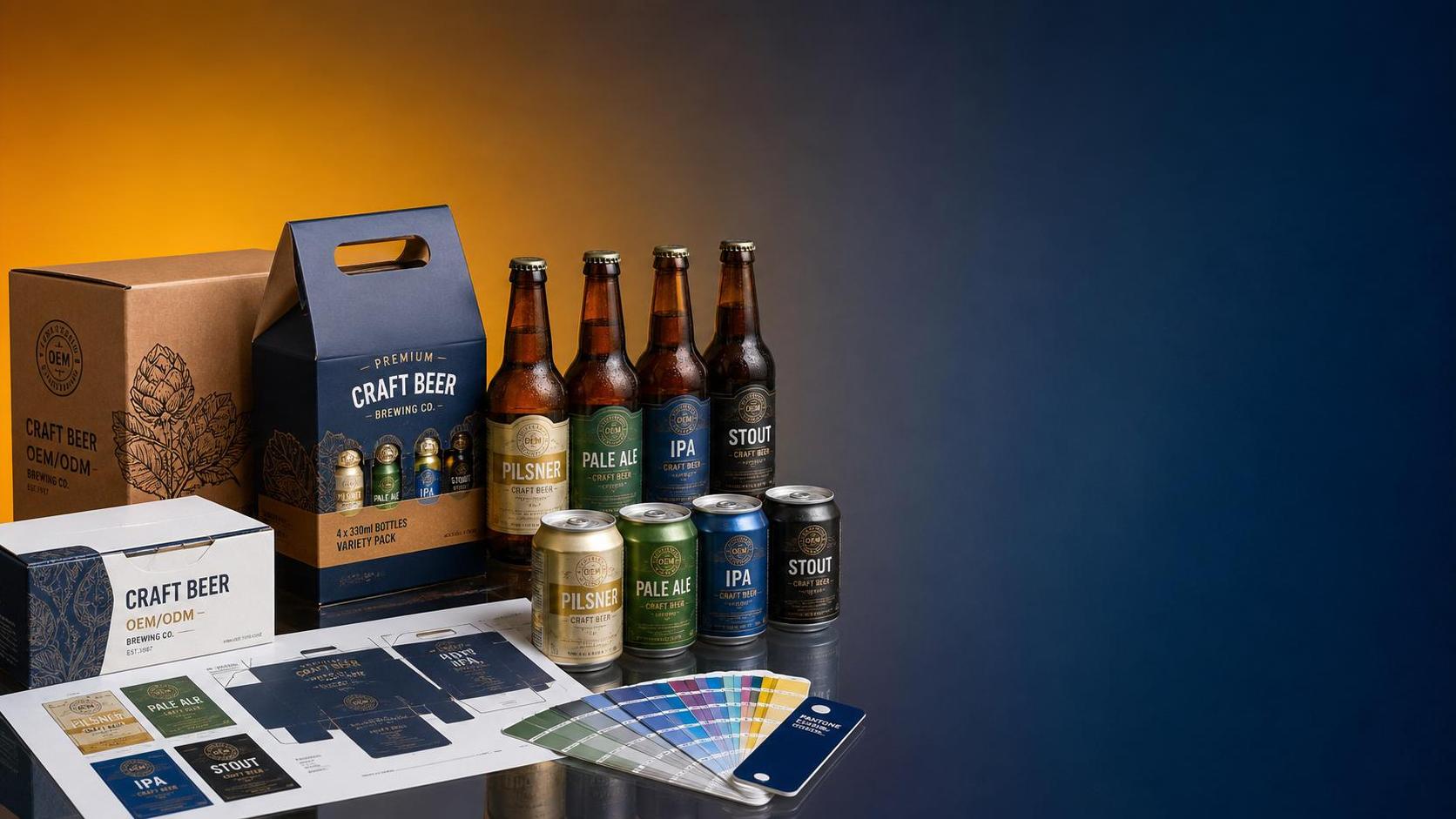
Should you rely on the factory for beer label and packaging design?
Do Chinese beer factories handle label and packaging design? In many cases, yes, but not always at the same depth.
That difference matters when you are sourcing beer from China and trying to balance launch speed, packaging cost and brand control.
For craft beer, packaging is not a minor detail. It shapes shelf appeal, legal compliance and how distributors judge product readiness.
The practical answer is that many OEM and ODM breweries can support packaging design, yet the scope varies from simple layout work to near full-service development.
With suppliers such as Jinpai Beer, which develops and produces classic lager, German wheat, sugar-free low-calorie beer, fruit beer and functional specialty beer, packaging support often connects directly with product customization.
So the better question is not only, do Chinese beer factories handle label and packaging design, but how much should they handle for your project.
What do Chinese beer factories usually manage in-house?
Most export-oriented beer factories can manage basic packaging tasks internally. That usually includes label size setup, dieline adjustment and print-ready file checks.
They may also help select bottle types, can formats, carton structures and finishing options based on filling line compatibility.
In actual projects, factories often coordinate three linked areas at once.
- Technical packaging adaptation for bottles, cans, carriers and cartons.
- Mandatory label content checks for export or destination-market basics.
- Printer coordination so artwork matches production timing.
However, factories are not always brand agencies. Their design team may be strong on execution but limited on premium positioning or retail storytelling.
If your product is a straightforward OEM beer line, in-house support can be enough. If the brand must stand out across multiple channels, outside design may add value.
When is factory-led packaging design the smarter choice?
Factory-led design works best when speed and operational fit matter more than highly original branding.
A common example is launching a private-label beer for supermarkets, bars or restaurant groups with a fixed timeline and controlled budget.
In that case, the brewery already understands print tolerances, label materials and secondary packaging required for shipping and palletization.
That reduces revision loops. It also lowers the risk that attractive artwork fails during real production.
This is especially useful for products with multiple SKUs, such as lager, wheat beer, fruit-flavored beer and low-calorie variants under one house brand.
A supplier like Jinpai Beer can align flavor positioning, packaging structure and OEM or ODM production planning in one workflow.
That integrated process often saves time in these situations.
- You need market-ready packaging fast.
- Your concept is clear but not design-heavy.
- You need one partner to manage product and pack compatibility.
- The first order volume does not justify a separate agency budget.
What usually makes outsourcing the better option?
Outsourcing becomes more attractive when packaging is expected to carry brand differentiation, premium pricing or cross-market consistency.
If the beer line will compete in crowded retail coolers, specialty stores or e-commerce channels, visual identity often needs deeper strategic work.
That includes naming systems, portfolio architecture, brand story hierarchy and packaging that performs across cans, bottles and display cartons.
An external agency or packaging studio may also be better at adapting branding for different countries without losing a unified look.
More importantly, outsourced specialists often bring stronger consumer insight. They design for buying behavior, not only production feasibility.
That matters for craft segments where visual cues influence whether a beer feels classic, healthy, fruity or functional before the first sip.
A simple comparison helps
If you are still asking, do Chinese beer factories handle label and packaging design, this table shows the real answer: they often do, but not for every strategic goal.
Which risks are easy to miss before approving the artwork?
The biggest mistake is assuming attractive design equals production-ready packaging. In beer projects, those are different checkpoints.
A label may look polished on screen but fail because of condensation, container curvature or print color variation.
Another common issue is compliance. Required information changes by market, and factories may only verify what they know from past export experience.
It is better to confirm destination rules independently, especially for alcohol content statements, ingredient wording, recycling marks and language placement.
The next risk is ownership. When artwork is adjusted by several parties, file control can become unclear.
- Confirm who owns editable source files.
- Check whether fonts and licensed graphics are transferable.
- Approve final dielines before mass printing begins.
- Request a physical or digital mockup for each SKU.
Needless revisions are expensive once cartons, labels and shipping plans are already tied to a production slot.
How should you decide between in-house factory support and outsourcing?
A useful decision method is to separate packaging into two layers: brand creation and production execution.
If your brand assets already exist, the factory can often take over adaptation efficiently. That includes size changes, regulatory text and carton coordination.
If the brand itself is still being built, outside design support may be the stronger starting point.
In practice, many successful beer projects use a hybrid model. A studio creates the visual system, then the brewery finalizes technical packaging files.
That approach works well for companies launching differentiated craft beer while relying on OEM or ODM manufacturing in China.
Questions worth answering before you choose
- Is this a speed-driven launch or a brand-building launch?
- Will the beer sell through retail, horeca, e-commerce or all three?
- How many SKUs and packaging formats are planned in the first year?
- Do you need local compliance help for several export markets?
- Will the design need to support premium pricing?
- Can one supplier manage both production and packaging without bottlenecks?
These answers usually reveal whether factory support is sufficient or whether outsourcing will protect long-term brand value.
So, do Chinese beer factories handle label and packaging design well enough?
For many beer sourcing projects, yes. Chinese breweries can often handle label and packaging design well enough to move from concept to launch smoothly.
That is especially true when the goal is efficient OEM or ODM execution, fast commercialization and packaging that works reliably on real production lines.
Still, outsourcing is the better route when packaging must do heavier brand work, support premium market entry or unify a more complex portfolio.
A supplier with broad category coverage, such as Jinpai Beer, can be valuable because product style, packaging format and customization requirements are considered together.
The most effective next step is to map your brand goals against timing, compliance needs, SKU count and channel plan.
Once that is clear, ask the brewery what parts of label development, carton design, print coordination and market adaptation they truly manage in-house.
That will tell you whether to keep packaging design inside the factory workflow, bring in outside specialists, or combine both for better control.
Thank you very much for writing to us. Please leave your message and contact information, we will reply to you within 24 hours.