



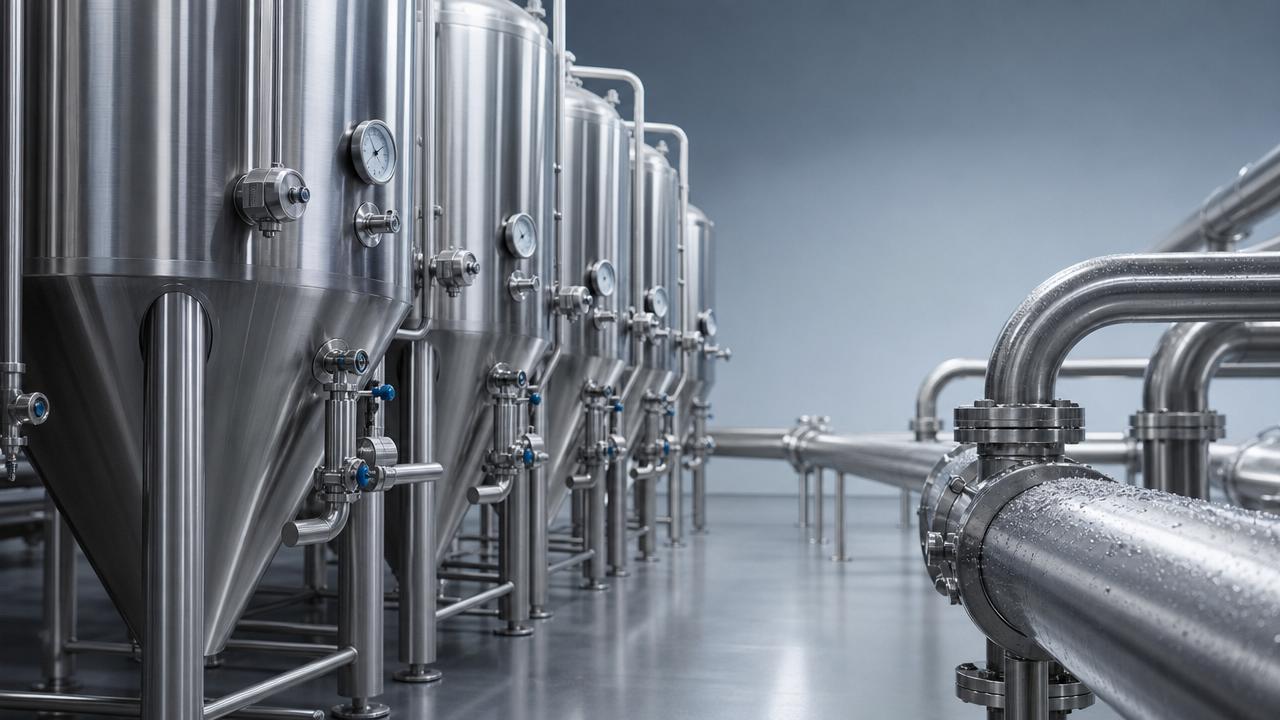
When evaluating a craft beer supplier, technical due diligence is critical—especially discrepancies between stated fermentation capacity and actual output. For engineers and quality assurance professionals, unexplained gaps may signal underinvestment in infrastructure, inconsistent process control, or scalability risks. At Jinpai Beer, we align claimed production volumes with verifiable tank capacity, batch cycle times, and real-time monitoring data—ensuring transparency for global partners assessing supply reliability. This article identifies key red flags to watch for—and how to validate them objectively.
Fermentation Capacity vs. Output: Why the Gap Matters
In craft brewing, fermentation capacity is not just about tank volume—it’s the measurable throughput of consistent, on-spec batches per unit time. A supplier claiming 30,000 hectoliters (hL) annual output but operating only 12 × 30-hL conical fermenters—with no reserve tanks, no parallel conditioning lines, and average cycle times exceeding 21 days—cannot sustain that volume without significant bottlenecks or quality compromises. Real-world constraints include yeast propagation lag (typically 48–72 hours), temperature ramping profiles (±0.3°C tolerance required for lager maturation), and CIP downtime (averaging 3.5–5.2 hours per tank per cycle).
For technical evaluators, mismatched claims often reveal deeper issues: outdated PLC systems lacking batch-level traceability, absence of dissolved oxygen (DO) or CO₂ pressure logging during active fermentation, or reliance on manual gravity readings instead of inline refractometers calibrated to ±0.05°P. These aren’t operational quirks—they’re risk indicators affecting shelf life, flavor stability, and regulatory compliance across export markets.
Six Objective Validation Checks
- Verify tank count × nominal volume × max realistic turnover rate (e.g., 8–10 batches/year for German wheat, 12–14 for lagers)
- Request anonymized batch logs showing actual fill-to-transfer duration (target: ≤95% of stated cycle time over 3 consecutive months)
- Confirm glycol chiller capacity (kW) relative to total fermenter jacket surface area (minimum 0.8 kW/m² for year-round ambient control)
- Review CIP system specs: minimum flow velocity (≥1.5 m/s), chemical contact time (≥15 min at ≥75°C), and rinse water conductivity thresholds (≤20 µS/cm)
- Inspect yeast management: viable cell count per mL at pitch (≥1 × 10⁷), viability post-storage (>92% after 7 days at 4°C), and strain verification via PCR or microsatellite profiling
- Validate QC frequency: at least 3 dissolved oxygen tests per batch (start, mid, end), plus weekly microbiological swabbing of transfer lines (target: <1 CFU/100 mL)
Red Flag Patterns & Cross-Verification Framework
Technical due diligence requires moving beyond marketing sheets. Below are three recurring red flag patterns observed across global craft beer supplier assessments—and how Jinpai Beer’s infrastructure addresses each.
The table above reflects real validation benchmarks—not theoretical ideals. For example, Jinpai’s German wheat program maintains a verified average cycle time of 16.8 days (including 72-hour cold crash), enabling 13.2 batches/year per 30-hL tank. This translates to a sustainable, auditable output ceiling—no extrapolation, no estimation.
How to Request Technical Documentation Responsibly
A credible craft beer supplier will provide documentation without NDAs for baseline technical review. Jinpai offers a standardized Technical Readiness Package—including equipment schedules (tank dimensions, agitator specs, jacket surface area), glycol loop schematics, CIP validation reports (per ASME BPE-2022 Annex D), and anonymized 90-day batch summary statistics (mean DO, standard deviation of final gravity, % batches within spec limits). All documents are timestamped, digitally signed, and version-controlled.
We recommend requesting these materials early in the evaluation cycle—not after commercial terms are agreed. Timely access enables engineering teams to model throughput, assess cold storage headroom (critical for sugar-free low-calorie and functional specialty beers requiring extended maturation), and verify compatibility with your existing logistics windows (e.g., pallet configuration, cold chain handoff protocols).
Conclusion: Building Trust Through Technical Transparency
Fermentation capacity misalignment isn’t merely an accounting issue—it’s a proxy for operational discipline, investment maturity, and commitment to reproducible quality. For technical evaluators sourcing craft beer suppliers, the most actionable insight lies not in peak theoretical numbers, but in verifiable consistency: Do batch logs reflect stable cycle times? Is glycol capacity engineered for worst-case ambient load? Are yeast handling practices validated—not assumed?
At Jinpai Beer, every claim—from 12,000 hL annual output for our fruit-flavored range to 8,500 hL for functional specialty beers—is anchored in physical infrastructure, real-time data, and third-party auditable processes. We support OEM/ODM partners with full technical disclosure, including remote SCADA access for qualified engineering teams and joint process capability studies (Cpk ≥1.33 target across ABV, bitterness, and residual sugar).
If you’re conducting technical due diligence on a craft beer supplier—or require a partner whose fermentation capacity, output consistency, and quality systems align with global retail and foodservice standards—contact Jinpai Beer today for a customized Technical Readiness Review.
Thank you very much for writing to us. Please leave your message and contact information, we will reply to you within 24 hours.