



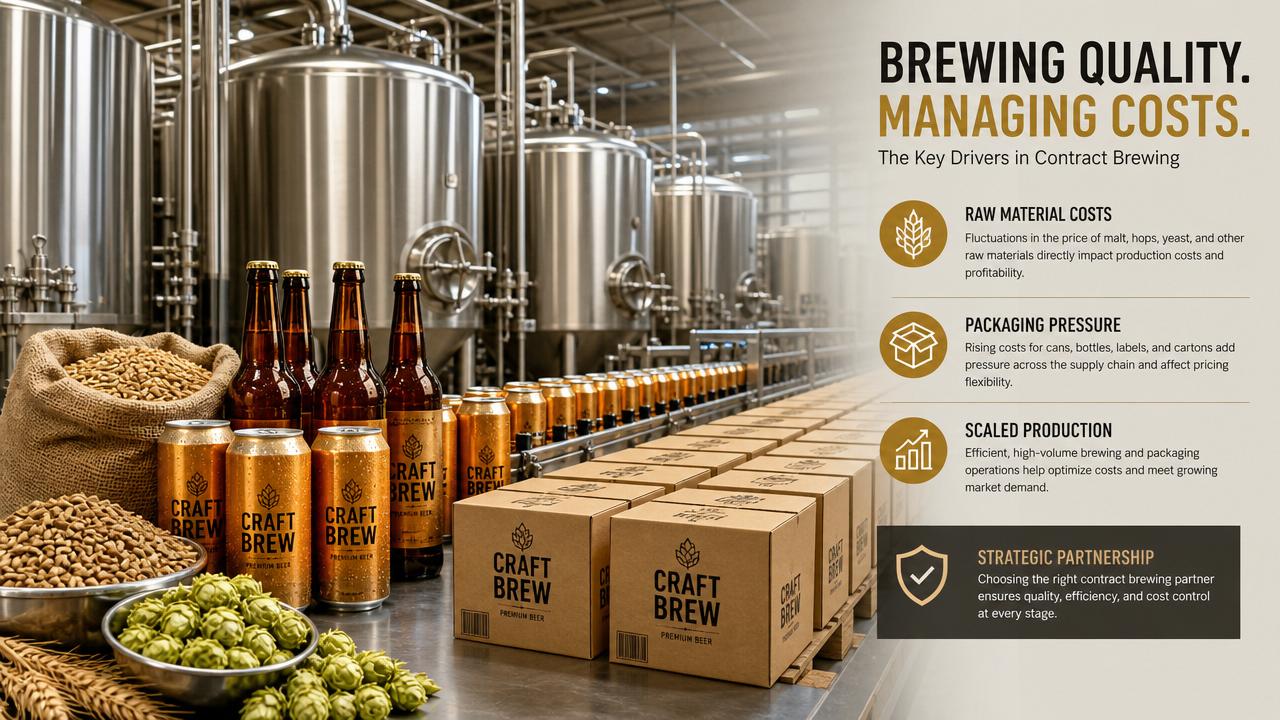
As 2026 approaches, Craft Beer Contract Brewing is entering a new cost cycle shaped by raw material volatility, energy pricing, packaging pressure and compliance upgrades. For financial decision-makers, understanding where margins may tighten—and where strategic partnerships can create stability—is essential before approving production budgets. This article highlights the key cost shifts to watch and the practical factors that can influence contract brewing value in a competitive global market.
What Financial Approvers Need to Know First
If you are reviewing a 2026 brewing budget, the main issue is not whether contract brewing will become universally expensive. The real question is which cost components are becoming less predictable, and whether your brewing partner can absorb, manage or transparently explain those changes.
For most buyers, Craft Beer Contract Brewing in 2026 will likely remain commercially attractive compared with building or expanding in-house capacity. However, total landed cost may rise if contracts are poorly structured, packaging is procurement-fragile, batch sizes are inefficient or compliance requirements are underestimated.
That means financial approval should focus less on headline price per unit and more on cost architecture. A contract brewer that appears cheaper on paper can become more expensive after freight adjustments, MOQ penalties, formula changes, rework risk, delayed lead times and market-specific labeling requirements are added.
Why 2026 Costs Are Shifting in Craft Beer Contract Brewing
Several forces are converging at once. Barley, wheat, hops, fruit ingredients and specialty functional additives remain exposed to weather variation, agricultural cycles and global supply chain disruptions. Even when commodity prices stabilize, premium and differentiated inputs can still carry pricing pressure.
Energy is another major variable. Brewing is energy-intensive, and fluctuations in electricity, steam, cooling and water treatment costs can directly affect the price a contract brewer must charge. Financial teams should expect energy management capability to become a more meaningful supplier selection criterion in 2026.
Packaging may be the most underestimated factor. Cans, bottles, lids, labels, trays, cartons and decorative finishes are all vulnerable to price shifts, especially for smaller or customized runs. In many cases, packaging inflation has a stronger impact on final product cost than modest changes in brewing ingredients.
Compliance costs are also rising. Export documentation, food safety controls, traceability systems, formula registration, alcohol labeling and local market certifications can increase operating overhead. These costs may not always appear in a base quote, but they affect the true value of a Craft Beer Contract Brewing partnership.
Which Cost Drivers Matter Most to Margin Control
Financial approvers usually care about margin protection, budget visibility and downside risk. In that context, the following cost drivers deserve the closest attention when evaluating contract brewing proposals for 2026.
1. Raw material mix
A classic lager and a fruit-flavored functional beer do not carry the same cost profile. Malt specification, hop program, yeast management, fruit preparations, sugar-free formulation systems and specialty active ingredients can materially change unit economics. The wider the product portfolio, the less useful a single average cost assumption becomes.
2. Batch size efficiency
Small or irregular batches often create hidden costs. Cleaning downtime, changeovers, quality checks and packaging line resets all reduce production efficiency. A supplier may offer an attractive per-case estimate, but if your order pattern lacks scale or consistency, actual cost can move upward quickly.
3. Packaging complexity
Standard formats usually offer the best cost control. Once custom can sizes, premium labels, gift-ready presentation or mixed-SKU outer cases are introduced, material waste, setup time and sourcing risk may rise. For finance teams, packaging standardization is often one of the easiest ways to protect gross margin.
4. Logistics and landed cost
Contract brewing economics should never be judged only at the factory gate. Ocean freight, domestic transport, warehousing, customs duties, insurance and channel-specific handling all affect the final cost to serve. For global programs, the lowest production quote is not always the lowest landed cost.
5. Quality consistency and rejection risk
Off-spec product, shelf-life issues, unstable carbonation, can seam defects or labeling errors can erase any nominal savings. A financially sound contract brewing partner is one that reduces the probability of rework, returns and market complaints. Quality reliability is a cost-control issue, not just an operations issue.
Where Buyers Are Most Likely to Underestimate 2026 Brewing Costs
Many brewing projects go over budget not because of a dramatic price shock, but because the original estimate excluded predictable secondary costs. Finance leaders should pay close attention to these often-overlooked items.
First, formula localization can add expense. A beer that works in one region may require ingredient substitutions, labeling adjustments or alcohol-content compliance changes for another market. Those changes affect approvals, production planning and sometimes shelf-life validation.
Second, urgent production slots usually cost more. If forecasts are weak and orders are placed late, the contract brewer may need to rearrange schedules, split raw material purchases or accept lower line efficiency. Rush production is rarely visible in strategic planning, but often appears in the final cost base.
Third, sample development and pilot runs can accumulate costs. For businesses launching new SKUs, especially fruit beer, low-calorie beer or functional specialty beers, repeated revisions can lengthen development cycles and reduce overall project profitability.
Fourth, inventory risk matters. If you approve too much safety stock because lead times appear uncertain, cash flow pressure rises. If you approve too little, you risk stockouts and expensive replenishment. Contract brewing value depends partly on whether the supplier can support smarter inventory planning.
How to Evaluate a Contract Brewing Quote Beyond Price Per Unit
For a finance-oriented audience, the best way to assess Craft Beer Contract Brewing is to use a total-value framework. A quote should be reviewed across at least five dimensions: direct production cost, packaging exposure, compliance cost, service reliability and flexibility for future volume changes.
Start by separating variable and semi-fixed costs. Ask which items move with raw material indexes, which are locked for a period and which may change with MOQ or packaging procurement conditions. This gives a clearer view of budget sensitivity.
Then ask how the brewer handles forecasting and procurement. A supplier with disciplined sourcing and demand planning may offer better cost stability than one with a lower initial quote but weaker purchasing leverage. Stability itself has financial value, especially when annual pricing approvals are involved.
It is also useful to examine the supplier’s SKU complexity tolerance. If your portfolio includes classic lager, German wheat, sugar-free low-calorie beer, fruit-flavored beer and functional specialty products, you need to know whether the brewer can manage that range efficiently without inflating operational cost.
Finally, evaluate responsiveness. Delayed communication, opaque change management and weak exception handling can create indirect costs that never appear on a quotation sheet. From a financial perspective, a reliable partner reduces management friction and improves planning confidence.
Questions Financial Decision-Makers Should Ask Before Approval
Before approving a 2026 contract brewing plan, finance teams should push for operationally specific answers. Good supplier discussions are not only about price negotiation; they are about identifying cost behavior under real commercial conditions.
Ask whether ingredient prices are fixed, indexed or subject to review windows. Ask what happens if order volume falls below forecast. Ask how packaging shortages are managed, whether alternates are pre-approved and what lead times are required for customized materials.
Ask about yield assumptions and loss ratios. A supplier with stronger process control may justify a higher quote if net output is more consistent. Ask how quality claims are handled, what documentation is available and whether the brewer has experience serving supermarkets, bars, restaurants and cross-border retail channels.
Also ask about scalability. A good contract brewing relationship should support growth without forcing a full cost reset at every volume milestone. The right partner should be able to explain where economies of scale will emerge and where constraints may remain.
How Strategic Brewing Partnerships Can Offset Cost Pressure
Rising cost pressure does not automatically mean weaker economics. In many cases, the right contract brewing structure can improve financial performance by reducing capital expenditure, shortening time to market and minimizing capacity underutilization risk.
For brands and distributors, OEM and ODM support can lower development burden and accelerate product launches. That is particularly relevant in craft beer segments where flavor innovation, low-calorie positioning and market-specific packaging are increasingly important for differentiation.
A capable supplier can also help rationalize product architecture. By aligning recipes, packaging formats and procurement schedules across multiple SKUs, businesses may reduce complexity without sacrificing market appeal. This is one of the most practical ways to defend margin in 2026.
Another advantage is channel adaptability. If your business serves restaurants, supermarkets, bars and mixed retail networks, you may need different pack formats, price points and turnover assumptions. A flexible contract brewer can help match production decisions to channel economics rather than applying a one-size-fits-all model.
What a Strong 2026 Contract Brewing Partner Should Demonstrate
Not every brewer is positioned equally for the next cost cycle. Financial buyers should favor partners that can demonstrate breadth of product capability, disciplined production management and familiarity with international distribution requirements.
A strong partner should be able to support both established and emerging categories, from classic lager and German wheat to sugar-free low-calorie beer, fruit-flavored beer and functional specialty beers. This matters because diversified demand can reduce commercial dependency on a single segment.
The partner should also offer clear OEM/ODM processes, wholesale supply capability and customized solutions that fit different markets. For buyers working across online and offline channels, practical execution capacity is more valuable than generic claims about flexibility.
Most importantly, the supplier should communicate transparently about what drives cost. In a year shaped by shifting input markets and compliance complexity, honesty and process visibility are critical. The best contract brewing relationships make budgeting easier, not harder.
Bottom Line for 2026 Budget Planning
For financial approvers, the key takeaway is straightforward: Craft Beer Contract Brewing in 2026 is still a viable and often attractive model, but only if you evaluate total cost, supply resilience and operational fit together. Unit price alone is no longer a sufficient basis for approval.
Expect the biggest pressure points to come from raw material volatility, energy usage, packaging procurement and compliance overhead. Expect hidden costs to surface where batch sizes are inefficient, customization is excessive or planning discipline is weak.
At the same time, expect well-structured partnerships to create real value. A contract brewer with strong R&D, broad product capability, dependable quality control and experience serving global channels can help stabilize cost expectations and improve strategic flexibility.
In practical terms, the best 2026 decision is not simply to find the cheapest quote. It is to select a brewing partner that can protect margin, support growth and provide the operational transparency needed for confident financial approval.
Thank you very much for writing to us. Please leave your message and contact information, we will reply to you within 24 hours.