



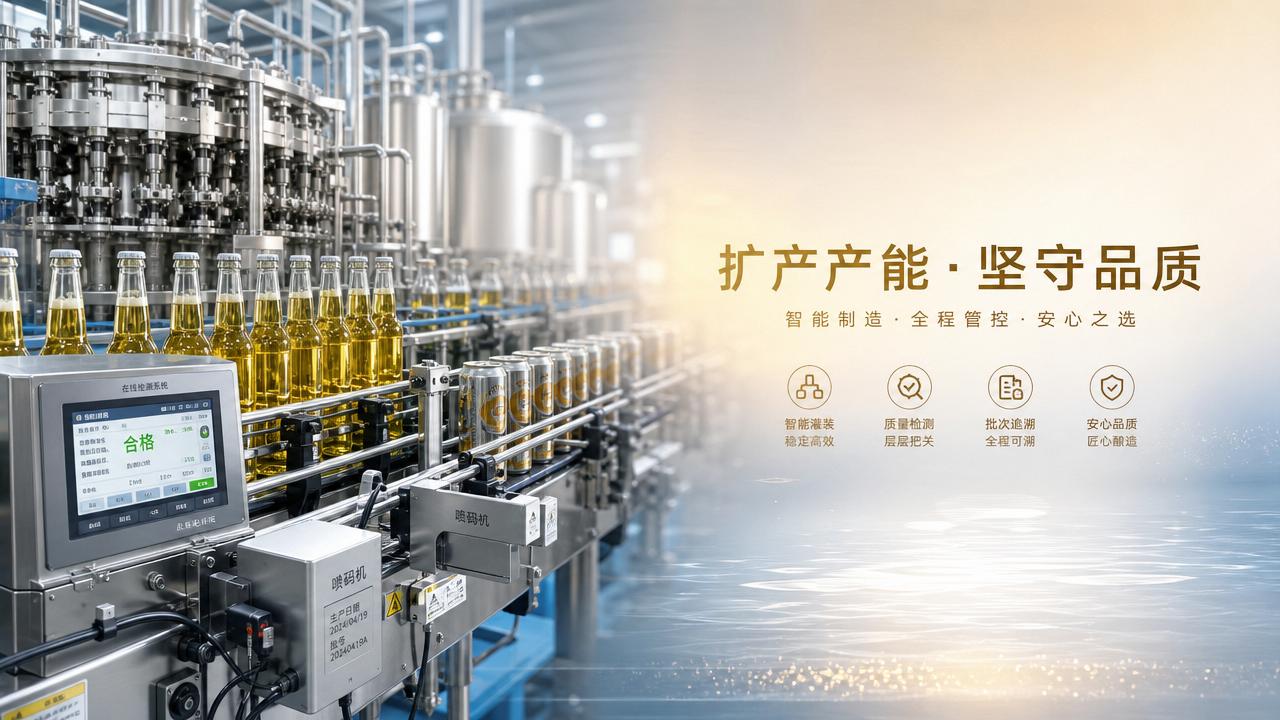
Chinese beer factory expansion and the new quality test
As every Chinese beer factory scales up to meet rising global demand, quality consistency and safety control become harder to ignore. For breweries, expansion is not only about higher output. It is also a direct test of raw material traceability, process stability, and compliance systems. When capacity grows faster than control, small deviations can become visible defects, recall risks, or brand trust issues.
This is especially true for craft beer producers that serve diverse channels. The same line may need to handle classic lager, German wheat, sugar-free low-calorie beer, fruit-flavored beer, and functional specialty beers. A Chinese beer factory that expands across more SKUs must keep sensory consistency, microbiological safety, and shelf-life performance aligned.
What expansion changes inside a Chinese beer factory
Capacity growth usually changes more than tank count or packaging speed. It changes the number of suppliers, the frequency of process handoffs, and the pressure on inspection systems. In a Chinese beer factory, these shifts often create hidden quality questions before they appear in finished products.
The most common changes include longer production schedules, more frequent batch switching, and wider distribution distances. Each factor increases the chance of temperature fluctuation, oxidation, contamination, or label mismatch. For beverage businesses, expansion must therefore be treated as a quality redesign, not only a capacity upgrade.
A practical definition is simple: a scalable Chinese beer factory is one that can raise output without weakening raw material control, fermentation stability, packaging integrity, or product traceability. That is the real benchmark behind healthy growth.
Quality signals that deserve attention
When a Chinese beer factory expands, these signals often reveal whether control systems are keeping pace:
- Batch-to-batch taste variation and color drift
- Foam stability changes after packaging
- Rising dissolved oxygen levels during filling
- Inconsistent carbonation or pressure retention
- More frequent label, date code, or carton defects
- Longer response time to quality deviations
These signs matter because beer quality is cumulative. A small issue in malt selection, yeast management, sanitation, or cold-chain handling can compound across large-scale output. The bigger the plant, the more important early detection becomes.
Why quality control becomes harder during rapid growth
Expansion adds complexity at every stage. Raw material sourcing may shift from a few local suppliers to a broader network. Packaging lines may run multiple formats. Export and domestic orders may follow different standards. A Chinese beer factory must keep these variables under control while preserving the same brand profile.
The biggest challenge is system consistency. If SOPs exist on paper but are not embedded in daily operation, growth exposes the gap. This is why quality and safety managers often focus on three areas first: traceability, process stability, and verification frequency.
Traceability answers where each input came from. Process stability confirms whether brewing conditions stay within target ranges. Verification frequency shows whether checks are strong enough for the new scale. Together, they form the foundation of a trustworthy Chinese beer factory.
Typical control areas and practical value
For a Chinese beer factory, these control areas support more than compliance. They protect commercial performance by reducing waste, complaint handling, and product returns. They also help wholesalers, retailers, restaurants, and online channels receive the same product experience.
Application scenarios across beverage business models
The pressure on quality control differs by channel and product mix. A Chinese beer factory serving multiple routes needs clear rules for each scenario.
- Domestic wholesale: focus on fast turnover, label accuracy, and stable lot coding.
- Export supply: focus on regulatory documents, packaging durability, and traceability.
- Restaurant and bar channels: focus on freshness, foam performance, and flavor reliability.
- Supermarket retail: focus on shelf-life stability and carton appearance.
- OEM/ODM programs: focus on formula control, sample approval, and batch matching.
Jinpai Beer’s product range shows why flexibility matters. A Chinese beer factory that can support lager, wheat beer, low-calorie beer, fruit beer, and specialty styles needs a stronger quality platform than a single-product plant. Product variety increases market reach, but only when control systems scale with it.
Practical steps to reduce quality risk
Expansion should be matched with a structured quality upgrade. A Chinese beer factory can lower risk by focusing on several practical steps.
- Strengthen supplier qualification and incoming inspection.
- Standardize sanitation, fermentation, and filling procedures.
- Use batch-based traceability from ingredients to shipment.
- Increase in-process checks during line speed changes.
- Track sensory, microbiological, and packaging metrics together.
- Review complaint data to identify recurring weak points.
It is also useful to separate scale-up risks from normal variation. Not every defect means a major failure, but repeated patterns usually signal a process issue. The sooner a Chinese beer factory detects that pattern, the easier it is to correct.
A stable expansion model for long-term trust
The strongest Chinese beer factory is not the one that grows fastest. It is the one that grows while preserving taste, safety, and delivery reliability. Expansion should improve commercial reach without weakening product identity.
For brands and channel partners, this means choosing factories that can demonstrate disciplined quality systems, clear OEM/ODM support, and consistent production records. For breweries, it means building quality into every stage of growth, from raw material control to final shipment.
If a Chinese beer factory can answer the new quality questions before customers ask them, expansion becomes a source of trust rather than risk. That is the standard worth pursuing in today’s beer market.
Thank you very much for writing to us. Please leave your message and contact information, we will reply to you within 24 hours.