



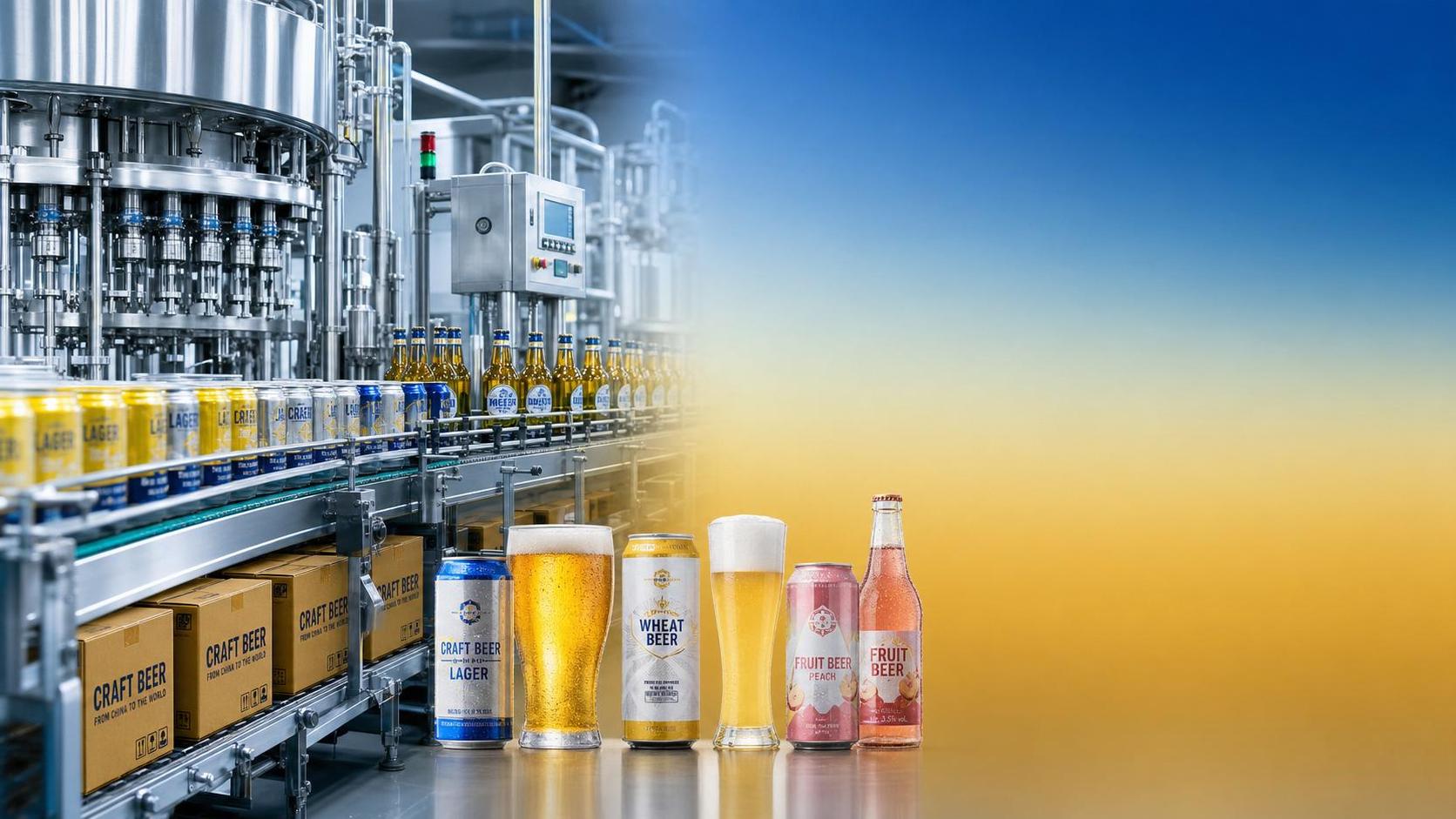
Why the Chinese Beer Factory Landscape Looks Different in 2026
The Chinese beer factory market is no longer defined by volume alone. In 2026, the sharper shift is toward flexible capacity, export readiness, and faster product adaptation.
That change matters because supply decisions now affect market speed, margin structure, and brand positioning at the same time.
From recent market movement, one signal stands out. Buyers are no longer comparing only price per container. They are comparing production stability, category breadth, and response time.
A capable Chinese beer factory in 2026 is expected to do more than produce standard lager. It must also support low-calorie recipes, fruit profiles, wheat beer, and functional specialty concepts.
This is why factory selection has become more strategic. A partner with balanced R&D, manufacturing discipline, and export experience can create more room for long-term channel growth.
Capacity is expanding, but not in the old way
Capacity growth is still happening across the Chinese beer factory sector, but the nature of that growth has changed.
Earlier expansion often focused on larger output and lower unit cost. Now, the more valuable upgrade is modular capacity that can switch between styles, batch sizes, and packaging formats.
This reflects a more fragmented demand pattern. Restaurants, retail chains, bars, and online channels are asking for different flavor structures and different pack strategies.
As a result, not every large plant becomes more competitive. Some high-output facilities still struggle when orders require shorter runs or mixed product portfolios.
The factories gaining attention are those that combine scale with agility. That means stable brewing systems, reliable sourcing, and production planning that can handle both classic and emerging SKUs.
What is driving this capacity shift
- Craft and specialty segments keep expanding beyond niche urban consumption.
- Private label and OEM projects require smaller, faster, and more customized runs.
- Export customers need compliance consistency across repeated shipments.
- Health-oriented beer categories are increasing formulation complexity.
- Channel diversification makes inventory planning less predictable.
For that reason, a Chinese beer factory with technical flexibility often creates more business value than one that only promises maximum output.
Export growth is becoming more selective
Exports remain one of the strongest opportunities in 2026, but the path is more selective than before.
International buyers are showing stronger interest in Chinese beer factory partners that can meet both price expectations and product differentiation goals.
That is especially clear in segments where mainstream beer competes with flavored, low-sugar, wheat, or functional concepts.
The export advantage is no longer based only on manufacturing cost. It increasingly comes from a factory’s ability to align recipes, packaging, documentation, and delivery performance.
In practice, this favors beer producers that already operate across online and offline channels and understand how different retail environments shape final product choices.
More export projects now start with a broader conversation. The issue is not only what a Chinese beer factory can brew today, but how well it can evolve with future market shifts.
Demand is moving toward differentiated drinking occasions
Demand in 2026 is not growing evenly across all beer categories. The more visible expansion is happening around specific consumption occasions.
Classic lager remains important, especially for broad-volume channels. Yet stronger momentum is coming from beers tied to lifestyle cues, lighter drinking preferences, and social sharing.
That includes German wheat for fuller texture, sugar-free low-calorie beer for wellness-conscious consumers, and fruit-flavored beer for casual and entry-level drinkers.
Another notable development is the rise of functional specialty beers. These products are attracting attention because they give brands a clearer story in crowded retail environments.
This shift changes how a Chinese beer factory should be evaluated. Production capability now needs to support both consistent core items and market-testing for new concepts.
Where demand signals are becoming clearer
- Supermarkets want wider shelf segmentation with clearer price ladders.
- Bars look for distinctive styles that support menu storytelling.
- Restaurants prefer pairable beers with stable repeat quality.
- Online channels respond faster to novelty and seasonal flavor rotation.
A Chinese beer factory that understands these occasion-based differences can support better assortment decisions instead of simply offering more SKUs.
The real impact is spreading across the whole supply chain
The 2026 shift does not stop at brewing. It is affecting packaging planning, export documentation, inventory turnover, and brand collaboration models.
For example, more varied product mixes create more pressure on forecasting. A wider portfolio can improve sales reach, but it also raises the need for disciplined launch planning.
There is also a stronger link between product development and channel execution. A Chinese beer factory with OEM and ODM capability can reduce friction when a market needs localized packaging or recipe adjustment.
This is where integrated suppliers stand out. When R&D, production, and distribution thinking are aligned, product adaptation becomes faster and less risky.
That operating model is especially relevant for businesses serving mixed channels, including retail, food service, and specialty beverage outlets.
What to focus on when comparing a Chinese beer factory
In this environment, factory comparison should move beyond headline capacity and unit pricing.
A more useful evaluation starts with three questions. Can the factory maintain stable quality across multiple beer styles? Can it support customized development without slowing delivery? Can it scale successful products across channels?
These questions matter because the market is rewarding resilience and adaptability, not just low-cost output.
- Check whether the product range covers mainstream and emerging beer categories.
- Review how the factory handles OEM, ODM, and customized packaging coordination.
- Assess whether export operations are already routine, not experimental.
- Look for evidence of channel understanding, not only production claims.
- Compare response speed for reformulation, seasonal launches, and repeat orders.
A Chinese beer factory with broad craft beer development experience often performs better here, especially when it already supports classic lager, wheat beer, low-calorie lines, fruit styles, and specialty functional products.
The next phase will reward balanced partners
Looking ahead, the most reliable growth will likely come from factories that balance scale, flexibility, and category innovation.
The Chinese beer factory sector is entering a stage where production strength alone is not enough. Export capability, tailored development, and channel-fit product design are becoming equally important.
That makes 2026 a useful year for recalibration. It is a good time to review whether current supply partners can support both immediate volume needs and future assortment shifts.
A practical next step is to map product demand by channel, then compare it against factory strengths in brewing range, customization, and delivery consistency.
Where market uncertainty is rising, phased planning becomes more valuable. Shortlist partners that can supply today’s core products while also helping test the next wave of differentiated beer demand.
That approach creates a stronger base for long-term growth than choosing a Chinese beer factory on price alone.
Thank you very much for writing to us. Please leave your message and contact information, we will reply to you within 24 hours.