



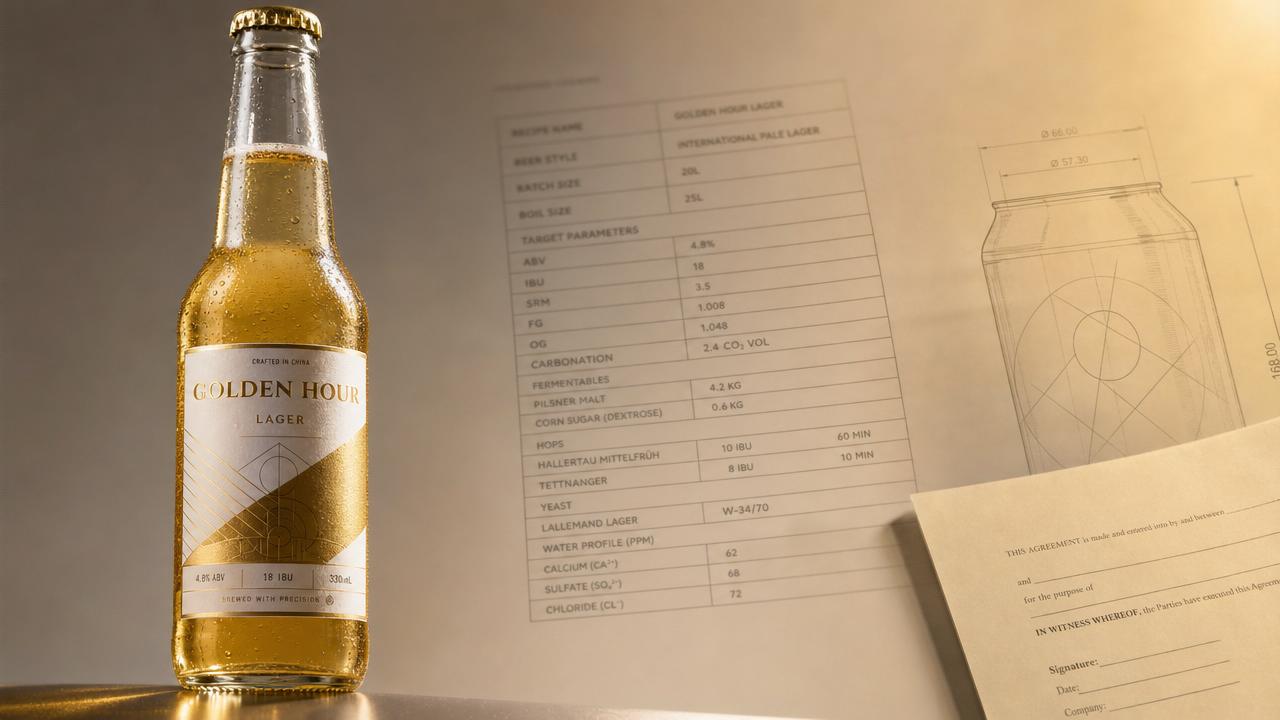
When signing China beer ODM contracts, most global brands focus on pricing, timelines, and labeling—yet overlook the single most critical clause: intellectual property ownership of custom formulations and packaging designs. For decision-makers sourcing craft beer via OEM/ODM in China, this omission can trigger disputes, loss of brand equity, or even production lock-in. At Jinpai Beer—a full-service craft beer ODM partner specializing in lagers, wheat beers, low-calorie, fruit-infused, and functional brews—IP clarity isn’t an afterthought. It’s the first clause we co-draft with every international client. Don’t launch before locking it down.
Why IP Ownership Is the Non-Negotiable Anchor in China Beer ODM Agreements
Unlike standard wholesale purchases, China beer ODM engagements involve deep collaboration: your brand defines taste profiles, ingredient specs, fermentation parameters, can artwork, and label compliance for target markets. Yet under Chinese contract law, unless explicitly assigned in writing, all original works—including proprietary recipes, yeast strain adaptations, flavor matrices, and graphic assets—default to the creator: the manufacturer. That means Jinpai Beer (or any ODM supplier) retains legal rights to reuse, modify, or license your custom lager formula—or your award-winning mango-hibiscus sour design—unless the contract states otherwise. This isn’t theoretical risk. Real cases include brands losing exclusive access to their own “signature” low-calorie IPA after contract expiration, or discovering identical packaging sold to a competitor in Southeast Asia.
The 7-Point IP Lockdown Checklist for China Beer ODM Contracts
- Explicit assignment language: Require “full, irrevocable, worldwide transfer of all IP rights” for custom formulations, process documentation, and final packaging files—not just “license” or “right to use.”
- Scope definition by deliverable: List each IP asset separately—e.g., “yeast propagation protocol for sugar-free pilsner,” “can mockup v3.2 (AI + PDF),” “flavor stability test report”—with clear ownership attribution.
- No residual rights clauses: Prohibit the ODM from retaining copies, backups, or derivative rights—even for internal R&D—unless expressly limited to non-commercial, confidential benchmarking.
- Pre-existing IP carve-out: Document Jinpai Beer’s background IP (e.g., base lager yeast bank, carbonation control system) in an annex—and confirm it remains theirs, while new co-developed IP belongs solely to you.
- Enforceable jurisdiction & remedies: Specify arbitration in Hong Kong or Singapore (not mainland PRC courts) and define liquidated damages for unauthorized use—e.g., USD $150,000 per infringement incident.
- Post-termination obligations: Mandate written certification of data destruction (servers, cloud, USBs) and return of all physical/digital assets within 5 business days of contract expiry.
- Chain-of-title verification: Require Jinpai Beer to warrant that no third-party ingredients, labs, or designers hold hidden claims over deliverables—backed by indemnity.
Scenario-Specific Safeguards You Can’t Skip
For functional specialty beers (e.g., sleep-support GABA lagers or probiotic wheat ales), verify that health claim substantiation reports, clinical reference data, and regulatory dossiers are fully assignable—not just the recipe. Many Chinese labs retain copyright on testing methodology; your contract must override that default.
With fruit-flavored or seasonal releases, ensure “flavor architecture” ownership covers not just final blend ratios but also sensory mapping documents, raw material sourcing logs, and shelf-life acceleration study datasets. These enable consistent re-brewing across facilities—and prevent your tropical gose from being replicated using alternate mango purée suppliers.
In low-calorie or sugar-free beer projects, where enzymatic hydrolysis or novel yeast strains drive innovation, demand assignment of all strain modification records, fermentation logs, and analytical chromatograms. Without this, you cannot validate batch consistency with third-party labs—or defend against purity challenges in EU or US markets.
Three Commonly Overlooked Risks—and How They Materialize
“Work-for-hire” ambiguity: Chinese law doesn’t recognize U.S.-style “work-for-hire” doctrine. Even if you pay for development, ownership isn’t automatic. A vague phrase like “client owns the output” is unenforceable without statutory transfer language.
Embedded open-source dependencies: Some ODMs integrate publicly available brewing algorithms or public-domain flavor databases into your formulation. If unreviewed, these may carry copyleft obligations—potentially forcing your proprietary recipe to be disclosed.
Cloud-hosted design files: When Jinpai Beer uses collaborative platforms (e.g., Figma, Autodesk Fusion), access permissions often outlive contracts. Your agreement must require export of native files and revocation of all shared links—not just deletion from a dashboard.
Actionable Execution Steps—Before You Sign
First, request Jinpai Beer’s standard China beer ODM IP annex—then redline it using the 7-point checklist above. Never accept “our template is non-negotiable.” Reputable partners refine terms collaboratively. Second, commission an independent IP audit: engage a bilingual IP attorney to review draft clauses against Article 17 of China’s Copyright Law and Article 328 of the Civil Code. Third, require Jinpai Beer to provide signed affidavits from all involved brewers, designers, and lab technicians confirming no personal IP claims exist on your deliverables.
Finally, embed IP verification into your launch gate: no production batch release until Jinpai Beer delivers certified ownership certificates for all listed assets—and your legal team confirms alignment with your home-market trademark and patent strategy.
Final Thought: IP Clarity Is Your First Batch of Leverage
China beer ODM offers unmatched agility, cost efficiency, and technical depth—especially for complex categories like functional or low-calorie craft beer. But speed shouldn’t compromise sovereignty. The moment you approve a custom German wheat formulation or finalize a neon-lit fruit beer label, you’re creating high-value intangible assets. Without ironclad IP assignment, those assets reside on someone else’s balance sheet. Jinpai Beer builds partnerships—not dependencies. We draft contracts where your brand owns every molecule, pixel, and process step. Because in global beer markets, formulation freedom isn’t optional. It’s foundational.
Ready to co-draft your IP-secured China beer ODM agreement? Contact Jinpai Beer’s International Partnership Team today. We’ll provide a clause-by-clause review, pre-vetted annex templates, and dedicated IP coordination support—all before your first sample brew.
Thank you very much for writing to us. Please leave your message and contact information, we will reply to you within 24 hours.