



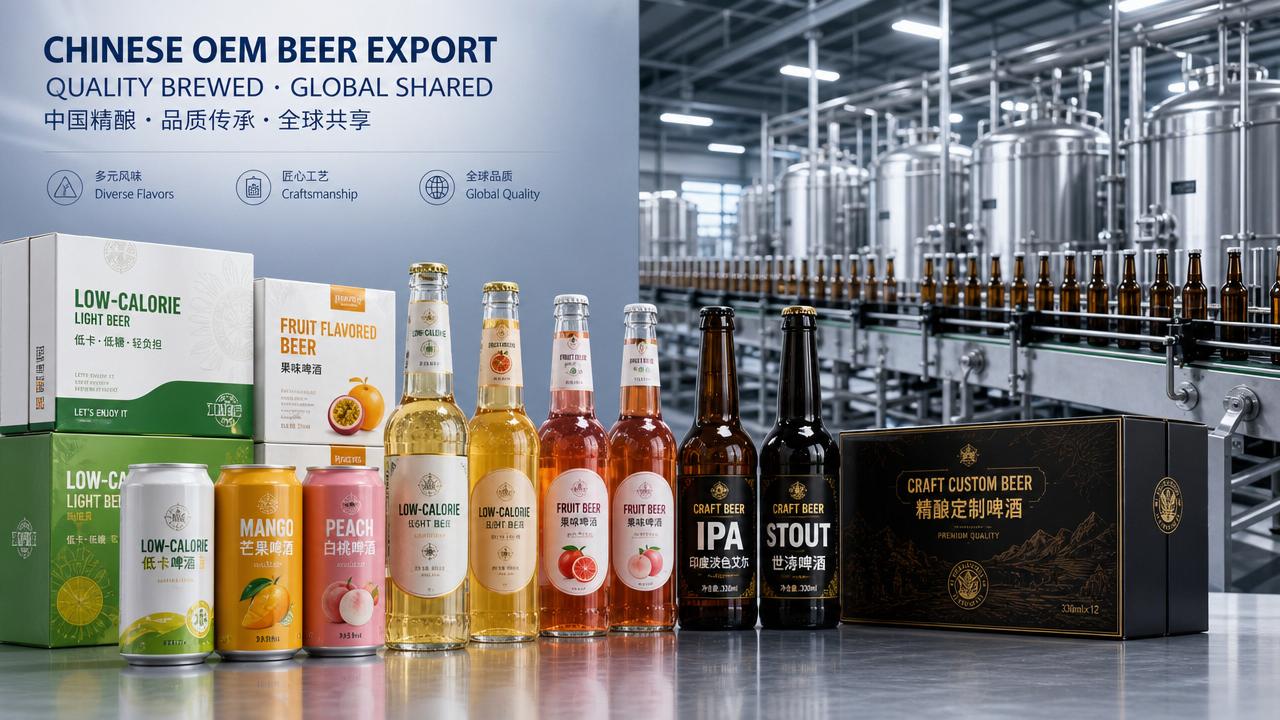
As global demand for private-label and craft beverages evolves, China beer OEM is becoming a strategic growth engine for brands in 2026. From healthier formulations and functional beer concepts to flexible customization and faster market response, decision-makers need to watch the shifts shaping product innovation and supply partnerships. Understanding these trends can help brands reduce risk, improve margins and build stronger market differentiation.
For business decision-makers, the core question is no longer whether to explore China beer OEM, but how to use it strategically. In 2026, the most successful brands will be those that treat OEM partnerships not simply as low-cost manufacturing, but as a way to accelerate product development, test new segments, improve supply flexibility and enter markets with less operational burden.
The search intent behind this topic is clear: readers want to know which trends matter commercially, what risks and opportunities they create, and how to choose the right manufacturing partner. They are less interested in generic overviews of the beer industry and more focused on practical judgment criteria, return on investment, product direction and supply-chain resilience.
Why China beer OEM matters more in 2026
China beer OEM has moved beyond a pure cost advantage model. Today, many overseas and regional brands are using Chinese manufacturing partners to gain speed, broader formulation capability and scalable customization. This is especially relevant for businesses that want to launch private-label beer, expand product lines quickly or serve different channels without building their own production base.
In 2026, market pressure is coming from several directions at once. Consumer tastes are fragmenting, retail channels are demanding faster turnover, and distributors are looking for products with better differentiation. A capable OEM supplier can help brands respond faster by offering ready-to-adapt recipes, packaging flexibility, compliance support and more efficient production scheduling.
For management teams, this means the decision is increasingly strategic. A good OEM partner can reduce time to market, lower development risk and make portfolio expansion more capital efficient. A poor one can create quality inconsistency, delayed shipments and brand damage. That is why the trend discussion must be tied to business outcomes, not just product fashion.
Trend 1: Health-oriented beer is becoming a mainstream OEM opportunity
One of the clearest shifts in China beer OEM for 2026 is the rise of health-conscious product development. Sugar-free low-calorie beer, lower-alcohol options and cleaner-label positioning are no longer niche concepts. They are becoming commercially important categories for supermarkets, convenience retail, e-commerce and restaurant groups targeting younger and more health-aware consumers.
For brands, this trend matters because health-oriented beer creates both pricing and portfolio advantages. It allows companies to address changing drinking habits without abandoning the beer category. It also opens doors to differentiated shelf positioning, especially in mature markets where standard lager alone may struggle to deliver growth.
When evaluating an OEM partner, decision-makers should ask more than whether a supplier can produce low-calorie or sugar-free beer. The real questions are whether the formulations are stable at scale, whether taste performance is competitive, and whether packaging and labeling can support compliant health-related claims in target export markets.
Brands that move early in this segment can use China beer OEM to test multiple SKUs with controlled risk. Instead of committing large capital to internal trials, they can validate demand across channels, compare repeat purchase data and then scale the variants that show stronger margins or customer retention.
Trend 2: Functional and specialty beer concepts are moving from novelty to category strategy
Functional specialty beers are attracting more attention in 2026, especially among brands trying to stand out in crowded markets. These products may include botanical infusions, vitamin-inspired concepts, energy-adjacent positioning or other lifestyle-oriented formulations. Not all of them will become mass-market winners, but they reflect a broader trend: beer is being repositioned as a more diverse beverage platform.
For enterprise buyers and brand owners, the opportunity is not in chasing every trend. It is in identifying which specialty concepts fit the brand’s existing audience, channel strategy and price architecture. A fruit-flavored line may work well for social retail and younger demographics, while a more functional or low-calorie beer may fit fitness-conscious urban consumers or premium convenience channels.
China beer OEM suppliers with R&D capability can be valuable here because they shorten experimentation cycles. Instead of sourcing multiple ingredients and building internal pilot production, brands can collaborate on sample development, sensory testing and packaging alignment in a more streamlined way.
The caution is equally important. Specialty and functional beer can create excitement, but they also raise risk around regulation, consumer understanding and repeat purchase. Decision-makers should assess whether the concept offers true market fit or simply short-term novelty. In most cases, strong OEM collaboration should include not only recipe development but also guidance on feasibility, shelf stability and production consistency.
Trend 3: Customization is becoming deeper, not just cosmetic
In the past, some buyers viewed OEM as a way to place a private label on standard products. In 2026, that approach is becoming less competitive. Buyers increasingly want deeper customization across flavor profile, alcohol level, calorie positioning, ingredient story, can or bottle format, carton design and channel-specific pack sizes.
This matters because brand differentiation is harder to achieve through marketing alone. If the product itself is too generic, price competition becomes more intense. China beer OEM is becoming more attractive because advanced suppliers can help tailor not just packaging but the full product-market fit for different regions and retail settings.
For example, a distributor serving bars may prioritize stable draft-like flavor and premium glass packaging, while a supermarket private label may need aggressive cost control, broad appeal and strong visual shelf impact. An e-commerce brand may prefer mixed cases, seasonal flavors or faster SKU turnover. These are very different business needs, and OEM value comes from meeting them with operational discipline.
Decision-makers should evaluate customization in practical terms. Can the supplier manage lower minimum order quantities for test launches? Can they adapt formulas for local taste expectations? Can they support multiple packaging specifications without excessive delays? The answers to these questions often matter more than headline pricing.
Trend 4: Speed to market is becoming a competitive advantage
One of the biggest reasons brands are turning to China beer OEM is speed. In 2026, being first or early in a category can shape distributor interest, retail placement and consumer awareness. Slow product development can mean missed seasonal windows, delayed promotional plans and lost opportunities in fast-moving beverage segments.
A capable OEM partner can compress timelines across formulation, sampling, packaging proofing and production planning. This gives brands more flexibility to respond to market signals, whether they are launching a fruit beer for summer, a low-calorie line for a retail program or a private-label range for a chain customer.
However, fast execution only creates value when quality systems remain strong. A decision-maker should look for evidence that the supplier can balance speed with process control. This includes batch consistency, material traceability, documented QA procedures and communication discipline during production milestones.
In practical terms, faster market response improves working capital efficiency and commercial agility. It allows brands to test, learn and adjust before competitors lock in distribution. That is one of the strongest business arguments for choosing the right China beer OEM partner in the coming year.
Trend 5: Export readiness and compliance are becoming selection priorities
As more beer brands use OEM production for cross-border distribution, export readiness is no longer optional. In 2026, decision-makers must pay closer attention to labeling compliance, packaging standards, documentation accuracy and the supplier’s experience with international channel requirements.
This is especially important for companies serving supermarkets, chain retail, importers or foodservice groups. These customers typically expect consistency not only in flavor and packaging but also in paperwork, shipping coordination and regulatory responsiveness. A supplier that can produce well but struggles with export execution may still become a costly bottleneck.
When assessing a China beer OEM manufacturer, buyers should ask about destination-market experience, documentation support, quality certifications, lead time reliability and incident handling. These details may seem operational, but they directly affect risk, landed cost and customer trust.
For executives, the key takeaway is simple: supply capability should be measured end to end. It is not enough that the beer tastes good in a sample room. The product must arrive on time, match the approved specification and support the commercial promise made to distributors or retailers.
How brands should evaluate OEM partners beyond price
Price remains important, but in 2026 it should not be the primary filter. A lower quote can become expensive if it leads to reformulation delays, unstable quality, packaging errors or weak service. The better approach is to evaluate total business value.
Start with technical capability. Does the supplier offer a broad enough product range to support future expansion, including classic lager, wheat beer, fruit-flavored beer, sugar-free low-calorie beer and specialty concepts? A wider capability base allows brands to grow with fewer supplier transitions.
Next, assess collaboration quality. Strong OEM relationships depend on clear communication, sample responsiveness, transparency around lead times and a willingness to solve problems jointly. For business buyers, this often matters as much as production scale.
Then review operational fit. Can the manufacturer support your target channels, such as restaurants, bars, supermarkets, e-commerce or wholesale distribution? Does their packaging capability align with your route to market? Can they offer customized solutions rather than forcing every product into a standard template?
Finally, look at strategic alignment. The best China beer OEM partnerships are built with long-term thinking. A supplier that understands your growth goals can contribute more than production capacity. They can help shape line extensions, reduce launch friction and support portfolio decisions over time.
What smart brands will do in 2026
The most successful brands will not approach China beer OEM as a short-term sourcing exercise. They will use it as a platform for faster innovation, margin control and market adaptation. That means choosing partners with real R&D depth, scalable production, export awareness and a strong customization mindset.
They will also build smarter launch strategies. Instead of betting everything on one large-volume SKU, they will test targeted product concepts, compare channel performance and use data to refine the portfolio. This is especially effective in categories such as low-calorie beer, fruit beer and functional specialty beer, where demand can vary significantly by market.
Most importantly, strong brands will ask the right questions before signing an OEM agreement. They will look at product quality, communication process, compliance support, flexibility and long-term cooperation potential. Those factors are what turn manufacturing capacity into commercial advantage.
Conclusion: China beer OEM is becoming a growth decision, not just a sourcing decision
In 2026, the biggest China beer OEM trends are not just about new flavors or lower costs. They are about health-led innovation, specialty product development, deeper customization, faster response and stronger export execution. For enterprise decision-makers, these shifts create real opportunities to launch smarter products, improve margin structure and reduce operational complexity.
The brands that benefit most will be the ones that evaluate OEM partners through a strategic lens. They will focus on market fit, supply reliability, product flexibility and long-term value creation. In a more competitive beverage landscape, that approach can make the difference between a generic private-label offer and a differentiated brand with sustainable growth potential.
If your business is considering private-label beer, customized craft beer or broader beverage portfolio expansion, now is the time to assess how a capable manufacturing partner can support those goals. China beer OEM is no longer just a production option. It is increasingly a tool for building resilience, speed and differentiation in the global beer market.
Thank you very much for writing to us. Please leave your message and contact information, we will reply to you within 24 hours.