



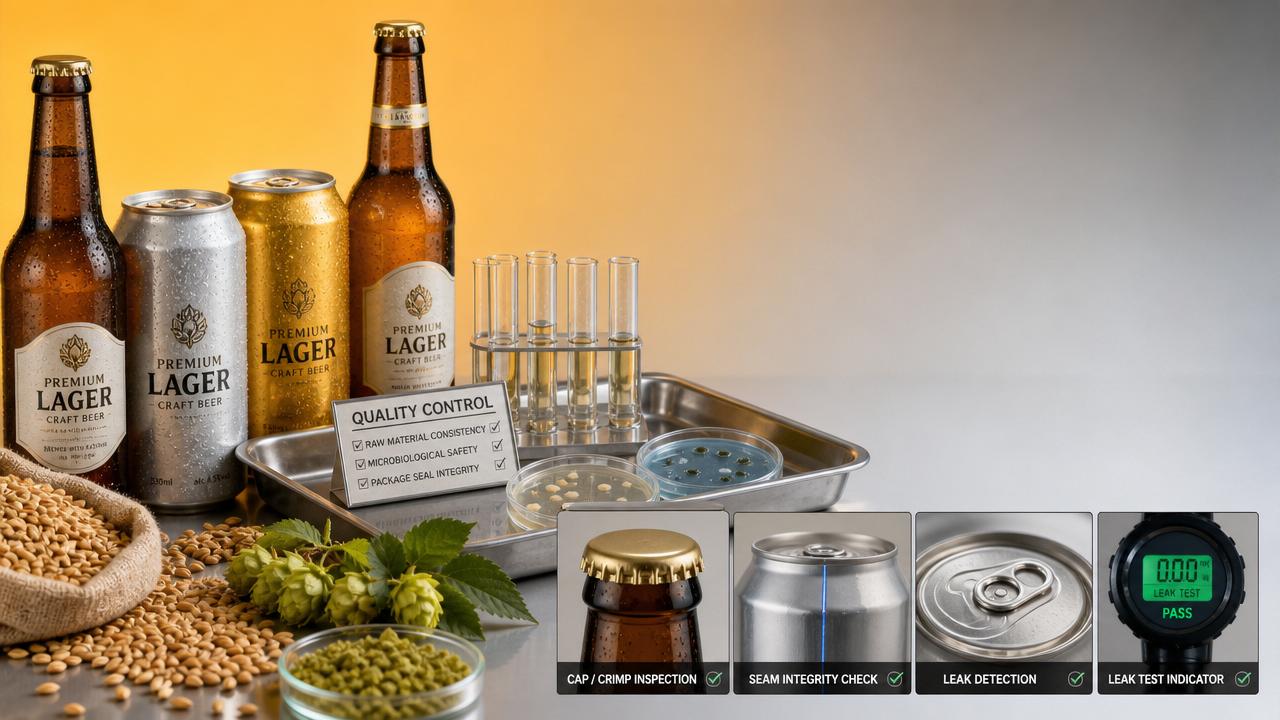
Before scaling any China beer OEM project, quality risk review should start long before packaging artwork and shipping schedules are finalized.
Beer quality is shaped by raw materials, brewing discipline, filling accuracy, storage conditions and legal compliance.
A weak point in any stage can create flavor drift, leakage, haze, microbiological issues or costly market complaints.
This guide explains the main checkpoints that help reduce uncertainty in China beer OEM cooperation before mass production begins.
Understanding the Core Quality Framework of China Beer OEM
China beer OEM refers to outsourcing beer development and production to a qualified brewery in China under private label, co-brand or customized formula arrangements.
The model can support lager, wheat beer, fruit beer, sugar-free low-calorie beer and functional specialty beer categories.
For stable results, the project should be managed as a controlled food production system, not only a packaging or sourcing transaction.
Key quality pillars usually include ingredient consistency, process repeatability, sanitation control, packaging compatibility, shelf-life validation and traceable documentation.
In China beer OEM, these pillars must be confirmed before commercial volumes are released, because later corrections are expensive and slow.
Current Industry Signals That Increase Pre-Production Risk
Several market trends have made pre-production checks more important across the alcoholic beverage sector.
- More customized formulas increase formulation variability and ingredient interaction risks.
- Lighter styles and low-calorie recipes can be more sensitive to oxidation and flavor imbalance.
- Fruit and functional additions raise microbiological and sediment stability challenges.
- Export projects face stricter labeling, shelf-life and transport durability expectations.
- Faster launch cycles often reduce the time available for pilot validation.
These signals explain why China beer OEM quality review should cover both brewing science and commercial execution.
Raw Material Risks to Verify Before Mass Production
Raw material consistency is the first major checkpoint in any China beer OEM program.
Malt origin, lot variation, enzymatic strength and color values directly affect extract yield, body and foam performance.
Hop form, storage temperature and alpha acid stability influence bitterness accuracy and aroma retention.
Yeast strain identity, vitality and propagation records are equally important, especially for wheat beer and specialty styles.
Water profile should also be reviewed, because mineral balance can alter mouthfeel, fermentation behavior and flavor expression.
For China beer OEM, approved supplier lists and incoming inspection criteria should be documented before the first production run.
Brewing and Fermentation Control Points
A recipe can look correct on paper but still fail during scale-up if process controls are loose.
Mash temperature profile, lautering performance, boil intensity and oxygen exposure all shape final beer quality.
Fermentation control deserves special attention in China beer OEM, because tank scheduling pressure can shorten conditioning time.
Review actual records for gravity drop, temperature curve, yeast cropping practice, maturation duration and filtration settings.
Pilot samples and retained references should be compared against target flavor, clarity, carbonation and alcohol range.
- Confirm standard operating procedures for each beer style.
- Check whether pilot and mass batch equipment parameters match.
- Verify cleaning and sterilization validation between product changeovers.
- Set acceptance limits for ABV, bitterness, color, pH and dissolved oxygen.
Microbiological Safety and Sanitation Readiness
Microbial spoilage is one of the most damaging failures in China beer OEM projects.
Contamination may not appear immediately, but it can cause sourness, gushing, haze, package swelling or shortened shelf life.
Pre-production review should include zoning hygiene, CIP effectiveness, sterile filtration integrity and environmental monitoring routines.
Special care is needed for fruit beer and functional formulas, because added ingredients can introduce extra microbial load.
Sampling plans should define test frequency for total plate count, yeast, mold and beer spoilage organisms.
If pasteurization is used, confirm temperature profile, holding time and package compatibility in advance.
Packaging Compatibility and Filling Line Risks
Many China beer OEM quality issues appear after brewing, during packaging and logistics.
Bottle, can, cap, lid and carton specifications should match the beer style, filling speed and export route.
Low seam quality, weak crown sealing or unsuitable liner materials can cause leaks and oxidation.
For carbonated beer, filling line settings must control oxygen pickup, net content variation and pressure consistency.
China beer OEM export batches should also be stress-tested for warm storage and long transit vibration.
Regulatory, Labeling and Documentation Accuracy
Compliance risk can block shipment even when product quality is acceptable.
In China beer OEM, label review should cover ingredient declaration, alcohol content, net volume, allergen information and destination market rules.
Claims such as sugar-free, low-calorie or functional should be supported by testing data and legal interpretation.
Batch coding, traceability files, COA records and retained sample systems should be confirmed before launch.
Documentation readiness is especially important when products enter supermarkets, restaurant chains, bars and cross-border retail channels.
Business Value of Strong Pre-Production Control
A disciplined China beer OEM review process protects more than product quality.
It helps stabilize flavor across batches, reduce waste, improve complaint handling and lower the risk of relabeling or product returns.
It also supports channel expansion, because distributors and retail partners usually prefer products with reliable specifications and repeatable shelf performance.
For breweries offering OEM and ODM support, stronger controls improve trust and make customized cooperation more scalable.
This is particularly relevant for portfolios covering classic lager, German wheat, fruit-flavored beer and specialized functional lines.
Typical China Beer OEM Project Types and Risk Focus
- Classic lager projects focus on fermentation consistency, clarity, carbonation and oxygen control.
- German wheat projects require close monitoring of yeast expression, haze stability and foam texture.
- Sugar-free low-calorie beer needs accurate analytical verification and balanced flavor correction.
- Fruit beer requires careful ingredient sanitation, sweetness stability and color retention.
- Functional specialty beer needs additional review of active ingredients, claims and compatibility with brewing conditions.
Each category in China beer OEM should have a separate validation checklist rather than a single generic approval standard.
Practical Steps Before Releasing the First Commercial Batch
- Approve the formula, process sheet and target specification together.
- Run a pilot batch and compare sensory and laboratory results.
- Audit raw material records and critical supplier controls.
- Verify sanitation, microbiology and packaging line readiness.
- Review label compliance and destination market documents.
- Conduct shelf-life and transport simulation before volume release.
- Keep retained samples and define complaint response procedures.
These steps create a more reliable approval path for China beer OEM mass production.
Next-Step Quality Alignment for Stable OEM Cooperation
Before confirming large-volume orders, build a written quality checklist covering ingredients, brewing, safety, packaging and compliance.
Use pilot validation, sample retention and measurable release standards to reduce avoidable risk in China beer OEM operations.
A brewery with integrated R&D, production and customized OEM or ODM capability can support this process more efficiently.
Clear technical alignment before mass production helps protect brand reputation and supports long-term growth across global beer channels.
Thank you very much for writing to us. Please leave your message and contact information, we will reply to you within 24 hours.