



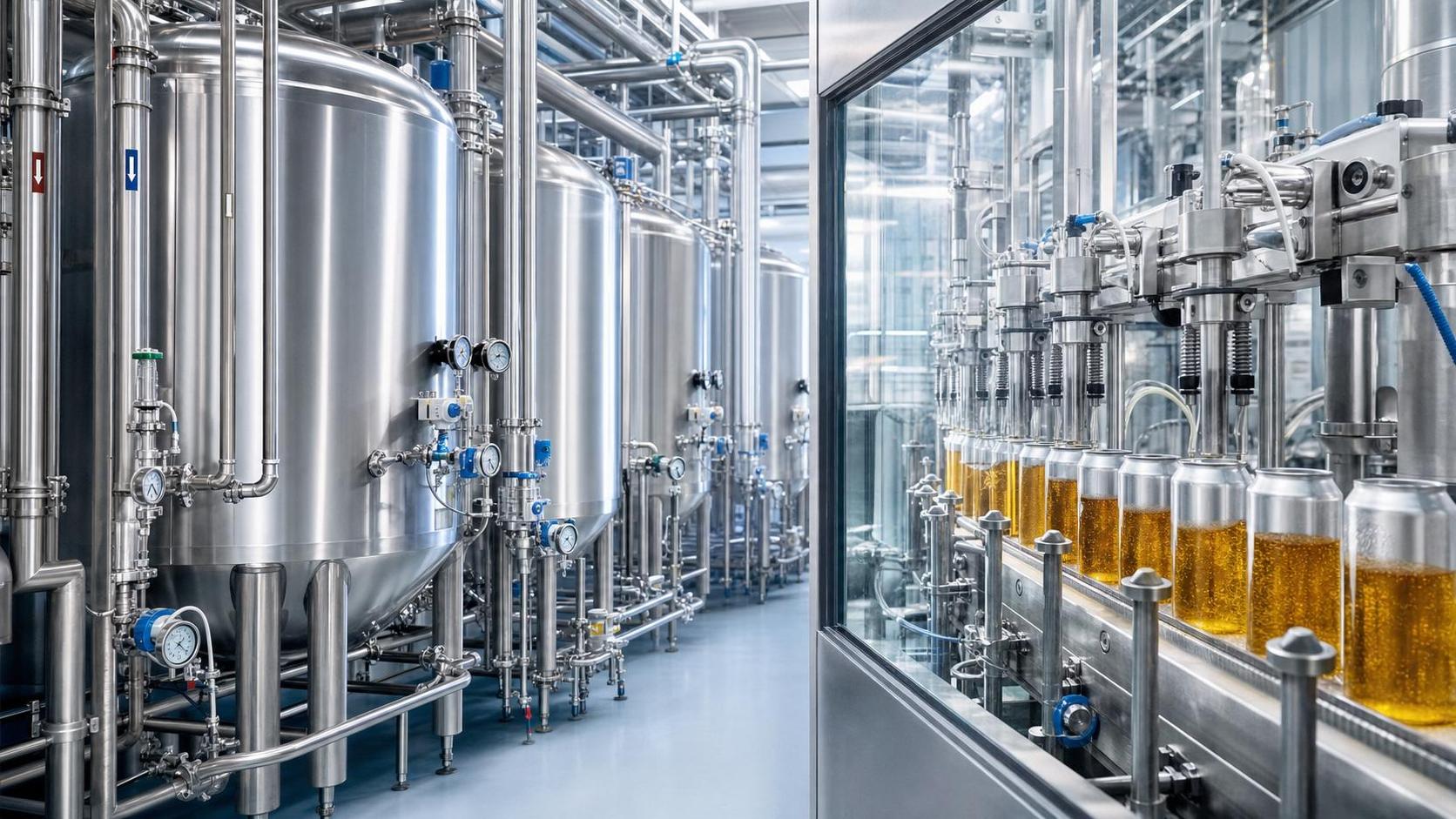
What defines a modern China beer factory—and why does it matter for global buyers?
Looking for reliable insights into the Chinese beer manufacturing landscape? This overview cuts through generic overviews to focus on what actually matters when evaluating a China beer factory: where production is concentrated, how capacity scales across facility types, and—most critically—how quality control translates into consistent, export-ready beer. It’s not just about volume or location. It’s about traceability, regulatory alignment, and operational flexibility that support real-world distribution needs.
For importers, distributors, or F&B operators vetting partners, understanding these layers helps distinguish between factories built for domestic scale and those engineered for international compliance, craft differentiation, and responsive collaboration.
Which regions host the most capable China beer factories—and what makes them distinct?
China’s beer manufacturing geography isn’t evenly distributed. Three clusters stand out—not because of historical branding alone, but due to infrastructure, raw material access, and export logistics maturity.
- Qingdao: Long associated with lager excellence, its coastal location supports cold-chain reliability and port-based export efficiency. Factories here often integrate barley sourcing networks from Northeast China and Inner Mongolia.
- Harbin: Benefits from stable low-temperature fermentation environments year-round, making it ideal for traditional pilsner and wheat beer production. Many facilities maintain legacy cold-storage systems upgraded with modern PLC controls.
- Guangdong (especially Shenzhen and Zhongshan): The hub for agile, smaller-batch craft operations. Proximity to component suppliers, packaging converters, and e-commerce fulfillment centers enables rapid iteration—critical for fruit-flavored, low-calorie, or functional specialty beers.
It’s worth noting: regional strength doesn’t imply exclusivity. A factory in Guangdong may produce German-style hefeweizens under strict yeast management protocols, while one in Harbin might run sugar-free formulations using imported enzymatic hydrolysis tech. Capability is increasingly defined by process design—not just postal code.
How do capacity benchmarks vary—and what do they signal about capability?
Annual capacity is often misread as a proxy for quality or reliability. In reality, it reflects strategic positioning:
- 10,000–50,000 KL/year: Typically craft-focused or pilot-scale OEM/ODM facilities. Prioritize recipe agility, small-lot trials, and label/packaging customization—ideal for launching new SKUs or testing regional preferences.
- 100,000–300,000 KL/year: The sweet spot for balanced scalability and responsiveness. Most certified export-ready China beer factory operations fall here—supporting multi-country distribution without sacrificing batch consistency.
- 500,000+ KL/year: Dominated by legacy national brands. While highly efficient for classic lagers, they’re less suited for complex fermentations or rapid SKU turnover unless purpose-built lines are dedicated.
Jinpai Beer operates across two tiers—40,000 KL/year for experimental batches and limited editions, and 220,000 KL/year for core range production—enabling both innovation velocity and commercial stability.
What quality control standards apply—and how are they enforced beyond certification?
Compliance starts with GB 4927 (China’s national beer standard) and ISO 22000—but true assurance comes from integration. Leading China beer factory operations embed checks at five non-negotiable stages: raw material screening (including malt protein ratio and hop alpha-acid verification), wort clarity pre-boil, yeast viability tracking per fermentation vessel, dissolved oxygen measurement post-filtration, and light-struck compound testing in final packaged units.
Third-party audits (e.g., SGS or Bureau Veritas) occur biannually—but internal micro-lab testing happens daily. For export partners, full lot traceability—including water source pH logs and CIP cycle records—is standard, not optional.
How do OEM/ODM capabilities differ among China beer factories—and what should partners verify?
OEM/ODM isn’t a monolithic service. Capabilities diverge sharply based on R&D depth, formulation ownership, and supply chain control. Below is a practical comparison to guide evaluation:
Jinpai Beer operates as an integrated ODM partner—developing proprietary functional beers (e.g., magnesium-enriched lagers, no-sugar citrus sours) with clients co-owning sensory profiles and process IP.
What’s the most practical next step after this overview?
Start with specificity—not scale. Ask: What beer profile must perform reliably across your target climate and retail format? Does your launch require rapid flavor iteration—or long-term batch uniformity? Are you prioritizing cost-per-kl, speed-to-shelf, or regulatory handoff simplicity?
Then, map those priorities against concrete indicators: certified lab reports (not just “ISO-compliant” claims), minimum order flexibility (e.g., 5,000 vs. 50,000 units), and evidence of active export to markets with comparable food safety expectations (EU, Japan, Canada).
A capable China beer factory isn’t defined by size or region alone—it’s measured by how seamlessly it bridges formulation intent, production rigor, and real-world distribution demands.
Thank you very much for writing to us. Please leave your message and contact information, we will reply to you within 24 hours.