



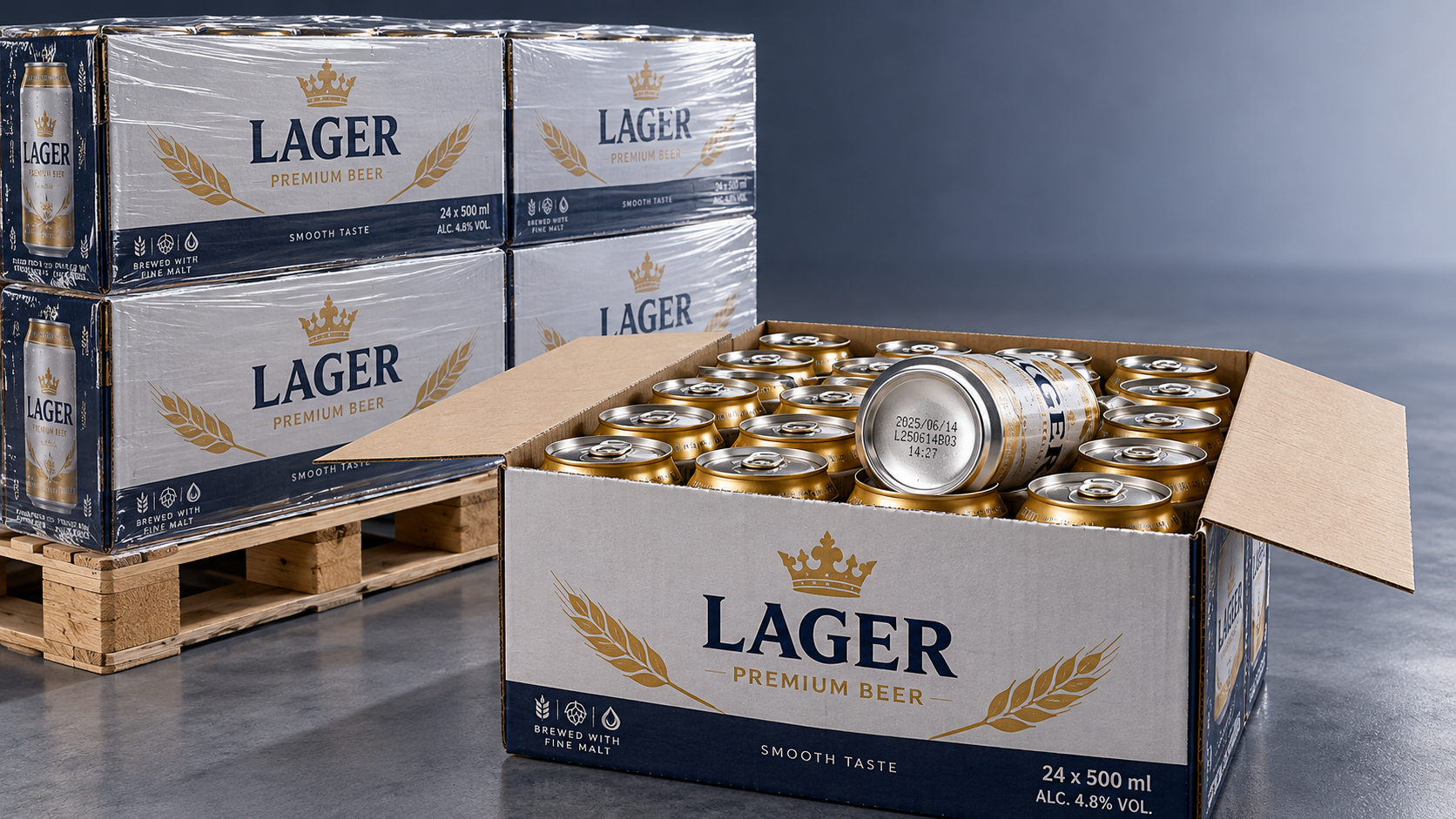
The lowest wholesale price for lager beer is not necessarily the lowest inventory cost. A shipment can be inexpensive at the brewery gate yet become costly after freight, import charges, storage, and markdowns on aging stock. The stronger offer is the one that delivers enough saleable life, at an order size the sales channel can absorb, with a clearly defined cost to the receiving warehouse.
Freshness, minimum order quantity (MOQ), and landed cost must therefore be evaluated together. A larger order may reduce freight per case while extending inventory holding time. A smaller order may preserve freshness but carry higher logistics charges. The decision should rest on cost per saleable case and realistic sell-through—not invoice price alone.
Compare the same beer, pack, and delivery commitment
Before comparing prices, establish a common specification. “Lager beer, one case” is not a sufficient purchasing description: a case of 24 × 330 ml cans contains a different volume from 24 × 500 ml cans, and glass bottles introduce different handling and breakage considerations.
Each quotation should identify the style, alcohol content, container material, unit volume, units per case, cases per pallet, production location, and preservation method. Pasteurized and unpasteurized products should not be treated as interchangeable without examining their validated storage conditions and shelf life.
Convert prices into both cost per case and cost per liter. The first supports ordering and channel margins; the second reveals differences concealed by pack size. Keep packaging suitability separate from volume economics: a cheaper liter price is not useful if the format does not fit refrigerator space, shelf plans, or serving requirements.
Delivery terms also need a common basis. Request a named place or port and the applicable Incoterms® version rather than accepting “FOB price” or “delivered price” without qualification. Under CIF, for example, the seller pays specified freight and insurance to the destination port, but risk transfers when the goods are loaded aboard the vessel at shipment. Paid freight does not mean the seller retains transit risk until arrival.
Buy remaining freshness, not nominal shelf life
A printed shelf life describes a product under specified conditions; it does not establish how much useful selling time remains when the shipment becomes available. Production age, consolidation, transit, customs clearance, and warehouse release all consume that window.
Ask suppliers to confirm whether the date code represents production, packaging, or best-before information. Obtain the declared shelf life, required storage conditions, and minimum remaining life guaranteed at an agreed handover point. A promise of “fresh stock” is less useful than a contractual requirement linked to identifiable batches.
Maximum warehouse selling window = declared shelf life − age at dispatch − transit and clearance time − receiving time − downstream residual-life requirement.
For an illustrative product with a 180-day shelf life, subtract 20 days of age at dispatch, 40 days for transport and clearance, 10 days for receiving and release, and a retailer requirement for 45 days remaining at delivery. That leaves 65 days to move stock through the warehouse. It does not leave 180 days, and it is not a prediction of sensory quality.
Use a conservative transport allowance when assessing the order. A sailing schedule alone excludes possible waiting time before departure, port handling, clearance, and inland delivery. If the purchase only works with the fastest transit estimate, the apparent margin depends on an optimistic logistics assumption.
Temperature history matters independently of the date code. Heat accelerates flavor deterioration; oxygen introduced during packaging can also reduce flavor stability. Light exposure creates an additional risk for beer in light-transmitting packaging. Cans prevent light exposure through the container, but they do not prevent heat-related aging.
Request storage and transport specifications supported by the supplier’s product validation. For temperature-sensitive beer, establish whether controlled transport is required and how excursions will be assessed. For beer approved for ambient distribution, do not interpret “ambient” as permission for unrestricted exposure to hot containers or loading yards.
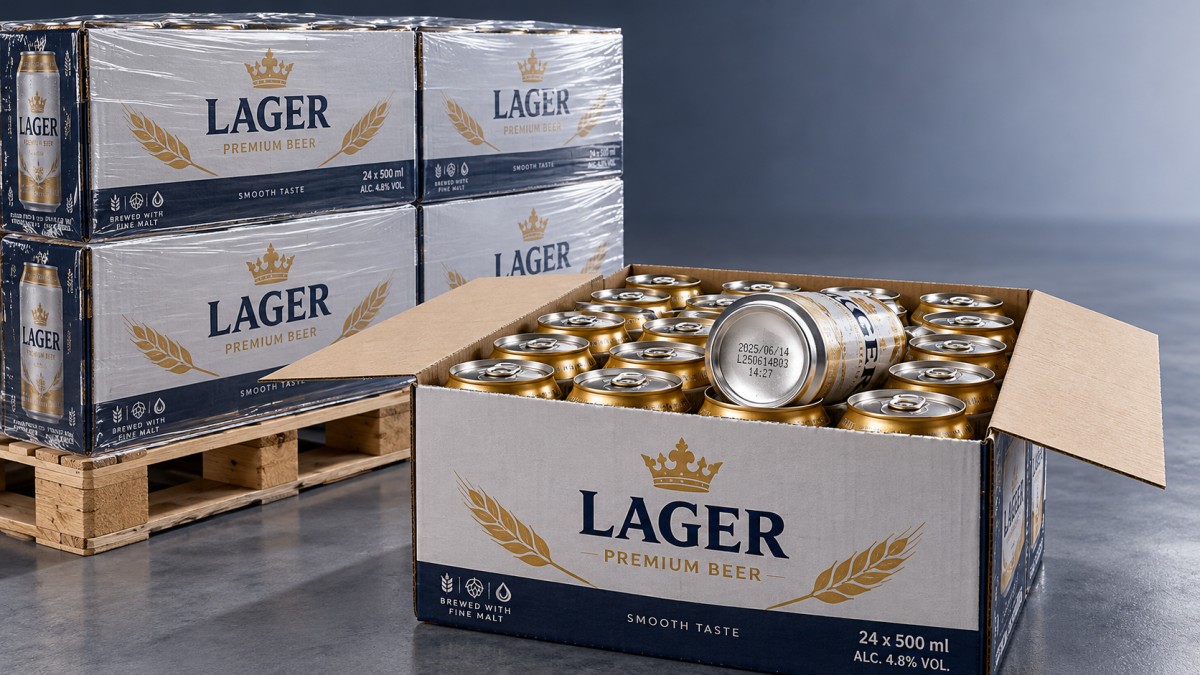
Samples should match the proposed commercial product and packaging. A recently produced sample sent by air cannot demonstrate the condition of an older batch after a sea voyage. Where quality exposure is material, agree on batch traceability, retained samples, receiving checks, and the evidence required for a claim.
Test the MOQ against the selling window
MOQ is not always a single supplier constraint. It may apply to a production batch, an individual SKU, a packaging design, a pallet, or a shipment. These distinctions determine whether a lower-risk order can be negotiated without changing the beer itself.
Stock products using standard packaging may offer more flexibility than private-label production. Customized cans, printed cartons, and labels can have separate purchasing minimums. Clarify who owns unused packaging, where it is stored, and whether its cost is included in the quotation or invoiced separately.
The useful comparison is between the minimum purchase and the quantity that can sell before the residual-life cutoff:
Indicative inventory ceiling = conservative daily sales × available warehouse selling days.
Using the 65-day window above, sales of 20 cases per day support an indicative ceiling of 1,300 cases before any contingency allowance. An MOQ of 2,000 cases would exceed that capacity unless there are additional confirmed outlets or a different replenishment arrangement. Higher sales projections should have a defensible basis, such as committed orders or comparable sales history.
For a new listing without a sales record, test a slower scenario as well as the expected one. Launch delays, staggered store distribution, and uneven demand across locations can leave inventory aging even when the headline sales forecast appears adequate.
Ask whether the supplier can offer mixed-SKU pallets, split releases, standard artwork, or staged production. These options solve different problems. Mixed pallets reduce exposure to one SKU but may add picking charges. Split delivery can reduce warehouse stock, but it does not improve freshness if the full quantity is produced upfront and held for later shipment.
Any call-off arrangement should state production timing, storage conditions, ownership, payment dates, and responsibility for unsold stock. Otherwise, apparent ordering flexibility may simply relocate aging inventory without reducing the buyer’s obligation.
Build landed cost to a defined warehouse boundary
A landed-cost comparison needs a consistent endpoint: for example, goods cleared for import and received at the designated warehouse. Include each cost once and identify which charges are already covered by the supplier’s delivery term.
Alcohol duties and excise depend on the destination’s rules and the product’s classification, origin, strength, and quantity. Confirm treatment with a qualified local customs adviser. Do not apply a generic “beer import tax” percentage across different destinations or products.
Separate recoverable VAT or similar input tax from nonrecoverable cost where recovery is legally available. It can still create a cash-funding requirement. Likewise, refundable packaging deposits and reusable keg deposits affect cash tied up but are not automatically consumed product cost; nonreturn or loss changes the calculation.
Freight allocation must reflect the actual shipment. Obtain a loading plan rather than assuming a container holds a standard number of cases. Container payload, pallet dimensions, stacking limits, packaging strength, and inland weight restrictions can change utilization. Beer is heavy enough that weight can constrain loading before all available space is used.
A lower case price paired with inefficient palletization may lose its advantage after freight. Conversely, removing pallets to increase loading density can add unloading labor or handling risk. Compare the complete receiving arrangement, not just the ocean rate.
Turn landed cost into cost per saleable case
Physical landed cost is only the starting point for evaluating margin. Breakage, rejected stock, expiry, and markdowns affect how much revenue the shipment can generate. Keep these commercial adjustments visible rather than hiding them inside an unexplained contingency percentage.
Cost per saleable case = total shipment cost to the agreed boundary ÷ expected saleable cases.
Consider two hypothetical offers for the same 1,000-case order, with matching pack size and specification. These figures illustrate the method; they are not market price benchmarks.
Offer A has the lower supplier invoice but the higher effective cost. In a live comparison, loss assumptions need evidence from the route, handling conditions, remaining shelf life, or relevant operating records. Do not assign a favorable loss rate simply because one supplier promises better quality.
Markdown stock requires a separate revenue calculation because it is still saleable, but at a reduced return. Financing and storage costs should also be added when comparing order sizes over different holding periods. A large shipment can look attractive at receipt while generating a weaker result after prolonged storage and discounting.
Make the purchase order enforce the comparison
The final agreement should preserve the conditions on which the supplier was selected. Record the approved specification, quantity tolerances, packaging, date-code format, batch traceability, storage requirements, and minimum remaining shelf life at the agreed delivery point.
Specify the documents needed for lawful import and sale in the destination market. Label approval, importer details, alcohol declarations, and supporting certificates should be resolved before production or dispatch where required. Generic food-safety certification does not by itself establish that a particular shipment meets local alcohol and labeling rules.
Define receiving checks and claims procedures, including notification periods, photographs, temperature records where relevant, batch references, and treatment of concealed defects. Clarify whether remedies involve credit, refund, or replacement; replacement stock may arrive too late to recover a missed selling period.
When an MOQ exceeds credible sell-through within the freshness window, a unit-price discount does not resolve the underlying mismatch. The commercially workable choice is a smaller commitment, a genuinely fresher release schedule, or another source. Wholesale lager buying succeeds when the quantity, arrival condition, and fully allocated cost remain acceptable together—even under a slower-sales or delayed-transit scenario.
Thank you very much for writing to us. Please leave your message and contact information, we will reply to you within 24 hours.