



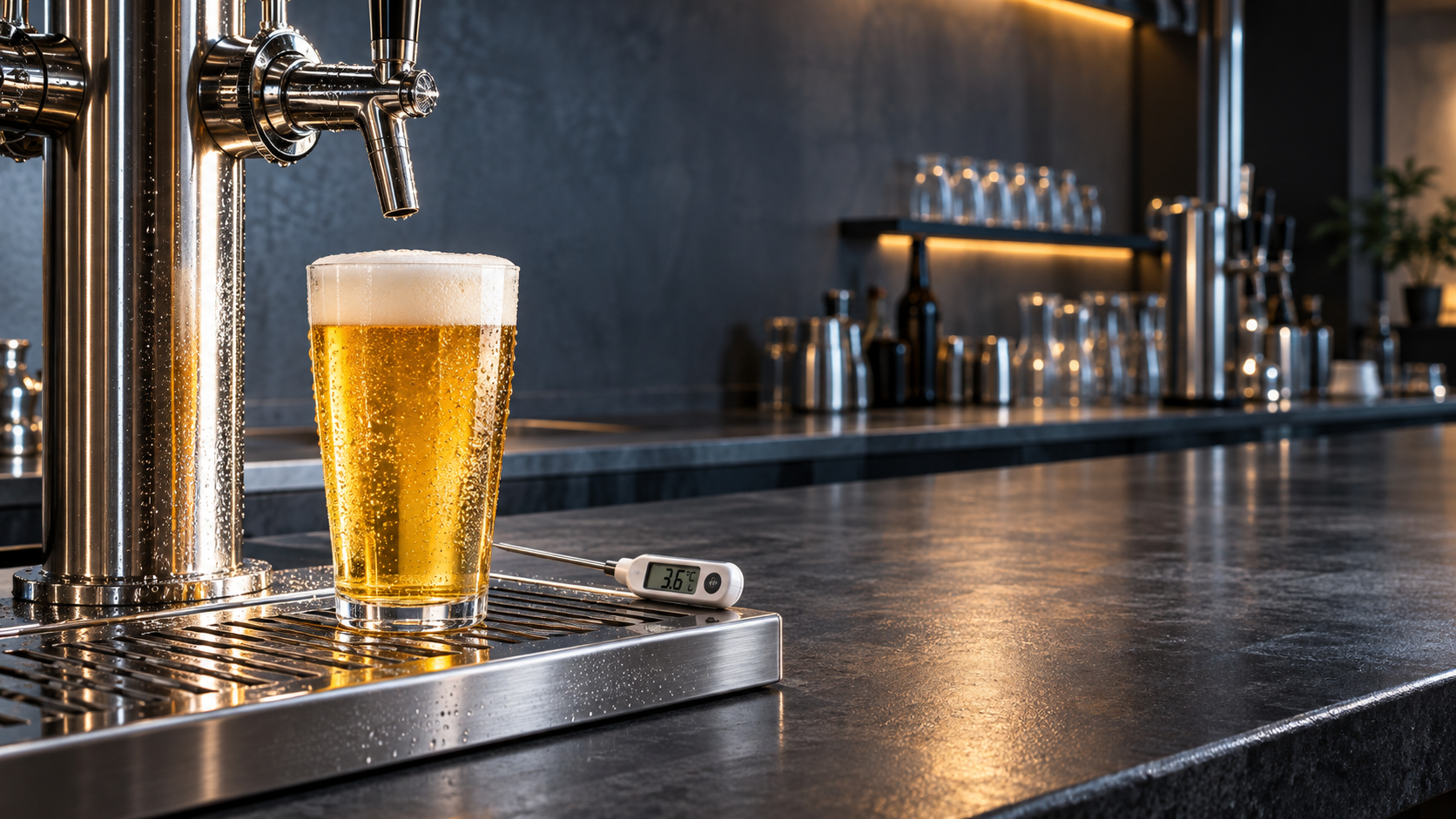
A tap that pours cleanly at opening but fills glasses with foam during service usually has a temperature or balance problem—not simply “too much gas.” Warm beer releases carbon dioxide more readily, while incorrect pressure or insufficient line resistance can make the pour unstable. The result is wasted lager beer, slower service, and a drink that may taste flat after the foam collapses.
Start by checking the actual beer temperature, then match dispensing pressure to the beer’s carbonation level and balance the line for controlled flow. Keep the entire route from keg to faucet cold. Do not lower the regulator simply because the glass is foaming: pressure that is too low can allow dissolved gas to break out inside the line and make the problem worse.
Check the beer temperature before touching the regulator
The refrigerator display measures conditions near its sensor, not necessarily the temperature of the beer leaving the faucet. A recently delivered keg, poor airflow around stored kegs, or an uncooled tower can leave part of the system warmer than the displayed setting suggests.
For many standard pale lagers, an actual dispensing temperature around 3–4°C (37–39°F) is a practical starting point. Follow the brewery’s recommendation where available; different products and service styles may call for another temperature. Whatever the target, consistency matters because the required equilibrium pressure changes with temperature.
- Use a clean, calibrated thermometer and a clean glass. Measure freshly dispensed beer promptly, without resting the probe against the glass.
- Compare the first pour after an idle period with a second pour immediately afterward. A warmer, foamier first pour points toward heat pickup near the faucet or tower.
- Check the cold-storage temperature separately. Cold room air with warmer beer may indicate that the keg has not cooled through or that refrigeration performance needs attention.
- Inspect the cooling path, including tower airflow or the glycol system on a remote installation. A cold keg cannot compensate for a warm section downstream.
A large keg cools slowly. Moving it into refrigeration shortly before service does not mean its contents have reached the setpoint. Allow sufficient conditioning time and verify the result rather than using elapsed time alone as the release criterion.
Set pressure to preserve carbonation, not to hide foam
Dispensing pressure has two jobs: maintaining the beer’s intended dissolved carbonation and moving it through the system. In a straightforward direct-draw setup using pure CO₂, the starting pressure comes from the beer temperature and its carbonation specification, usually expressed in volumes of CO₂.
Use a carbonation chart with those two inputs. As an illustration, beer at approximately 38°F with about 2.5 volumes of CO₂ requires roughly 11–12 psi of equilibrium gauge pressure near sea level. This is an example, not a universal setting for lager. A different carbonation specification, temperature, or site elevation changes the requirement.
Pressure below equilibrium can let CO₂ leave solution, producing bubbles or pockets of gas in the beer line. Pressure above the appropriate level can gradually increase carbonation when pure CO₂ remains connected. That change may appear over time rather than immediately after an adjustment.
Why remote systems need a different calculation
Long runs, elevation changes, and cooling hardware may require more total driving pressure than a short direct-draw system. Simply applying that higher pressure with pure CO₂ can overcarbonate the beer. Properly designed remote systems may use a specified CO₂/nitrogen blend or other dispensing equipment to provide transport pressure while maintaining suitable CO₂ partial pressure.
Do not substitute a gas blend based only on what cylinder is available. Confirm the beer’s carbonation requirement, system design, gas composition, and operating pressure with the equipment supplier or draft technician. A blend intended for a nitrogenated beer is not automatically suitable for a conventionally carbonated lager.
Record the original regulator setting before changing it. Make one controlled adjustment at a time, and distinguish an immediate flow change from the slower process of changing dissolved carbonation. Repeatedly raising and lowering pressure during a shift makes diagnosis harder.
Use line resistance to control the pour
Once temperature and carbonation pressure are correct, the beverage line must provide enough resistance to produce a manageable flow. Too little resistance allows beer to accelerate excessively; too much produces a slow pour. Line length, internal diameter, tubing material, vertical rise, fittings, and faucet design all affect the result.
There is no reliable universal rule that every keg needs the same length of beer line. Tubing with the same nominal diameter can have different resistance characteristics. Use the tubing manufacturer’s specifications and account for the complete route, including the height difference between the keg and faucet.
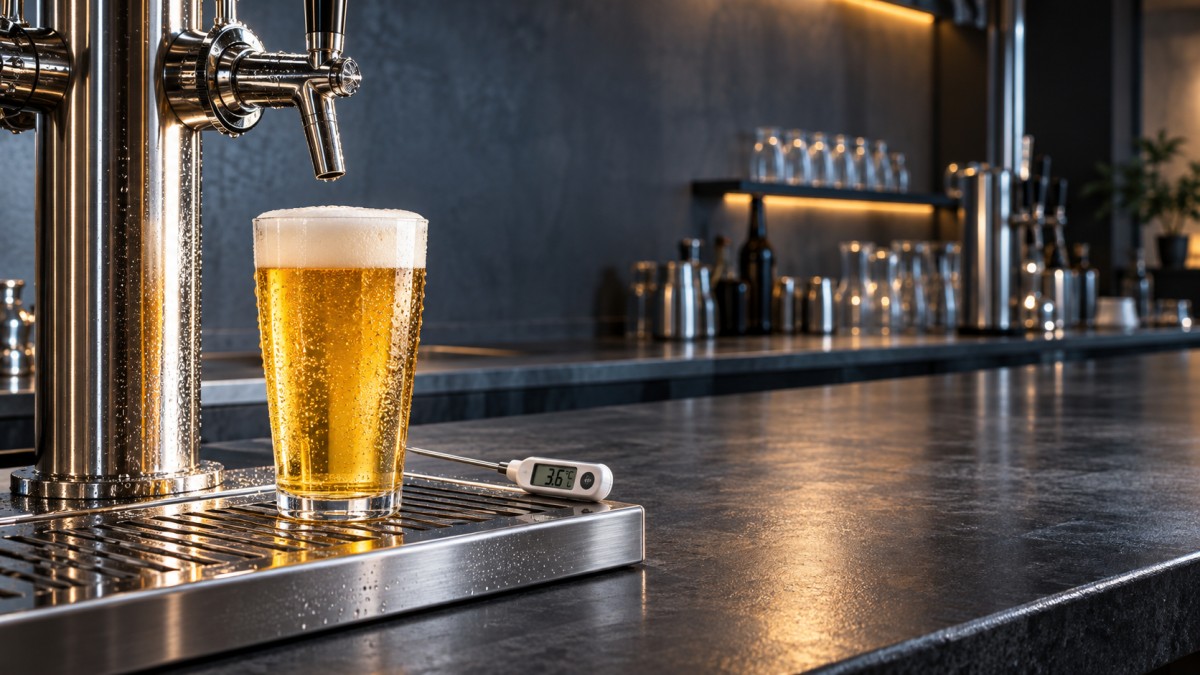
A short, wide replacement line may seem convenient but can remove resistance the system needs. Conversely, adding narrow tubing without calculation may restrict flow excessively. When replacing a line, record its material, internal diameter, and length rather than matching its outside appearance.
On a correctly balanced direct-draw system, avoid using low keg pressure as a permanent flow-control method. Restore the appropriate carbonation pressure, then address line resistance. A compatible flow-control faucet can help fine-tune service within its operating range, but it cannot repair warm beer, gas breakout, or an unsuitable gas supply.
Read the symptom before choosing the adjustment
Observe when the problem occurs and whether it affects one tap or several. That pattern often narrows the search more effectively than another regulator change.
Foam at the faucet does not establish that the keg is overcarbonated. Likewise, bubbles in a visible line section do not identify one cause by themselves. Interpret these signs alongside temperature, pressure, and the point where gas first becomes visible.
Eliminate faucet and glass problems
A balanced system can still pour badly through dirty or damaged components. Deposits, worn seals, partially opened faucets, and restrictions can disturb the stream. Follow a documented cleaning schedule for beverage lines, faucets, and couplers, using chemicals compatible with the equipment and following the cleaner manufacturer’s concentration, contact-time, and rinsing instructions.
Cleaning is not just running water through the line. Components that require disassembly must be cleaned as directed, and residue must be removed before returning the system to service. Never mix cleaning chemicals. If cleaning history is unknown, address that uncertainty before using pressure adjustments to compensate for poor flow.
- Open the faucet fully. Partially opening a standard draft faucet can create turbulence rather than gently reducing flow.
- Use a beer-clean glass. Grease, detergent residue, and rinse-aid contamination can affect foam stability. Persistent bubble trails from isolated points can indicate residue or surface imperfections.
- Avoid frozen glassware. Ice crystals can encourage excessive foaming, while freezer odors can affect the drinking experience.
- Keep the faucet out of the beer. Contact with the glass or liquid creates a sanitation concern and is not a substitute for controlling the pour.
Begin with the glass tilted and let beer run down its inner wall, then straighten it to form the desired head. Set the presentation standard for the product and glassware rather than trying to eliminate foam entirely. Stable head is part of normal service; a glass dominated by coarse, rapidly collapsing foam is not.
Recover service without creating tomorrow’s problem
During a busy shift, establish whether the fault belongs to one keg, one dispense path, or shared equipment. Compare the affected tap with another operating under similar conditions. Check actual temperature, gas availability, shutoff valves, coupler engagement, and visible line kinks before making a change.
A newly connected keg deserves particular attention. Confirm that it is sufficiently chilled, uses the correct coupler, and has not been connected with damaged seals. Recent movement can temporarily disrupt pouring, but waiting alone will not correct warm beer or an incorrect pressure setting.
Do not repeatedly vent a keg to suppress foam. Venting alters pressure, releases CO₂, and can encourage further breakout when operating pressure remains below equilibrium. Correct the underlying temperature or balance problem instead. Any necessary depressurization must follow the keg and dispensing equipment manufacturer’s procedure.
When the problem cannot be corrected immediately, stop serving from the affected tap rather than repeatedly pouring away foam. Record what was measured and changed so the next shift does not restart the same trial-and-error cycle.
Keep a usable baseline for each tap
After stable service is restored, record the beer, measured pouring temperature, gas type, regulator setting, and line specification. Note whether readings were taken after an idle period or during continuous service. This makes future comparisons meaningful, especially when a different beer replaces the current keg.
Recheck the setup after refrigeration work, line replacement, faucet changes, or switching to a product with a different carbonation level. A setting that worked for one lager is not proof that the next product needs identical conditions.
Escalate unexplained pressure drift, repeated gas breakout at verified conditions, damaged keg fittings, or remote-system balancing problems to a qualified draft technician. Secure gas cylinders and keep storage areas appropriately ventilated: CO₂ can accumulate in enclosed spaces. A suspected gas leak requires the site’s safety procedure, not continued testing by pouring beer.
Thank you very much for writing to us. Please leave your message and contact information, we will reply to you within 24 hours.