



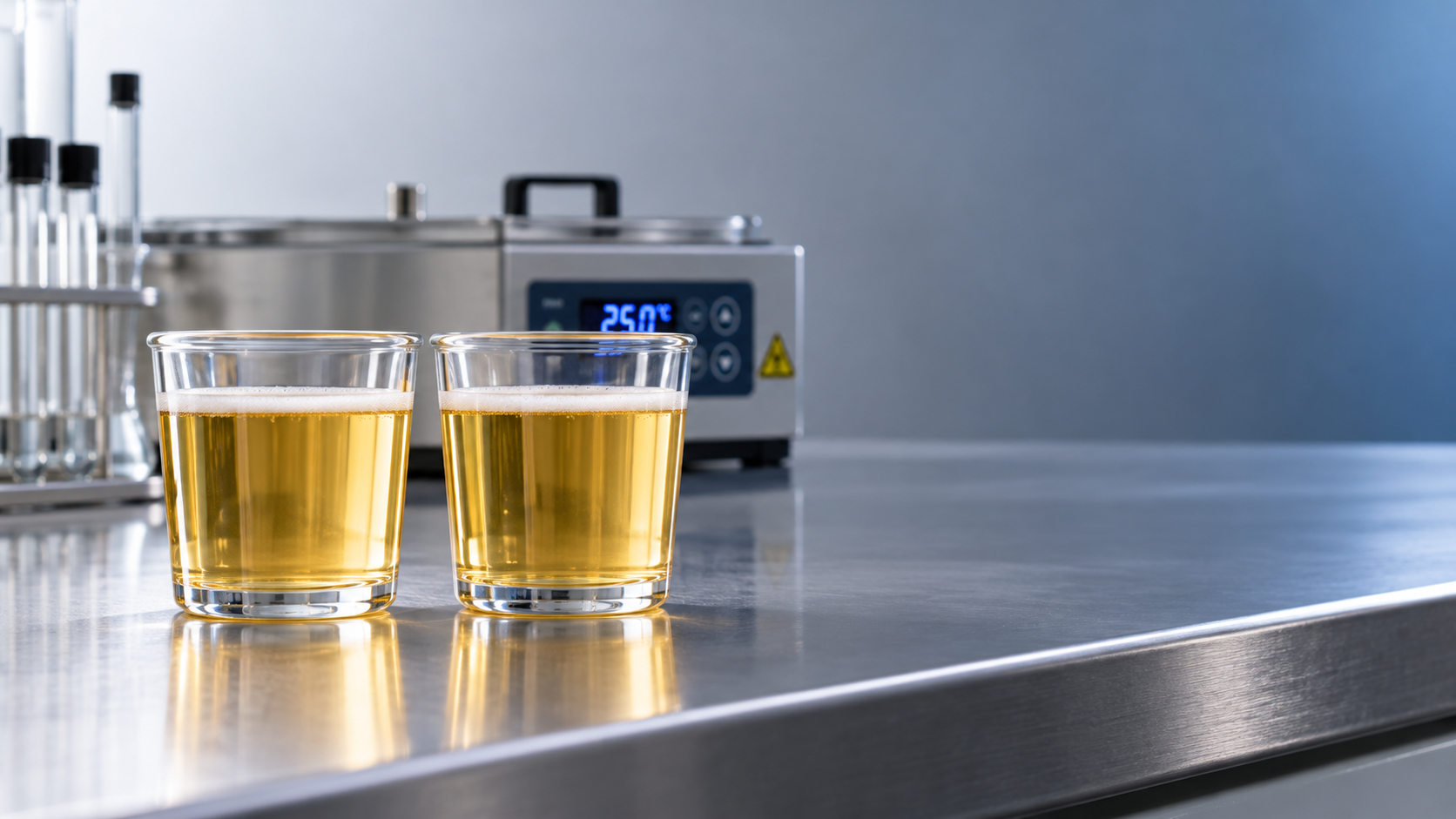
A buttery flavor in lager beer most often points to diacetyl, a fermentation compound that should fall below the beer’s sensory and analytical limits before release. The immediate response is to hold the affected batch, compare untreated and forced-diacetyl samples, and examine when the flavor appeared. Butteriness during late fermentation suggests a different problem from butteriness that develops only after packaging.
Smell alone cannot establish the source. Yeast metabolism, incomplete maturation, and certain beer-spoilage bacteria can all produce the same aroma. Effective troubleshooting connects three pieces of evidence: the amount of diacetyl already present, the potential for more to form, and the batch’s fermentation and handling history.
The butter character can appear after fermentation seems complete
During fermentation, brewing yeast produces alpha-acetolactate as an intermediate in amino acid synthesis. Some escapes into the beer, where it converts chemically into diacetyl. Healthy, metabolically active yeast subsequently takes up diacetyl and reduces it to compounds with much less flavor impact, including acetoin and 2,3-butanediol.
This sequence creates a timing problem. The precursor can remain when the beer tastes clean, then form diacetyl later. A satisfactory gravity reading or an acceptable tasting result therefore does not establish that maturation is complete.
Temperature affects both sides of the process. Warmer conditions accelerate precursor conversion and support yeast activity within the strain’s suitable operating range. Cooling too early slows cleanup, particularly when yeast has already settled or been removed. Residual precursor can then produce a buttery character during subsequent storage.
A diacetyl rest gives remaining precursor time to convert while sufficient active yeast is available to remove the resulting diacetyl. Its endpoint should follow analytical results and the batch trend. A fixed rest duration copied from another recipe provides weak assurance when yeast condition, wort composition, or fermentation performance differs.
Separate present diacetyl from the potential to produce more
The first useful distinction is between the beer’s current condition and its condition after precursor conversion. A forced-diacetyl test addresses that gap by comparing matched samples, with one receiving controlled heat treatment to accelerate conversion of alpha-acetolactate.
Use a validated brewery or laboratory procedure with defined sample volume, vessel, heating conditions, cooling conditions, and assessment temperature. Heat only in vessels suitable for the procedure; uncontrolled heating of sealed carbonated samples creates pressure hazards. Both samples need comparable serving temperatures for sensory assessment, because temperature changes aroma perception.
The heated sample indicates diacetyl potential. It does not prove bacterial contamination, and a sensory comparison does not provide a reliable numerical concentration. Heating also changes the sample matrix, so trained assessment and suitable controls matter.
For analytical testing, establish exactly what the reported result represents. Diacetyl belongs to the vicinal diketone group, which also includes 2,3-pentanedione. Depending on the method, a report labeled “VDK” can combine compounds or include precursor converted during sample preparation. Directly comparing that result with a free-diacetyl specification can produce a misleading release decision.
A validated chromatographic method can distinguish individual compounds when configured for that purpose. The laboratory report should identify the analytes, whether precursor conversion is included, and the method’s reporting limit. Results close to the specification require consideration of measurement uncertainty and sampling consistency.
Use the batch timeline to narrow the source
Butteriness before cooling usually starts with fermentation performance
If diacetyl remains high near the expected end of fermentation, review the temperature trace alongside gravity, yeast additions, and yeast removal. A programmed temperature setting does not prove the entire tank followed that profile. Probe location, calibration, tank size, and cooling behavior affect what the recorded value represents.
Underpitching, poor yeast vitality, inadequate oxygenation at pitching, and unsuitable nutrient balance can disrupt fermentation and subsequent cleanup. Viability alone is an incomplete measure: yeast can remain alive while performing poorly. Compare the affected batch with successful batches using the same strain and similar wort, including repitch history and fermentation progression.
Wort amino acid composition also influences precursor formation. A change in raw materials or recipe can alter the fermentation pattern even when original gravity remains unchanged. This becomes especially relevant when a recurring issue follows a formulation change but sanitation and packaging results remain stable.
Early cropping, clarification, or filtration can remove the yeast needed for reduction. If the process removes yeast before precursor conversion is complete, simply extending cold storage may yield little improvement. The investigation should identify whether cleanup lacked time, suitable temperature, or sufficient active biomass.
A later increase changes the investigation
Diacetyl first detected after transfer or packaging requires comparison across process locations. Sample the source tank, transfer outlet, bright beer tank, and packaged beer where those points exist. Samples collected only after packaging cannot establish whether the compound originated in fermentation or appeared downstream.
Certain lactic acid bacteria, including strains within Pediococcus and Lactobacillus-related groups, can produce diacetyl in beer. Associated acidity, haze, or other flavor changes strengthen suspicion, but their absence does not exclude contamination. A low initial organism count can delay obvious spoilage.
Review microbiological findings together with the flavor trend. Repeated increases during storage, particularly when linked to a specific transfer route or filler, support investigation of that equipment. They do not by themselves identify the organism or establish where it entered.
Wild yeast and other contaminants also deserve attention when attenuation, carbonation, or package pressure changes unexpectedly. Butteriness is a useful symptom, but it should not determine the entire microbiological test panel.
Build a sampling plan that can locate the problem
Collect samples before corrective treatment changes the evidence. Record the vessel or line, sampling time, beer temperature, fermentation stage, and recent process actions. Sample valves require a defined preparation procedure; contamination introduced during collection can falsely implicate an otherwise acceptable batch.
A practical investigation uses several complementary comparisons:
- Within the affected batch: compare a current sample with retained samples from before cooling, transfer, or packaging, where available.
- Across shared equipment: include another batch that passed through the suspected route. A common downstream exposure can explain problems across different recipes.
- Across storage conditions: assess retained packages under defined conditions. Warm incubation can accelerate evidence of instability, but its outcome needs interpretation against the test design and normal distribution conditions.
Microbiological methods should fit the suspected organisms and beer matrix. Culture requires suitable media, atmosphere, and incubation time; an early negative result is not equivalent to a completed negative test. Molecular methods provide different evidence, and some detect DNA without distinguishing viable organisms from nonviable material. Interpret each result within the method’s validated scope.
If results indicate a downstream source, examine filler components, valve seats, gaskets, sample ports, dead legs, and other locations where cleaning coverage or drainage is difficult. A successful cleaning cycle record confirms that programmed steps occurred. It does not establish that every product-contact surface received effective treatment.
Match the correction to the demonstrated cause
For incomplete maturation in an otherwise microbiologically acceptable batch, maintain or restore suitable conditions for yeast reduction within the established process limits. Follow both present diacetyl and precursor potential over time. A falling direct measurement is encouraging, but release remains premature if the forced result shows substantial formation potential.
Where yeast has been removed or has lost activity, extra holding time alone is an unreliable correction. Any use of fresh active yeast, blending, or other reprocessing needs a validated procedure that addresses flavor, fermentation consequences, microbiological status, and final product specifications. Such treatment also changes the evidence, which is why diagnostic samples should be retained first.
Confirmed contamination requires containment and source control. Separate affected product and investigate connected equipment and batches. Extending a diacetyl rest does not resolve an ongoing microbial source, and a treatment that stops microbial growth does not necessarily remove diacetyl already present.
For recurring precursor problems, prevention starts earlier in fermentation. Standardize yeast management, verify pitching and oxygenation performance, and connect the cooling decision to maturation results. Where an alpha-acetolactate decarboxylase enzyme is used, it converts the precursor toward acetoin before diacetyl forms. Its use requires validation for the process and applicable product requirements; it does not replace hygiene controls or remove existing diacetyl.
Release against a defined result, with the remaining uncertainty visible
There is no single sensory threshold that guarantees acceptance for every lager beer. A delicate pale lager exposes butteriness differently from a fuller, more strongly flavored beer, and individual sensitivity varies. Establish the product limit using the intended flavor profile, a validated analytical method, and trained sensory assessment. Avoid treating a published threshold as an automatic release specification.
Keep flavor disposition separate from food-safety disposition. A buttery aroma alone neither establishes a pathogen hazard nor demonstrates that the beer is safe. Unexpected microbial findings or broader process deviations require assessment under the brewery’s established food-safety procedures.
The release record should connect the final analytical result with precursor assessment, sensory findings, and any microbiological investigation triggered by the batch history. After corrective action, retain representative packaged samples and follow their stability under defined conditions. If butteriness returns, the timing and location of that return provide evidence for the next investigation.
Thank you very much for writing to us. Please leave your message and contact information, we will reply to you within 24 hours.