



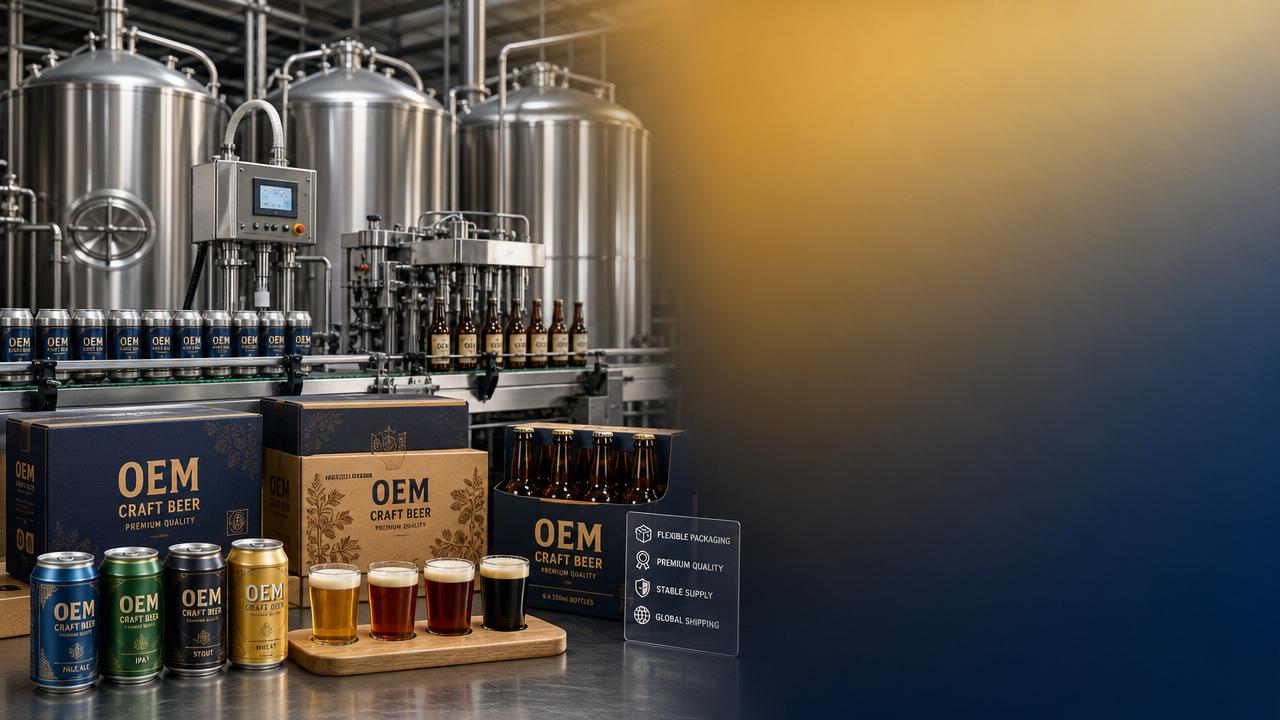
Selecting the right Chinese beer factory for private label production goes far beyond price alone. From brewing expertise and flexible OEM/ODM capabilities to quality control, product innovation and global supply reliability, every detail affects your brand’s success. Before making a decision, it is essential to understand which capabilities truly matter when choosing a long-term beer manufacturing partner in China.
What should buyers evaluate first in a Chinese beer factory for private label?
Many importers, distributors, supermarket buyers, bar chains, and startup beverage brands begin with one question: can this supplier make good beer at a workable cost? That matters, but it is only the first layer.
A capable Chinese beer factory for private label must support product consistency, regulatory documentation, scalable production, packaging flexibility, and reliable communication. Without these, even a competitively priced offer can become expensive after delays, complaints, or reformulation.
For alcohol beverages, the manufacturer is not simply a packer. It directly influences taste stability, shelf performance, labeling accuracy, and your speed to market. That is why procurement decisions should be made with a wider operational view.
- Brewing depth: recipe development, fermentation control, flavor adjustment, and repeatability across batches.
- Product range: ability to support classic lager, wheat beer, low-calorie beer, fruit beer, and specialty functional concepts.
- Business flexibility: OEM, ODM, wholesale, custom branding, private label packaging, and mixed channel support.
- Export readiness: document response, packaging compliance, shipping coordination, and stable lead-time management.
Jinpai Beer fits this decision logic because its business covers R&D, production, and distribution of craft beer across multiple styles, while also supporting OEM/ODM, wholesale supply, and customized solutions for different retail and foodservice channels.
Which production capabilities matter most before signing an OEM or ODM agreement?
When reviewing a Chinese beer factory for private label, buyers should look beyond equipment photos or broad promises. The real issue is whether the factory can translate a concept into a repeatable commercial product.
Recipe development and style coverage
A strong partner should be able to develop or adapt recipes for different markets. Some buyers need approachable lager for supermarkets. Others need German wheat for restaurants, fruit-forward products for younger consumers, or sugar-free low-calorie beer for health-focused channels.
This range matters because private label growth often starts with one SKU and then expands. A factory that already works across mainstream and specialty styles reduces the time needed for line extension.
Batch consistency and process control
A beer that tastes excellent in a sample but changes in mass production is a major commercial risk. Buyers should ask how the factory controls raw material sourcing, brewing temperature, fermentation timing, filtration, carbonation, and final filling conditions.
Consistency is especially important for importers serving chain stores or bars, where repeated consumer experience directly affects reorder rates. A reliable Chinese beer factory for private label should have clear internal checks from wort production to finished goods release.
Packaging adaptability
Packaging is not only visual branding. It affects transport cost, shelf presence, market positioning, and route-to-market suitability. Different customers may need cans for convenience retail, bottles for restaurants, or gift-oriented mixed packs for promotional channels.
- Can the supplier support multiple packaging formats for different channel strategies?
- Can labels and outer cartons be adjusted for local language, barcode, or importer information?
- Can the factory coordinate artwork confirmation without slowing production planning?
These questions are practical, and they often separate a trading-style supplier from a true manufacturing partner.
How do you compare beer factory capabilities in a structured way?
If several suppliers appear similar, a scorecard helps make the decision more objective. The table below highlights key dimensions buyers should compare when selecting a Chinese beer factory for private label projects.
This comparison method helps buyers avoid overemphasizing unit price. In many projects, the lowest quotation becomes less competitive once reformulation, late packaging revisions, or missed delivery windows are added to the total cost.
Why quality control and supply reliability often decide long-term success
Beer is highly sensitive to process discipline. Flavor, aroma, carbonation, clarity, and shelf stability can all suffer if brewing and filling controls are weak. For a private label brand, these issues damage trust quickly because consumers associate every defect with your name, not the factory.
What quality control should buyers discuss?
- Incoming raw material management for malt, hops, yeast, adjuncts, and flavor ingredients.
- In-process monitoring during mashing, fermentation, maturation, filtration, and carbonation.
- Packaging line stability to reduce seam issues, filling variation, leakage, and label errors.
- Finished product review for sensory profile, appearance, and shipment release consistency.
For export buyers, quality is also linked to logistics. Strong palletization, suitable carton strength, and careful loading plans help preserve product condition during sea freight and multiple handling stages.
A dependable Chinese beer factory for private label should not treat quality as a final inspection step alone. It should be built into raw material control, production scheduling, packaging execution, and shipment preparation.
How important are product innovation and market-fit development?
Private label buyers increasingly compete on differentiation, not only price. Retailers want category variety. Bars want house-branded products with a story. Importers want offerings tailored to local trends. This makes product development a major selection factor.
A factory with strong R&D can help you launch styles that match channel demand more precisely. Jinpai Beer’s portfolio across classic lager, German wheat, sugar-free low-calorie beer, fruit-flavored beer, and functional specialty beers gives buyers more room to build a structured product line instead of a single generic item.
Typical channel-driven product choices
Different sales channels need different beer profiles, packaging logic, and price architecture. The table below can help buyers align product development with business goals before choosing a Chinese beer factory for private label cooperation.
This kind of channel mapping prevents a common mistake: choosing a factory that can produce beer, but not the right beer for your actual customer base. Product-market fit is a capability issue as much as a branding issue.
What should buyers ask about compliance, documents, and export coordination?
Even strong beer quality is not enough if documents are delayed or packaging information is not aligned with destination market requirements. Importers should ask early about specification confirmation, label details, carton markings, and shipment document coordination.
Key practical points to confirm
- Product specification details, including style, alcohol content, packaging format, and shelf-life expectations.
- Private label artwork process, including revision timing, approval steps, and print confirmation responsibilities.
- Export document response speed, because customs and import registration often run on tight deadlines.
- Shipment planning, especially for buyers combining multiple SKUs, promotional packs, or mixed distribution schedules.
Where market-specific standards or certifications are required, the buyer should verify needs first and communicate them clearly. A professional factory will discuss what can be supported, what must be confirmed in advance, and how lead times may be affected.
This is another reason many international buyers prefer an experienced Chinese beer factory for private label over a purely price-driven source. Smooth communication around compliance and export execution can save weeks in launch timing.
How can you reduce cost risk without sacrificing brand quality?
Cost control matters, but the right question is not “Who is cheapest?” It is “Which supplier gives the best commercial result for the target channel?” In beer procurement, low price can hide risks in flavor stability, carton strength, slow response, or limited customization.
A more balanced approach is to compare total project value. That includes sample efficiency, formulation fit, packaging accuracy, logistics support, and reorder reliability. A factory that helps you avoid relabeling, customer complaints, or stock gaps often creates better margins over time.
Cost-risk checklist for private label beer buyers
- Do not compare prices without matching beer style, packaging specification, and order structure.
- Ask whether lower prices reflect simpler formulas, narrower service scope, or reduced packaging flexibility.
- Consider whether the supplier can support future SKU additions, not only the first launch.
- Evaluate communication speed, because project delay is also a real cost in seasonal or promotional sales.
For many distributors and retailers, the best partner is the one that balances accessible cost with dependable delivery and product consistency. That balance is especially valuable in competitive private label programs.
FAQ: common questions before choosing a Chinese beer factory for private label
How do I know if a factory is suitable for my market position?
Start from your channel, target consumer, and price band. A supermarket line may need clean, accessible flavor and stable packaging economics. A bar-exclusive line may need more character and stronger customization. The right Chinese beer factory for private label should be able to discuss these differences in detail, not just quote a standard product.
Is ODM better than OEM for a new beer brand?
It depends on your resources. OEM is suitable when you already have a clear concept and need manufacturing execution. ODM is helpful when you need support on formulation, style planning, and product-market adaptation. For newer brands, ODM often shortens development time and reduces trial-and-error cost.
What are the biggest mistakes in private label beer sourcing?
The most common mistakes are buying on price alone, skipping detailed sample evaluation, ignoring packaging practicality, and underestimating export coordination. Another mistake is selecting a supplier with too narrow a product range, which limits later expansion into low-calorie, fruit, or specialty segments.
Which buyers benefit most from working with a broad-capability beer factory?
Importers building regional portfolios, supermarket private label teams, hospitality groups, online beverage sellers, and wholesalers serving mixed retail channels all benefit. They usually need more than one beer style, packaging option, or pricing tier over time, so a broader manufacturing partner is strategically stronger.
Why choose us for your private label beer project in China?
If you are looking for a Chinese beer factory for private label cooperation, Jinpai Beer offers a practical combination of product breadth, OEM/ODM flexibility, and channel-oriented supply support. Our business covers R&D, production, and distribution, allowing buyers to discuss formulation, packaging, and commercial rollout in one connected process.
We can support projects across classic lager, German wheat, sugar-free low-calorie beer, fruit-flavored beer, and functional specialty beers. This helps distributors, agents, supermarkets, bars, and retail partners build more targeted product lines for different consumer groups.
You can contact us to discuss specific needs such as product selection, private label positioning, packaging format, delivery schedule, sample support, OEM or ODM cooperation model, and quotation planning. If your market has special label, documentation, or launch timing requirements, sharing them early will help us propose a more workable custom solution.
A successful private label beer program depends on more than manufacturing capacity alone. It depends on choosing a partner that understands brewing, customization, quality control, and export execution together. That is the capability set worth prioritizing before you make your final decision.
Thank you very much for writing to us. Please leave your message and contact information, we will reply to you within 24 hours.