



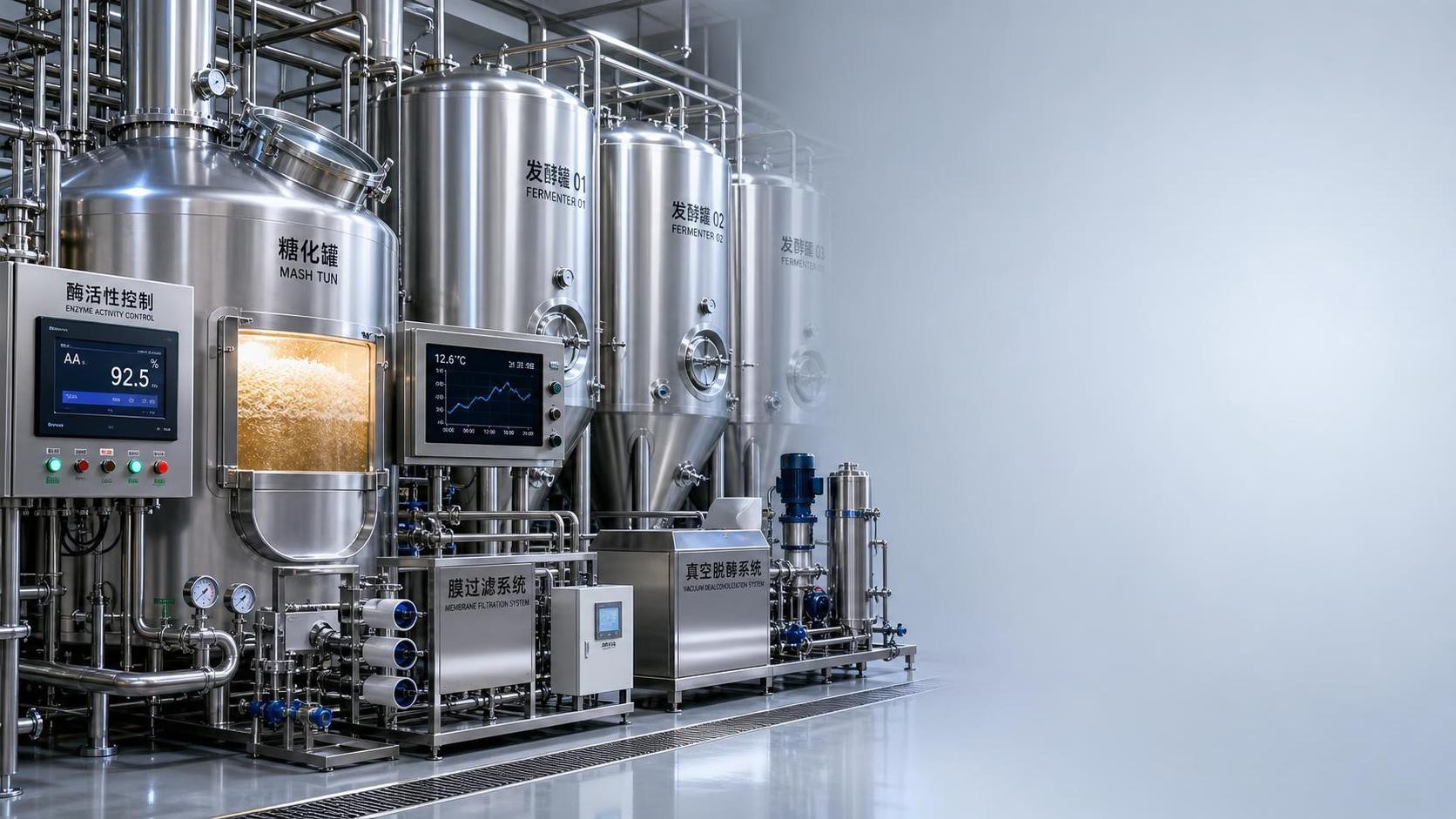
Why “Beer Factory” vs. “Malt Drink Factory” Isn’t Just a Label—It’s a Technical Threshold
For technical evaluators assessing production partnerships—whether for OEM capacity, regional distribution infrastructure, or co-development of non-alcoholic innovations—the distinction between a beer factory and a malt drink factory isn’t semantic. It’s operational. It reflects divergent assumptions about raw material control, microbial management, regulatory exposure, and, most critically, the flexibility to pivot across alcohol content bands without compromising consistency, safety, or scalability.
This isn’t about whether one is “more advanced” than the other. It’s about where the hard constraints lie—and how those constraints shape what you can reliably source, launch, or scale.
Raw Material Handling: Malting Control vs. Adjunct Readiness
A true beer factory treats barley as a living input—not just a starch source. Its malting line (or tightly controlled third-party malting partnership) governs enzyme profile, diastatic power, moisture retention, and kilning-derived flavor precursors. Even when using adjuncts like rice or corn, the base malt remains enzymatically active and thermally tuned to support full saccharification during mashing. That means mash temperature ramps, pH adjustments, and rest times aren’t just process steps—they’re levers for controlling fermentability, body, and haze stability.
In contrast, many malt drink factories rely on pre-gelatinized, enzyme-inactivated adjunct powders or syrups. These simplify blending and reduce thermal load—but they also decouple the facility from granular control over wort composition. No enzymatic activity means no opportunity to modulate dextrin-to-maltose ratios mid-process. The result? Consistent sugar profiles, yes—but limited ability to adjust mouthfeel or fermentation yield for low-ABV or zero-ABV variants without reformulation at the syrup level.
The practical implication: If your project requires rapid iteration across ABV tiers (e.g., scaling from 0.5% to 4.5% while retaining identical base flavor), a facility built around malting discipline—not just adjunct reconstitution—offers tighter control over wort fermentability and reproducibility across batches.
Fermentation Control: From Alcohol Yield to Arrested Metabolism
Fermentation in a beer factory is fundamentally metabolic engineering: yeast strain selection, pitching rate, oxygenation, temperature ramping, and nutrient timing are calibrated to deliver predictable attenuation, ester balance, and terminal gravity. Even for low-alcohol products, fermentation proceeds to near-completion before being arrested—typically via cold crash, centrifugation, or membrane filtration. This preserves authentic yeast-derived complexity but demands rigorous microbiological monitoring throughout the entire cycle.
Malt drink factories often bypass fermentation entirely—or use it only for flavor development, not alcohol generation. Some employ immobilized yeast reactors with strict residence time control; others add post-fermentation alcohol removal (e.g., vacuum distillation or reverse osmosis). But here’s the catch: removing ethanol *after* fermentation introduces new variables—oxidative stress on hop compounds, volatile loss, and potential Maillard byproducts from thermal stripping. And if the original fermentation wasn’t designed for clean arrest (e.g., no controlled flocculation, no precise glycerol/ester ratio targeting), the “non-alcoholic” version may lack structural integrity or shelf-life stability.
Crucially, neither approach is inherently superior—but their failure modes differ. A beer factory’s risk lies in over-attenuation or contamination during extended fermentation. A malt drink factory’s risk lies in flavor dilution or chemical instability post-stripping. Technical evaluators must ask: Does this facility validate its non-alcoholic versions under real-time storage conditions (e.g., 6-month accelerated aging at 30°C)? Or does it rely solely on initial sensory panels?
Non-Alcoholic Product Lines: Infrastructure Determines Innovation Velocity
“Non-alcoholic beer” isn’t a single category—it’s a spectrum spanning 0.0% ABV functional beverages, 0.5% “de-alcoholized lagers,” and 1.2% “low-ferment” styles that leverage yeast metabolism without crossing regulatory alcohol thresholds. A facility optimized for only one segment struggles when demand shifts.
Jinpai Beer’s craft-focused infrastructure exemplifies a hybrid model: its brewhouse supports traditional all-malt mashes, yet its fermentation tanks are fitted with dual-temperature jacketing and inline dissolved CO₂ monitoring—enabling both full-ferment lagers and precisely arrested wheat beers. Its packaging line includes nitrogen-dosed fillers compatible with low-oxygen, low-ABV formats, and its QC lab runs routine HPLC analysis for residual ethanol, acetaldehyde, and diacetyl—not just for alcoholic batches, but across the entire portfolio.
That kind of cross-line validation matters because regulatory definitions vary sharply. In the EU, “alcohol-free” means ≤0.5% ABV—but in Saudi Arabia or parts of India, it means ≤0.0% ABV, verified by accredited labs. A facility that treats 0.0% as an afterthought—rather than a primary process parameter—may pass internal QA but fail import certification. Worse, it may produce batches that meet label claims at bottling but drift above threshold within 3 months due to residual fermentable sugars or microbial reactivation.
So when evaluating capacity, don’t just ask: “Can they make non-alcoholic beer?” Ask instead: “Where is the ABV measurement point? Is it post-filtration, pre-packaging, or post-aging? What’s their false-negative rate for ethanol detection at 0.03%?” Those answers reveal more about technical maturity than any brochure claim.
What This Means for Your Next Sourcing Decision
If you’re scoping OEM partners for a functional malt-based beverage with botanical extracts and no alcohol claim, a dedicated malt drink factory may offer faster onboarding—especially if your formulation relies heavily on standardized syrups and avoids complex grain bill interactions.
But if your roadmap includes iterative ABV tuning (e.g., launching parallel 0.0%, 0.5%, and 4.2% SKUs under one brand identity), or if your target markets impose tiered labeling requirements (e.g., “alcohol-free” vs. “non-alcoholic” vs. “low-alcohol”), then facility architecture becomes decisive. You need a site where malt handling, fermentation control, and analytical rigor are unified—not siloed across separate departments or even separate buildings.
Also be wary of assumptions baked into common terminology. “Craft brewery” doesn’t guarantee malt flexibility; some operate on 100% imported malt extract. “Malt drink facility” doesn’t imply lower technical bar—some deploy continuous enzymatic hydrolysis systems more precise than batch mashing in legacy breweries. What matters is traceability: Can they map each gram of barley back to harvest lot, kilning curve, and proteolytic index? Can they correlate fermentation temperature logs with final diacetyl levels across 50+ batches?
Those capabilities don’t appear on spec sheets. They emerge in audit reports, batch records, and—not least—in how quickly they adapt when you say: “We need the same base wort, but with 30% less fermentable sugar, stable at pH 3.8, and packaged in aluminum cans with 12-month shelf life.”
That’s not a request. It’s a stress test. And how a facility responds tells you everything about where its real boundaries lie.
Thank you very much for writing to us. Please leave your message and contact information, we will reply to you within 24 hours.