



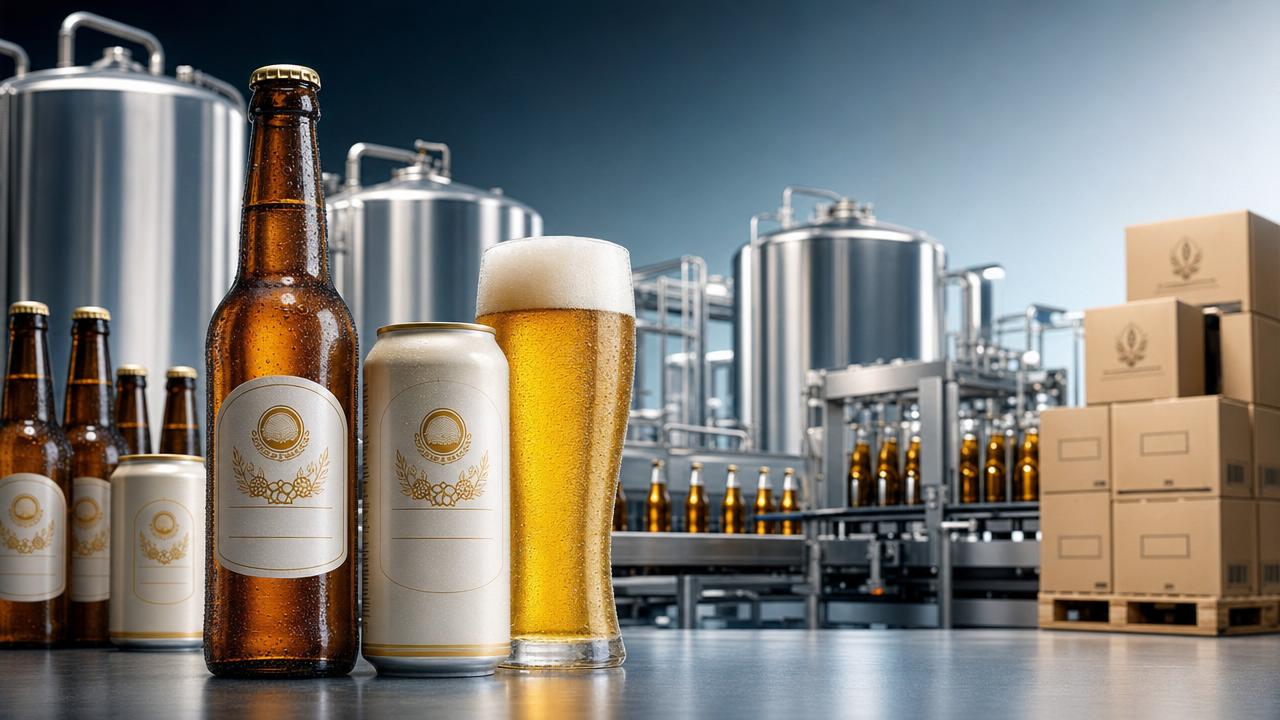
As craft beer brands face rising costs, shifting consumer tastes and tighter speed-to-market demands in 2026, the choice between Beer OEM and in-house brewing has become a strategic business decision. For executives seeking scalable growth, stronger margins and product flexibility, understanding the trade-offs is essential. This article explores which model better fits modern beverage brands, distribution goals and long-term market expansion.
Why the Beer Production Decision Looks Different in 2026
The beer industry is entering 2026 with a very different operating reality from just a few years ago. Demand is still there, but it is more fragmented. Consumers want classic lagers, wheat beer, low-calorie options, fruit-infused flavors and functional specialty beers at the same time. That variety is creating pressure on brewers to innovate faster while keeping costs under control. As a result, Beer OEM is no longer viewed only as a tactical outsourcing option. It is increasingly part of a growth strategy.
At the same time, in-house brewing remains attractive for brands that want direct control over production, process discipline and facility-based brand value. For business decision-makers, the real issue is not which model is universally better. The more useful question is which model matches the company’s current stage, channel structure, product roadmap and capital priorities.
This shift matters across the beverage sector because production decisions now influence speed-to-market, export readiness, SKU expansion, inventory risk and working capital. In 2026, Beer OEM versus in-house brewing is less about tradition and more about strategic fit.
The Main Signals Reshaping Beer OEM and In-House Brewing
Several clear market signals are pushing brands to revisit their production model. First, product cycles are shorter. Seasonal beer, sugar-free concepts and flavor innovation move quickly, which makes flexible batch planning more valuable. Second, channel diversity is growing. Restaurants, bars, supermarkets, e-commerce and cross-border wholesale each require different pack sizes, labeling standards and supply timelines. Third, cost pressure has not disappeared. Energy, labor, packaging and compliance continue to affect profitability.
These changes favor production models that can balance responsiveness with quality consistency. For many brands, Beer OEM offers a way to test new concepts without building full brewing capacity. For others, in-house brewing still makes sense when utilization is high, brand identity is tightly tied to the brewery, or proprietary process control is central to the market position.
Why More Brands Are Considering Beer OEM
The strongest driver behind Beer OEM is flexibility. In an environment where consumer preferences shift rapidly, companies need a production structure that supports both experimentation and scaling. Beer OEM can help brands launch a classic lager for mass retail, a German wheat line for restaurants, a fruit beer for younger buyers and a low-calorie beer for health-conscious consumers without investing in multiple dedicated production lines.
Another important factor is capital efficiency. Building or expanding a brewery requires major spending on land, equipment, utilities, quality systems and staffing. That investment can make sense for a mature brand with stable demand. But for fast-growing, export-oriented or channel-driven businesses, tying up capital in infrastructure may limit agility. Beer OEM lets management preserve cash for brand building, distribution expansion and market development.
There is also the issue of operational complexity. Producing beer at scale is not only about brewing. It involves formulation adaptation, packaging sourcing, quality control, lead time planning and logistics coordination. A capable Beer OEM partner can absorb much of that complexity, especially for companies entering new markets or launching private label programs.
Why In-House Brewing Still Holds Strategic Value
Despite the growth of Beer OEM, in-house brewing remains a strong choice in several scenarios. The first is brand authenticity. Some craft and premium brands rely on brewery ownership as part of their story. Visitors, distributors and hospitality buyers may see a physical production site as proof of craftsmanship and consistency. In these cases, the brewery is not just a cost center; it is a brand asset.
The second advantage is process control. Companies with highly specialized recipes, proprietary fermentation methods or strict internal quality protocols may prefer direct oversight. In-house production can improve coordination between R&D, brewing and sensory evaluation, especially when the business is focused on fewer core SKUs with predictable demand.
The third advantage is margin capture at scale. If a company has strong volume stability, efficient operations and high facility utilization, internal brewing may generate better long-term unit economics. However, this is highly dependent on throughput. Underused capacity quickly turns from an asset into a burden.
The Real Comparison: Control, Speed, Risk and Growth
For executives, the Beer OEM versus in-house brewing decision should be judged against four strategic variables: control, speed, risk and growth potential. Control includes recipe protection, process visibility and quality consistency. Speed covers development timelines, packaging adaptation and market launch capability. Risk relates to capital exposure, utilization uncertainty and supply continuity. Growth potential reflects whether the model can support new channels, export markets and product line expansion.
Beer OEM often performs better on speed and capital risk. In-house brewing often performs better on direct control and facility-based identity. But in many cases, the winning model depends on the company’s stage. Early-stage and channel-first brands usually benefit from flexibility. Established regional leaders may favor a mixed approach. Large-volume players with stable demand may justify internal capacity for core products while using Beer OEM for innovation and overflow production.
Who Is Most Affected by This Shift
The move toward Beer OEM is especially relevant for private label operators, new beverage brands, restaurant groups, importers, supermarket suppliers and cross-border distributors. These buyers often need broad product coverage, reliable supply and customized packaging more than they need brewery ownership. They are focused on speed, margin structure and market responsiveness.
By contrast, brewpub operators, destination breweries and companies whose customer proposition depends on local production may remain more committed to in-house brewing. Their challenge is to preserve identity while adapting to changing consumer demand. Some of these businesses may still use Beer OEM selectively for canned retail lines, seasonal launches or export programs.
For procurement and strategy teams, the key implication is clear: production is no longer a back-end issue. It is a front-line business model choice with direct impact on revenue opportunities and strategic flexibility.
What Decision-Makers Should Watch Before Choosing a Model
Before committing to Beer OEM or in-house brewing, companies should examine several signals. The first is demand predictability. If sales are volatile or strongly seasonal, outsourcing may reduce exposure. The second is channel complexity. If the business serves bars, supermarkets and online channels at once, a flexible partner may be more efficient than a fixed internal setup. The third is product roadmap intensity. The more frequently the portfolio changes, the more valuable adaptable production becomes.
Decision-makers should also look beyond unit price. A lower production cost per liter does not automatically mean a better strategic result. Hidden costs can include slower launches, unused capacity, delayed packaging changes, compliance burden or missed sales opportunities. A proper comparison between Beer OEM and in-house brewing should include total commercial impact, not just factory economics.
Another critical factor is partner quality. Beer OEM only works well when the manufacturer can support stable quality, formulation execution, packaging flexibility and scalable supply. This is why experienced producers with strong R&D, broad style capability and global supply experience are becoming more valuable in 2026.
A Practical 2026 Decision Framework
A practical way to evaluate the two models is to separate core products from growth products. Core products are high-volume, stable and forecastable. Growth products are new, experimental, channel-specific or market-entry focused. In many cases, the best answer is not pure Beer OEM or pure in-house brewing. It is a hybrid structure.
For example, a company may keep flagship brewing internal while using Beer OEM for fruit beer, sugar-free low-calorie beer, specialty functional beer or export-only SKUs. This allows the business to protect its signature brand identity while still moving quickly in emerging segments. It also reduces the risk of overbuilding capacity in categories that may evolve rapidly.
This is where suppliers such as Jinpai Beer become relevant to strategic planning. With capabilities in craft beer R&D, production and distribution across classic lager, German wheat, sugar-free low-calorie beer, fruit-flavored beer and functional specialty beers, plus OEM/ODM, wholesale supply and customized solutions, the company reflects what many global buyers now seek: breadth, adaptability and channel readiness.
Which Model Makes More Sense in 2026?
For many growth-focused beverage businesses, Beer OEM makes more sense in 2026 because the market rewards flexibility, speed and efficient capital use. This is particularly true for companies expanding across retail, horeca and international channels, or for those building a wider product matrix. Beer OEM can shorten launch cycles, lower fixed-cost exposure and support tailored offerings for different customer groups.
In-house brewing makes more sense when production utilization is strong, the brand depends heavily on owned-brewery credibility, or direct process control is central to competitive advantage. It remains a valid model, but it demands greater confidence in long-term volume stability and operational discipline.
The most future-ready answer for many companies may be selective integration: own what must be controlled, outsource what must stay agile. That mindset aligns better with the uncertainty and opportunity of 2026 than a rigid all-or-nothing approach.
Final Business Takeaway
If your company is deciding between Beer OEM and in-house brewing, the next step is to test the choice against real business conditions rather than legacy assumptions. Review how quickly your portfolio changes, how many channels you serve, how predictable your volumes are and where your capital can create the highest return. Those questions usually reveal whether flexibility or ownership matters more right now.
If you want to judge how these trends affect your business, focus on five points: which products truly require internal control, which SKUs need faster market entry, where current capacity creates risk, how much packaging customization your channels demand and whether a Beer OEM partner can strengthen your expansion plan. The companies that answer those questions early will be better positioned to grow in the next beer cycle.
Thank you very much for writing to us. Please leave your message and contact information, we will reply to you within 24 hours.