



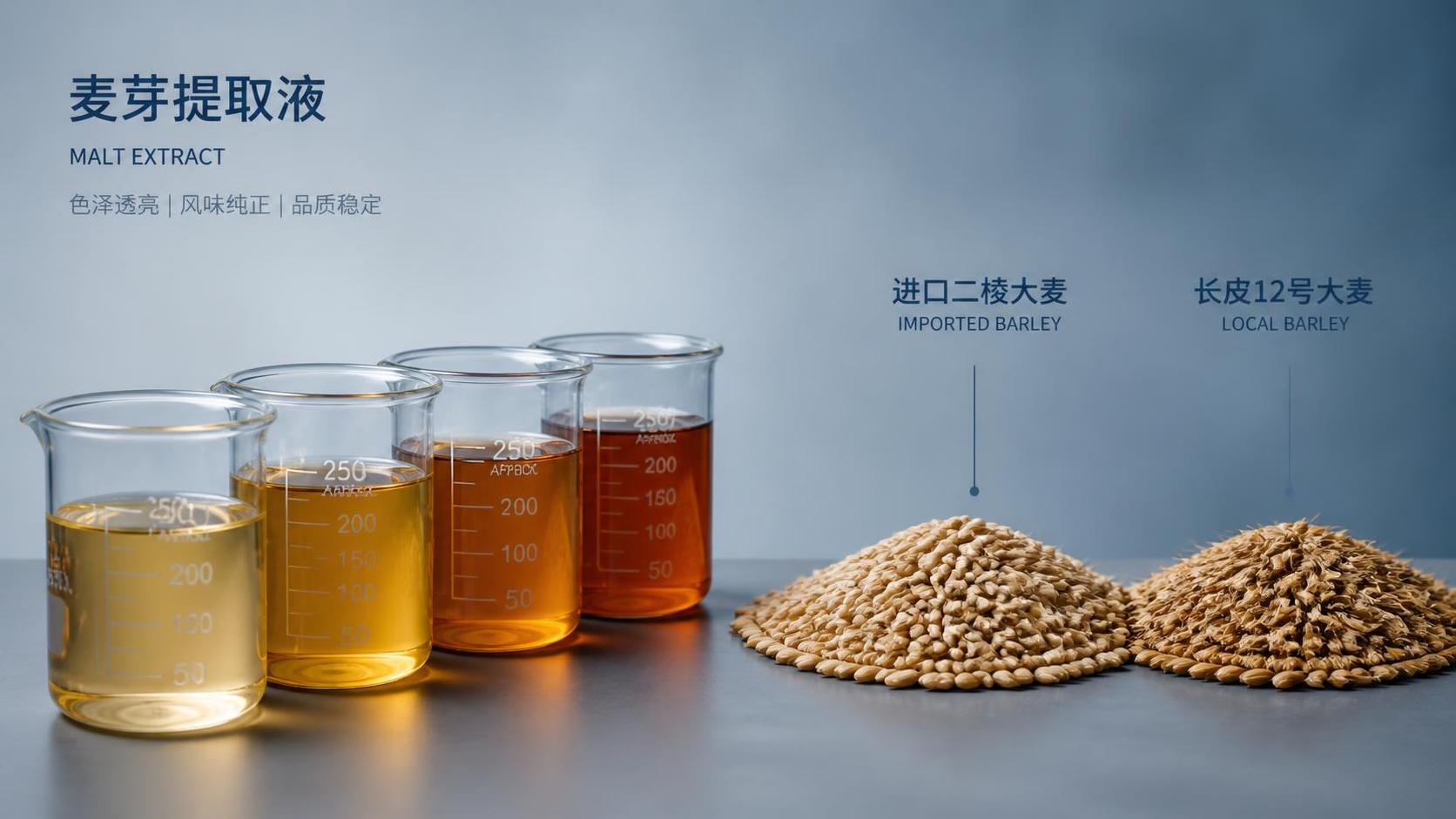
Barley Sourcing Isn’t Just About Yield—It’s a Working Capital Decision
When finance leaders at craft breweries like Jinpai Beer review ingredient cost forecasts, barley rarely stands out—until it does. Not because of volume (it’s only ~12% of total COGS for non-alcoholic beer), but because of timing, volatility, and procurement rigidity. Right now, 0.0% alcohol beer raw material price trends are tightening around two levers: the lag between harvest cycles and the real cost of holding inventory against tariff uncertainty. And domestic barley isn’t entering the conversation as a “local pride” play—it’s appearing on cost-model spreadsheets as a working capital hedge.
Why Barley Timing Matters More in Non-Alcoholic Beer Than in Regular Lager
Most brewers assume barley is fungible across product lines. But with 0.0% alcohol beer, extraction efficiency and consistency become non-negotiable—not for flavor, but for process control. These beers rely heavily on enzymatic hydrolysis and vacuum evaporation to remove ethanol post-fermentation. If malt extract variability spikes (due to inconsistent protein content or diastatic power), you get batch-to-batch yield swings that compound downstream: longer evaporation times, higher energy costs, more rework. Imported barley—especially from EU or Canadian sources—has tighter spec bands, but lead times stretch 90–120 days, with no flexibility for mid-season adjustments. Domestic barley, by contrast, often moves on 30–45 day terms—and for Jinpai’s fruit-infused and functional SKUs, where recipe agility matters (e.g., rotating seasonal fruit bases or adjusting mineral profiles for electrolyte claims), that window is operational leverage.
The Price Gap Is Narrowing—But Not Uniformly
Yes, imported two-row malt still averages $0.48–$0.53/kg landed (Q2 2024, based on spot contracts with major European mills). Domestic malt hovers at $0.42–$0.47/kg—but only if sourced from contracted growers in Inner Mongolia or Heilongjiang who meet brewer-grade specs (protein ≤11.8%, moisture ≤5.0%, friability ≥80%). The catch? That $0.05–$0.06/kg differential disappears fast when you factor in minimum order quantities (MOQs), storage premiums for malted vs. raw grain, and the cost of blending to stabilize diastatic power across harvest lots. We’ve seen clients overestimate savings by 18–22% because their models assumed “domestic = cheaper,” without modeling the added QC labor, moisture testing frequency, or buffer stock needed to cover late-harvest delays.
Procurement ROI Depends on Your Channel Mix—Not Just Your Recipe
Here’s what we see in practice: OEM partners building private-label 0.0% beers for supermarket chains tend to benefit most from domestic barley. Why? Their margin pressure is acute, shelf-life windows are tight (often <9 months), and formula changes are rare—so stability trumps novelty. For Jinpai’s own DTC and bar-channel SKUs—especially sugar-free low-calorie and functional variants—the calculus shifts. Those lines require frequent small-batch trials, rapid iteration on adjunct ratios (e.g., monk fruit vs. stevia synergy), and precise pH control during dealcoholization. In those cases, imported malt’s tighter spec consistency often delivers better yield predictability—even at a higher headline price. It’s not about cost per kilogram. It’s about cost per *usable liter* after evaporation loss and filtration rejection.
Avoid the “Single-Origin Trap”
Some finance teams push for 100% domestic substitution across all SKUs to simplify forecasting. That rarely works. Barley isn’t like hops or yeast—where one origin can serve multiple styles. Domestic barley varieties (e.g., Longpi 12 or Heilongjiang 22) excel in enzyme stability but lack the husk integrity needed for high-gravity mashes in German wheat–style non-alcoholic bases. Meanwhile, imported Maris Otter or CDC Copeland offer superior lautering performance but require longer conditioning time pre-milling—adding 3–5 days to production planning. The smarter play? Tier your sourcing: domestic for core lager and fruit-forward SKUs (where speed and margin matter), imported for wheat, rye, or specialty functional batches (where process repeatability justifies the premium).
What to Watch in the Next 12 Months
Don’t anchor on today’s spread. Three developments could tilt the balance:
- China’s draft GB/T 35885-2024 revision (expected Q4 2024) may tighten allowable DON (deoxynivalenol) limits for malted barley—raising QC thresholds for domestic suppliers, possibly widening the spec gap with EU-certified mills.
- The 2024 Inner Mongolia drought has reduced projected malt barley acreage by ~7%. Early indications suggest limited impact on 2024 supply (carryover stocks remain healthy), but 2025 forward pricing already shows a 3.2% uptick in 6-month futures—vs. flat EU quotes.
- More domestic maltsters are investing in lab-scale malting lines to support craft brewers’ small-lot needs. That won’t close the spec gap overnight, but it does reduce MOQ friction—making blended sourcing (e.g., 70% domestic base + 30% imported specialty malt) operationally viable for the first time.
Bottom Line for Finance Teams
Shifting toward domestic barley alternatives isn’t about replacing imports—it’s about rebalancing risk exposure across your SKU portfolio and channel commitments. If your wholesale contracts lock in fixed COGS for 12+ months, domestic barley gives you pricing optionality. If your OEM clients demand guaranteed batch yields for retail shelf-ready packs, imported malt may still be your lowest-risk path—even at a higher unit cost. The real leverage lies in aligning sourcing strategy with your actual production rhythm, not just headline prices. For Jinpai’s global partners, that means evaluating barley not as a commodity line item, but as a variable in your yield model, your cash conversion cycle, and your ability to scale new functional formats without retooling your entire malt pipeline.
One final note: barley decisions made today affect your 2025 innovation calendar. If you’re planning sugar-free, botanical, or adaptogenic variants—and you want to move fast—you’ll need malt that behaves predictably, not just cheaply. That’s where the numbers stop telling the whole story.
Thank you very much for writing to us. Please leave your message and contact information, we will reply to you within 24 hours.