



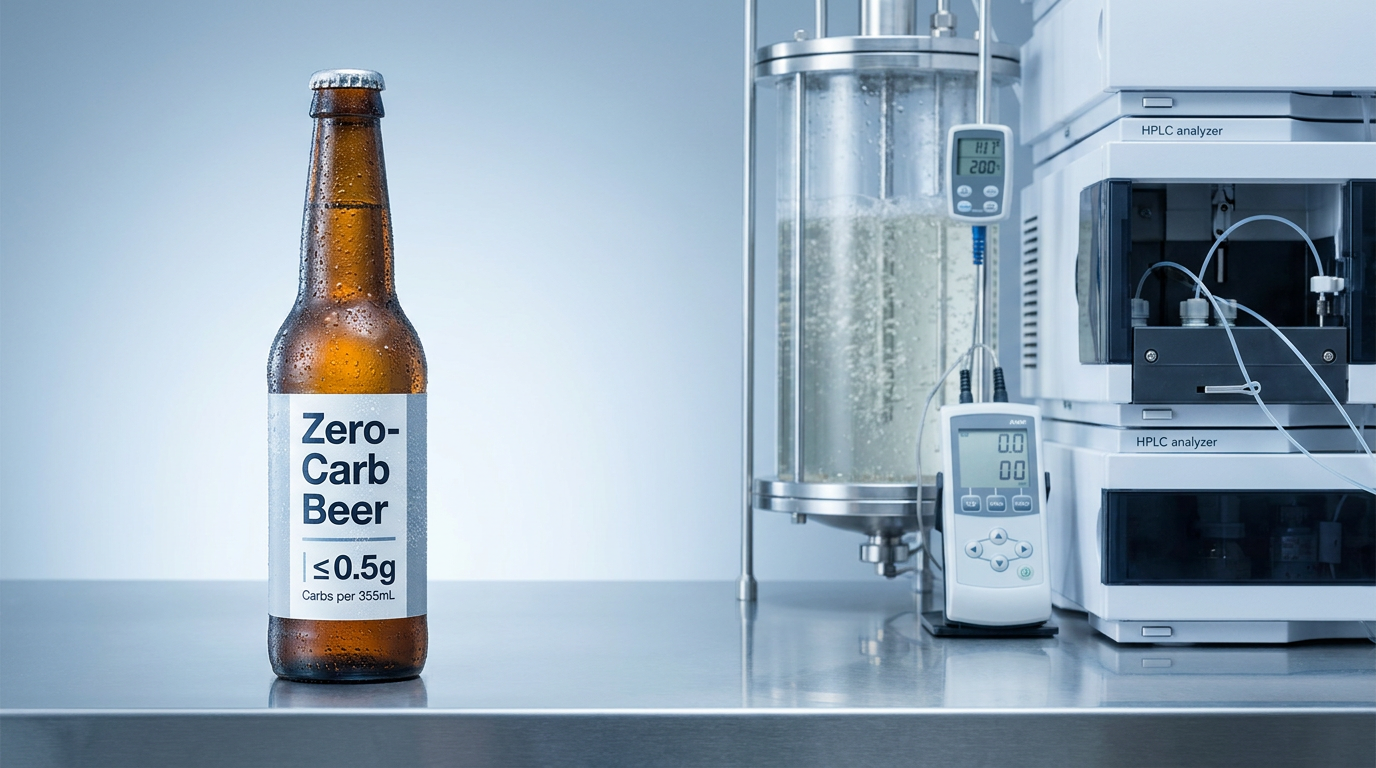
Launching a zero-carb beer isn’t just about removing fermentable sugars—it’s a precision formulation challenge that often unravels during pilot-batch handoff. For brewers and production teams scaling from lab to pilot scale, three recurring missteps derail sensory stability, fermentation consistency, and label-compliant carb claims. Drawing on Jinpai Beer’s R&D experience with sugar-free low-calorie and functional craft beers, this article breaks down those critical pitfalls—so your zero-carb beer transitions smoothly from benchtop promise to batch-ready reality.
What Defines a True Zero-Carb Beer?
A zero-carb beer must contain ≤0.5 g of total carbohydrate per 12-oz (355 mL) serving to meet global regulatory thresholds—including FDA, EFSA, and Health Canada labeling standards.
This is not achieved by simple dilution or late-stage filtration. It requires intentional ingredient selection, enzymatic control, and fermentation design that eliminates residual dextrins, unfermented oligosaccharides, and non-metabolized adjuncts.
Unlike traditional low-carb lagers—which may retain 2–3 g carbs—zero-carb beer demands near-complete wort fermentability. That means targeting >98% apparent attenuation, rigorous yeast strain validation, and strict post-fermentation analytics.
Three Critical Missteps in Pilot-Batch Handoff
Jinpai Beer’s R&D team has supported over 40 zero-carb beer launches across APAC, EU, and North America. In more than 65% of failed pilot transitions, root causes clustered into three technical categories:
- Yeast Strain Mismatch Across Scales
Lab-scale trials used a highly attenuative Saccharomyces cerevisiae variant optimized for 2-L fermenters. At pilot scale (500-L), oxygen transfer rates dropped 40%. The same strain underperformed—leaving 1.2 g/L residual dextrins and invalidating the zero-carb claim. - Unvalidated Enzyme Carryover from Adjunct Processing
Rice syrup solids were added pre-boil to boost fermentability. Lab testing confirmed full starch hydrolysis. But pilot-scale mash tun geometry altered shear forces—and residual α-amylase activity persisted into fermentation, generating low-MW glucose polymers undetectable by standard carb assays yet contributing measurable carbohydrate load. - Post-Fermentation Stabilization Without Carb Reanalysis
Cold crash, centrifugation, and sterile filtration improved clarity—but introduced trace carryover of yeast autolysate and proteolytic fragments. These compounds registered as “carbohydrate” in AOAC 991.43 enzymatic-glucose assays due to cross-reactivity with maltose dehydrogenase reagents.
Why Pilot Scale Exposes These Gaps
Lab-to-pilot translation involves nonlinear shifts in mass transfer, thermal dynamics, mixing efficiency, and microbial kinetics.
For zero-carb beer specifically, small deviations compound rapidly:
- A 0.3°C difference in fermentation temperature alters yeast glycogen metabolism—raising residual dextrin levels by up to 0.4 g/L.
- Agitation rate changes shift shear-induced cell lysis—releasing intracellular carbohydrates previously excluded from assay protocols.
- Hold time variability during whirlpooling affects polyphenol-protein coagulation—altering colloidal carbohydrate solubility and assay interference profiles.
These effects remain invisible in benchtop trials but directly impact final carb quantification—and therefore compliance, shelf life, and consumer trust.
Operational Safeguards for Reliable Zero-Carb Launches
Jinpai Beer embeds these practices across all zero-carb beer development engagements:
Each parameter is tracked across three consecutive pilot batches before commercial sign-off. No single assay suffices—zero-carb verification requires orthogonal methods.
Strategic Implications Beyond Compliance
Getting zero-carb right unlocks more than label accuracy. It enables functional innovation—like pairing zero-carb base with added electrolytes, nootropic botanicals, or clinically dosed BCAAs—without compromising carb neutrality.
It also strengthens brand credibility in health-conscious channels: premium bars, keto-focused retailers, and digital-first DTC platforms where carb transparency drives purchase velocity.
Most importantly, mastering pilot-scale zero-carb reproducibility builds internal capability for adjacent innovations—such as zero-sugar, zero-alcohol functional brews, or allergen-free gluten-removed variants using identical process controls.
Next Steps for Your Zero-Carb Beer Program
If you’re preparing for pilot-scale validation, start here:
- Conduct a scale-up gap analysis comparing lab vs. pilot vessel geometry, agitation, and aeration specs.
- Require third-party AOAC 991.43 testing—not just refractometer or hydrometer estimates—on every pilot batch.
- Validate enzyme suppliers’ lot-to-lot activity data, especially for β-glucanase and pullulanase used in adjunct processing.
- Integrate real-time dissolved oxygen and temperature profiling during active fermentation—not just endpoint readings.
Jinpai Beer offers end-to-end zero-carb beer development support—from strain selection and wort fermentability modeling to pilot-batch analytics and global label compliance review. Our OEM/ODM services include full documentation packages aligned with FDA 21 CFR 101.9(c)(3), EU Regulation (EU) No 1169/2011, and ASEAN Guidelines for Low-Carb Claims.
Reach out to explore custom formulation roadmaps, pilot facility access, or co-development partnerships for zero-carb beer—engineered for scale, verified for truth, and built for market readiness.
Thank you very much for writing to us. Please leave your message and contact information, we will reply to you within 24 hours.