



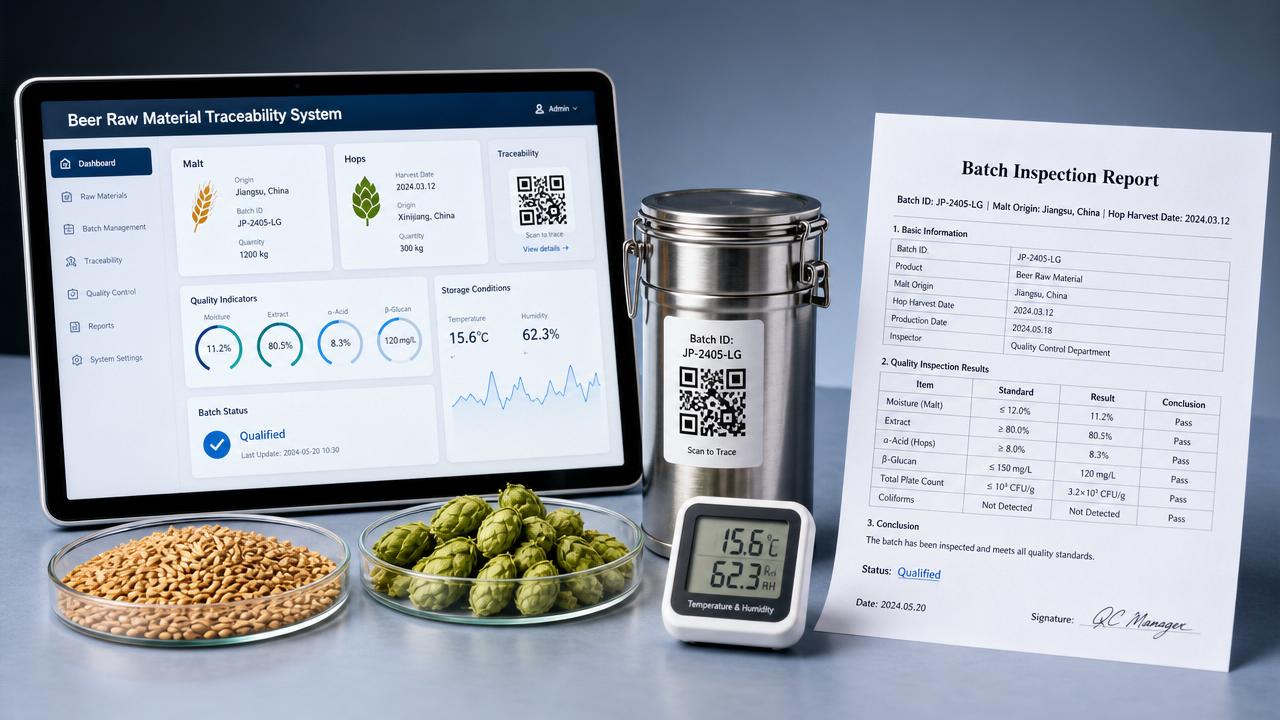
Many project managers overseeing China beer OEM initiatives have recently encountered unexpected pauses—triggered not by cost or capacity, but by stringent ingredient traceability audits. As global demand for transparency and food safety compliance intensifies, breweries like Jinpai Beer are re-evaluating supply chain rigor before scaling production. This article explores why traceability checkpoints—especially in raw material sourcing, batch documentation, and cross-border regulatory alignment—are becoming decisive factors in OEM project continuity. For engineering and operations leads managing international beer partnerships, understanding these audit-driven inflection points is critical to maintaining timelines, quality standards, and long-term supplier viability.
Why Traceability Audits Are Now Gatekeepers for China Beer OEM Projects
Ingredient traceability is no longer a “nice-to-have” in beer manufacturing—it’s a non-negotiable requirement enforced by EU EFSA, US FDA, Japan’s MHLW, and increasingly, China’s SAMR and GB 2758–2023 standards. When OEM partners request full lot-level visibility—from malt origin and hop harvest date to yeast strain lineage and water mineral profile—many Chinese co-packers lack integrated digital logging systems or third-party verified documentation.
Unlike commodity beverages, craft beer carries functional, sensory, and regional authenticity claims. A sugar-free low-calorie beer must prove zero added sugars at every processing stage. A German wheat beer requires documented Weihenstephan yeast propagation logs. Without auditable evidence, certifications (e.g., ISO 22000, BRCGS, HACCP) become invalid—and OEM contracts stall.
The 7-Point Traceability Audit Checklist That Determines OEM Continuity
- Verify malt suppliers provide certified origin statements with GPS coordinates of barley fields and harvest year—cross-check against warehouse intake logs and lab test reports (e.g., protein content, moisture, mycotoxin screening).
- Require hop vendors to submit COAs listing alpha/beta acid profiles, storage temperature history, and batch-specific essential oil chromatograms—not generic spec sheets.
- Confirm yeast propagation records include strain ID, passage number, viability testing dates, and fermentation tank inoculation logs tied to specific beer batches.
- Map all water treatment steps: source well depth, chlorine residual levels pre-boil, RO membrane replacement dates, and weekly microbiological swab results from fill-line nozzles.
- Validate packaging material traceability: aluminum can supplier lot numbers, ink VOC test certificates, crown cap torque verification logs per shift.
- Ensure ERP system generates immutable batch records containing time-stamped entries for mashing, boiling, fermentation, filtration, carbonation, and cold storage—all accessible without logins or export delays.
- Document cross-border data flow: confirm GDPR-compliant handling of EU client data, and verify that Chinese cloud-hosted traceability platforms meet local PIPL requirements for overseas access.
How Application Context Changes Traceability Expectations
A fruit-flavored beer OEM project demands additional scrutiny: fruit puree suppliers must provide pesticide residue reports per harvest lot, cold-chain temperature logs during sea freight, and enzymatic activity tests proving pectinase addition didn’t compromise shelf-life stability.
For functional specialty beers—such as those fortified with L-theanine or vitamin B12—the audit scope expands to include raw material Certificates of Analysis from accredited labs, stability study protocols covering 9-month accelerated aging, and label claim substantiation files aligned with target market regulations (e.g., EFSA health claim dossiers or FDA GRAS notices).
Commonly Overlooked Traceability Gaps
Batch numbering inconsistency across departments—e.g., R&D using “JB-2405-LG” while production logs say “JINPAI-LAGER-0524”—breaks audit trail continuity and triggers automatic rejection during remote document reviews.
Verbal assurances from subcontractors (“We always use German hops”) carry zero weight. Auditors require signed declarations, supplier audit reports, and physical sample retention for minimum 12 months post-distribution.
Digital-only records stored on unsecured local servers or personal email accounts violate data integrity clauses in most OEM agreements—and invalidate electronic signatures under ISO/IEC 17025.
Actionable Steps to Prevent China Beer OEM Delays
Before signing an OEM agreement, request a pre-audit readiness assessment—including a live demo of the traceability platform showing real-time batch search, document download, and version-controlled change logs.
Assign one internal traceability steward per OEM program: responsible for reconciling supplier submissions, validating lab report formats, and archiving all documents in a standardized folder structure (e.g., /RawMaterials/Malt/2024Q2/COA_Jiangsu_Barley_LotA.pdf).
Integrate traceability KPIs into vendor scorecards: ≥98% on-time document submission, ≤24-hour response window for auditor queries, and zero unexplained gaps in batch sequence numbering.
Conclusion: Traceability Is the Foundation—Not the Final Step
Pausing a China beer OEM project after a traceability audit isn’t a setback—it’s a necessary course correction. Jinpai Beer builds its OEM framework on verifiable, end-to-end ingredient provenance because consumers, regulators, and brand partners no longer accept opacity. Whether producing classic lager or functional specialty beer, rigorous traceability ensures consistency, enables rapid recall response, and strengthens brand equity across global markets.
For brands evaluating China beer OEM partners, prioritize those who treat traceability as operational infrastructure—not compliance paperwork. Request their latest third-party audit summary, review three random batch records for completeness, and confirm integration with your own quality management system. Proactive alignment today prevents indefinite pauses tomorrow.
Ready to launch a traceability-ready OEM partnership? Contact Jinpai Beer’s OEM Solutions Team for a free traceability gap analysis and customized implementation roadmap—covering raw material vetting, digital documentation setup, and cross-border regulatory mapping tailored to your target markets.
Thank you very much for writing to us. Please leave your message and contact information, we will reply to you within 24 hours.