



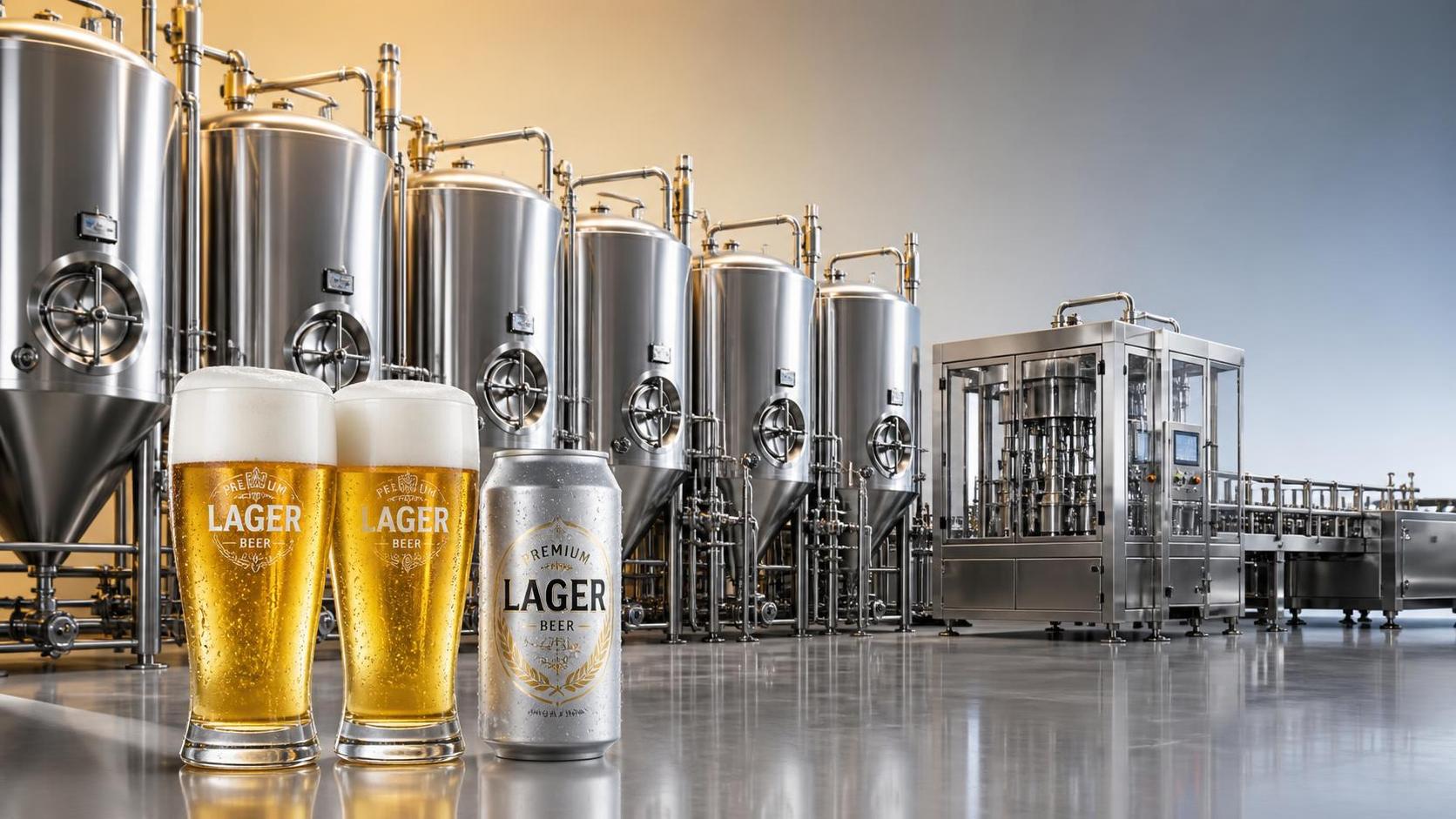
Choosing a High-concentration lager beer contract manufacturer is not mainly about who can brew the most volume. For most buyers, the real concern is whether the manufacturer can keep flavor, aroma, mouthfeel and stability consistent from pilot batch to commercial shipment. If the product tastes different from one order to the next, brand trust weakens quickly, especially in export, retail and multi-channel distribution.
That is why flavor consistency should be treated as a technical and commercial issue at the same time. A qualified manufacturing partner needs the right brewhouse capability, yeast management, raw material control, process discipline and packaging standards. In high-concentration lager production, small variations often become more visible after dilution, filtration, storage and transport, so consistency requires tighter systems than many buyers first expect.
The good news is that consistency can be evaluated before cooperation begins. Buyers comparing OEM or ODM suppliers can look at recipe development methods, batch control procedures, sensory testing, shelf-life verification and communication workflows. These factors reveal whether a manufacturer can support long-term product repeatability rather than only complete a one-time production order.
Why flavor consistency matters more in high-concentration lager production
High-concentration lager is brewed at a higher original gravity than standard lager, then managed through a process that may include adjustment, maturation and packaging controls to reach the target finished profile. This approach can improve production efficiency and logistics flexibility, but it also increases technical sensitivity across the brewing chain.
In a regular beer program, slight movement in malt balance, hop utilization or fermentation performance may remain within an acceptable range. In a high-concentration system, those same shifts can affect alcohol perception, bitterness sharpness, sweetness balance and body more noticeably. The result is not always a defective beer, but it may no longer taste like the same product.
For brand owners, that difference matters. Restaurants want repeatable pours, supermarkets want fewer complaints, and distributors want a product that performs consistently across markets and storage conditions. A dependable High-concentration lager beer contract manufacturer protects not only liquid quality, but also sales continuity, consumer confidence and the credibility of the brand behind the label.
What buyers are really evaluating when they compare contract manufacturers
Most information-stage buyers are not yet selecting packaging artwork or final shipment terms. They are trying to judge risk. They want to know whether the manufacturer can reproduce the same beer profile across batches, whether scale-up will alter the drinking experience, and whether technical claims are backed by real operating systems.
They also want clarity on practical questions. Can the supplier manage multiple SKUs? How stable is the beer during transport? What happens if raw material lots change? How are deviations recorded and corrected? These questions are more useful than broad claims about quality, because they show how a factory behaves under normal commercial pressure.
Another common concern is whether customization will weaken consistency. Many buyers need private-label or market-specific formulas, including sugar-free, low-calorie, fruit-flavored or functional variants. A strong OEM or ODM brewery should be able to customize responsibly while preserving core process control, rather than improvising from project to project.
How brewing technology affects batch-to-batch consistency
The first technical checkpoint is the brewhouse itself. A manufacturer needs equipment that delivers stable mash temperature control, predictable wort concentration, repeatable boiling performance and accurate timing. In high-concentration lager brewing, variation at the hot side often carries through the whole process, even if later corrections are attempted.
Automation also matters, but only when it is paired with process discipline. Digital controls can help manage temperature curves, dissolved oxygen, transfer timing and cleaning cycles. However, technology does not replace good brewing practice. Buyers should look for a supplier that can explain how its systems reduce variation at each stage, not just list equipment specifications.
Fermentation management is equally important. Lager yeast is highly sensitive to pitching rate, oxygen level, nutrient condition and temperature stability. If yeast vitality drifts, the beer may show differences in ester expression, sulfur notes, attenuation or finish. Those shifts can be subtle in one batch and obvious in the next, especially in clean lager styles.
Maturation and clarification complete the picture. High-concentration lager often depends on careful conditioning to smooth alcohol edges, unify flavor and improve drinkability. If maturation time is shortened for scheduling reasons, the beer may still meet analytical targets while tasting less integrated. That is a major warning sign for buyers focused on long-term consistency.
Ingredient control is one of the clearest indicators of manufacturing reliability
Even excellent brewing equipment cannot compensate for unstable raw materials. Malt, hops, yeast and water treatment inputs all shape flavor consistency. A capable contract manufacturer should have clear supplier standards, incoming inspection procedures and lot-traceability records. Without these basics, consistency becomes dependent on luck rather than management.
Malt quality affects fermentability, color, foam, body and flavor tone. If protein levels, extract performance or modification differ too much between lots, the beer may not respond the same way in mashing and fermentation. Buyers do not need every lab detail, but they should expect evidence that the manufacturer adjusts process parameters based on actual raw material behavior.
Hop management is another key factor. Alpha acid value, aroma intensity and storage condition all influence sensory outcome. In high-concentration lager, bitterness balance can become harsh or thin if hop additions are not recalibrated correctly. A reliable partner monitors these variables and updates dosage methods instead of applying a fixed formula mechanically.
Yeast may be the most underestimated variable. Consistency depends on strain integrity, generation tracking, propagation hygiene and retirement standards. A professional brewery should be able to describe how it monitors yeast health and decides when to reuse or replace it. This directly affects flavor cleanliness, attenuation stability and repeatable lager character.
Why quality systems matter more than marketing claims
Many suppliers say they prioritize quality, but buyers need to know how quality is measured. A serious manufacturer uses linked systems: standard operating procedures, in-process checks, finished beer analysis, microbiological monitoring and sensory evaluation. These create a repeatable control loop that catches drift before it becomes a market problem.
For high-concentration lager, analytical testing should include more than alcohol and extract. Dissolved oxygen, bitterness, color, pH, carbonation and microbiological status all affect shelf performance and flavor retention. If a factory cannot explain which indicators are tracked at different stages, it may struggle to manage the product consistently at scale.
Sensory testing is especially important because not every flavor issue appears clearly in lab numbers. Structured tasting by trained staff can detect sulfur imbalance, oxidation, green notes, sweetness shift or thinning body before shipment. Buyers should ask how sensory panels are organized, how reference standards are maintained and how disagreements are resolved.
Corrective action procedures also reveal maturity. No production system is perfect, but professional manufacturers document deviations, investigate causes and update controls. Buyers gain confidence when a supplier can explain what happens after an out-of-spec result. That response often matters more than the promise that problems never occur.
Scale-up risk: why pilot success does not guarantee commercial consistency
One of the most common misunderstandings in OEM and ODM beer projects is assuming that a good sample batch guarantees a stable commercial product. In reality, scale changes heat transfer, hop extraction, fermentation dynamics, filtration behavior and packaging performance. A sample can be excellent while large-scale output still drifts.
This is why process translation matters. An experienced High-concentration lager beer contract manufacturer should have a documented method for moving from development to production. That includes pilot verification, commercial trial criteria, target specification ranges and release standards. The goal is to preserve the intended profile, not simply reproduce the recipe on a larger system.
Buyers should also ask whether the manufacturer has produced similar beer styles before. Experience with classic lager, wheat beer, low-calorie beer or flavored beer can be valuable, but style-specific familiarity still matters. High-concentration lager has its own process demands, and previous success in adjacent categories does not automatically transfer.
When evaluating samples, request comparison across more than one batch if possible. A single good sample proves potential; repeat samples prove control. This is one of the simplest ways for information-stage buyers to separate capable long-term partners from suppliers who mainly perform well during early negotiations.
Packaging and logistics can either preserve or weaken consistency
Flavor consistency is not secured when brewing ends. Beer can lose freshness or develop instability during filtration, filling, storage and transport. Oxygen pickup, sealing quality, temperature exposure and light protection all influence what the customer ultimately tastes. A technically strong brewery must control the full chain, not only the brewhouse.
For canned and bottled lager, dissolved oxygen management is critical. Even small oxygen increases can reduce hop freshness, flatten malt definition and accelerate stale notes. Buyers should ask about line performance, oxygen targets and package integrity checks. This is particularly important for export programs and extended distribution channels.
Packaging choice also affects market performance. Some projects require cans for convenience and channel compatibility, while others need glass bottles for positioning or regional preference. The manufacturer should be able to explain how packaging format influences shelf life, sensory retention and transport risk, then match the recommendation to the actual sales scenario.
Logistics coordination matters as well. Beer that leaves the factory in good condition can still suffer if warehouse turnover is slow or shipping temperatures are uncontrolled. Buyers should look for partners who understand export handling, inventory rhythm and practical shelf-life planning, especially when supplying supermarkets, bars and international retail networks.
Questions to ask before choosing a high-concentration lager beer contract manufacturer
A useful evaluation process starts with direct, technical questions. Ask how the brewery defines target flavor specifications, how often batches are compared against retained references, and how formulation changes are approved. These questions move the discussion away from generic capability claims and toward proof of operational control.
Ask about raw material substitution policy. If a hop lot changes or a malt source becomes unavailable, what is the procedure? A reliable supplier should explain how alternatives are validated before use. That answer shows whether the manufacturer protects flavor consistency systematically or reacts only after differences appear in finished beer.
Request information on sample retention, shelf-life testing and complaint tracing. When a market issue arises, the manufacturer should be able to compare the shipped lot with retained samples and production records. This is essential for fast diagnosis and responsible customer support, especially in private-label business where the brand owner bears public accountability.
Finally, ask how communication works during production. Timely updates on batch scheduling, test results, packaging status and shipment readiness reduce commercial uncertainty. Strong manufacturing partnerships depend on transparent communication as much as technical strength, because buyers need to make inventory, channel and launch decisions with confidence.
What a strong long-term manufacturing partner looks like
The best partner is not simply the one with the lowest quote or the broadest catalog. It is the one that can combine product development flexibility with disciplined execution. In beer categories ranging from classic lager and German wheat to sugar-free, fruit-flavored and specialty functional styles, repeatability is what turns manufacturing into a scalable business asset.
For buyers working across wholesale, retail, foodservice and export channels, this matters even more. Channel expansion exposes products to wider storage conditions, different turnover speeds and more consumer touchpoints. If flavor consistency is weak, those variables magnify the problem. If consistency is strong, the brand gains resilience as distribution grows.
A brewery with real OEM and ODM strength should be able to support formulation, scaling, packaging selection and supply coordination while keeping the beer aligned with agreed sensory and technical standards. This balance is what differentiates a factory that can fill orders from one that can support brand building over time.
Conclusion
When assessing a High-concentration lager beer contract manufacturer, buyers should focus on one central question: can this partner deliver the same drinking experience reliably, batch after batch, at commercial scale? Capacity matters, but consistency is what protects product reputation, channel performance and long-term customer trust.
The answer depends on more than recipe design. Brewing technology, ingredient control, yeast management, quality systems, scale-up method, packaging discipline and logistics planning all influence the final result. The most dependable manufacturers are those that can explain these controls clearly and demonstrate them with records, samples and process transparency.
For information-stage readers comparing OEM or ODM options, the practical takeaway is simple. Look past general quality language and evaluate the systems behind consistency. That is the clearest way to identify a manufacturing partner capable of producing stable, market-ready high-concentration lager that supports both immediate supply needs and future brand growth.
Thank you very much for writing to us. Please leave your message and contact information, we will reply to you within 24 hours.