



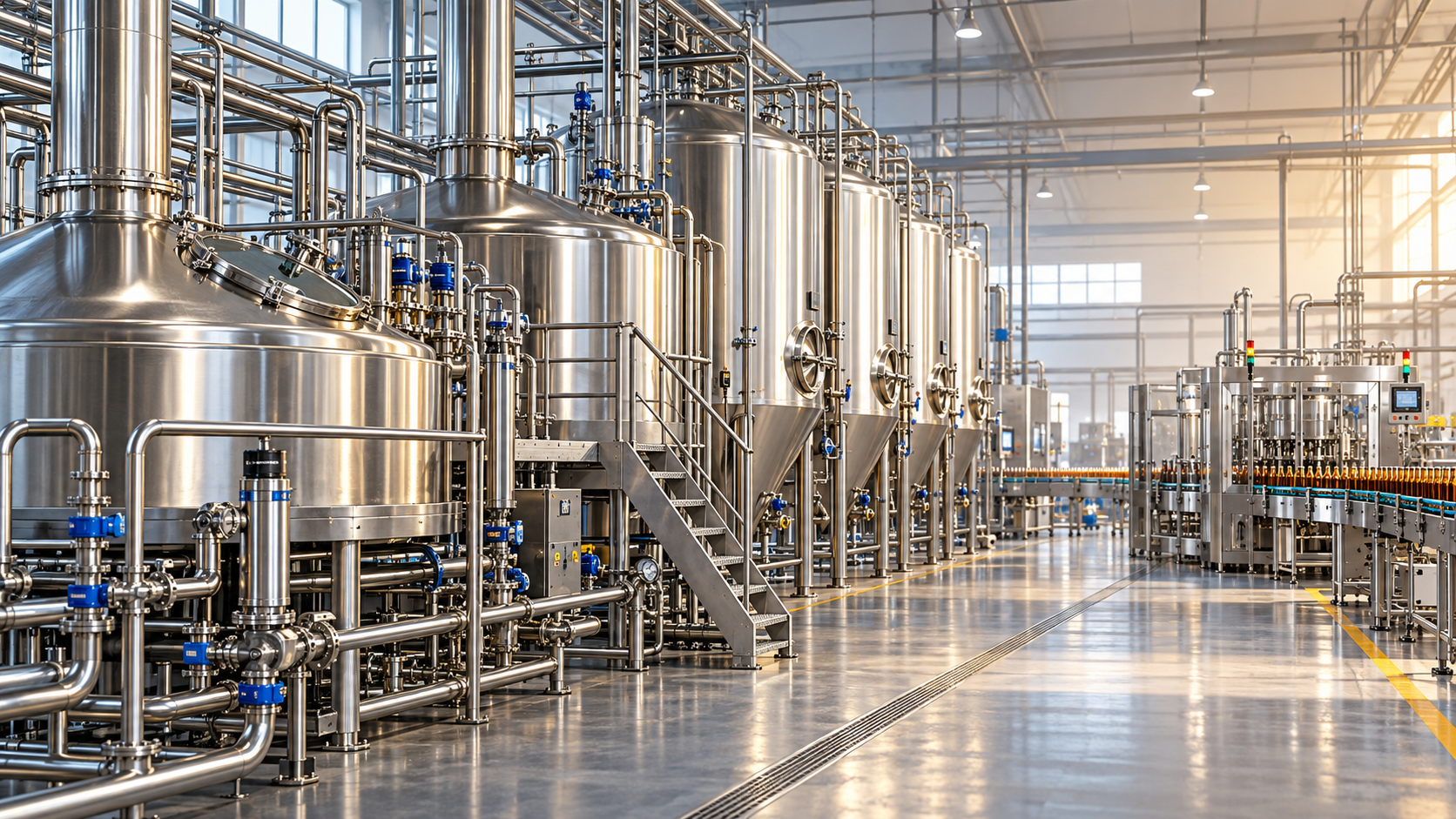
Building a beer factory requires more than a budget for brewing equipment. Land, construction, utilities, licensing, labor and working capital all shape the investment—and the final number depends heavily on what the factory is expected to produce. A facility designed around classic lager, for example, may have different tank and storage requirements from one focused on fruit-flavored or specialty beers.
For financial decision-makers, the central question is not simply “How much does a beer factory cost?” It is whether the proposed capacity, product mix and route to market can support the full cost of ownership. A credible assessment starts with the production plan and follows the money through construction, commissioning and the first years of operation.
Start with the production plan, not the equipment quote
A supplier can provide a brewhouse price quickly, but that figure is only useful when it matches a defined operating model. Before requesting quotations, establish the expected annual sales volume, package formats and number of products. Then translate those assumptions into production requirements, allowing for seasonal demand, downtime, cleaning and the time beer spends in tanks.
Annual output alone can conceal important differences. Two projects with the same sales target may need different equipment if one runs a limited schedule while the other operates multiple shifts. A business serving bars in kegs will also have a different packaging and distribution profile from one supplying supermarkets with cans or bottles.
For approval purposes, ask the project team to document:
- Forecast sales by product, package and channel, with a realistic ramp-up period.
- Planned brewing frequency, operating days and shift pattern.
- Fermentation, conditioning and storage time for each major beer style.
- Expected losses during brewing, transfer and packaging.
- Room for expansion without assuming that future demand is guaranteed.
These assumptions determine whether the proposed beer factory is sized for actual demand or for an optimistic headline capacity. Excess capacity can tie up capital; insufficient capacity can lead to overtime, outsourced production or an expensive redesign.
Where the investment goes
The largest visible purchases are often the brewhouse and packaging line. Yet a complete project includes assets and services that may not appear in an early equipment proposal.
Buildings and utilities can change the economics
A low-cost building is not necessarily a low-cost brewery site. The facility must accommodate production equipment, wet cleaning, raw materials, finished goods and safe movement of people and vehicles. Existing drainage, ceiling height and utility connections may be unsuitable even when the floor area looks adequate.
Water deserves particular attention. Beyond its role as an ingredient, it is used for cleaning and other operations, while wastewater must be managed according to local requirements. Heating and refrigeration loads also depend on the process and production schedule. An equipment quotation that excludes utility generation or connection work can leave a substantial gap in the project budget.
Before approving a site, obtain technical assessments and location-specific estimates for utility capacity, wastewater discharge and required building work. Verify who is responsible for supplying each connection and whether upgrades depend on external providers or permits.
Packaging choices have consequences beyond the line itself
Kegs may suit a business focused on bars and restaurants, while cans or bottles may be more appropriate for retail distribution. Each choice carries different equipment, material, storage and handling requirements. Multiple formats add commercial flexibility, but they can also introduce changeovers, more inventory items and additional quality-control steps.
Compare packaging options on a delivered-cost basis rather than equipment price alone. Include containers, labels, cartons, labor, line losses, warehousing and transport. For returnable kegs, consider collection, cleaning, tracking and the capital tied up while containers are in circulation.
How beer styles affect factory costs
Product strategy is a financial decision as much as a marketing one. Classic lager and German wheat beer do not necessarily occupy tanks for the same length of time or require identical handling. Longer residence times can reduce the number of batches a tank supports, making cellar capacity a constraint even when the brewhouse itself has spare capacity.
Fruit-flavored beers introduce decisions about ingredient preparation, dosing, storage and consistency between batches. Sugar-free or low-calorie products may require a carefully controlled recipe and process, along with testing to support any claims made in the intended market. Functional specialty beers can raise further questions about ingredient compatibility, stability and the rules governing product descriptions.
None of these categories automatically requires a particular machine or guarantees a higher cost. The point is to have the technical team define the process before capital is committed. Ask equipment suppliers to identify which products their proposed configuration can produce, which assumptions underpin that assessment and what modifications would be needed if the range changes.
Separate project cost from the cost of operating
A beer factory may fit within its construction budget and still struggle financially after launch. Ingredients, packaging, labor, utilities, maintenance, quality testing, insurance, logistics and sales expenses continue regardless of how attractive the original equipment price was. Some costs vary with volume; others remain even when the facility is underused.
Prepare an operating model that distinguishes variable production costs from fixed or relatively fixed expenses. Include expected production losses and the practical cost of holding ingredients and finished beer. Where duties, taxes or regulatory charges apply, model them for each target market rather than treating them as an afterthought.
Working capital is especially easy to underestimate. Suppliers may require payment before beer is sold, while distributors or retailers may pay later. At the same time, product can be tied up in fermentation, conditioning, packaging and transit. The launch budget should cover this cash cycle as well as the ramp-up period, when production volumes and sales may be uneven.
Model utilization, not just installed capacity
Installed capacity describes what the equipment can potentially produce under specified conditions. Utilization describes how much of that capacity the business actually uses. A factory with low utilization spreads fixed costs over fewer units, increasing the cost per unit even if ingredients and packaging remain unchanged.
Test the business case under several sales outcomes, including a slower launch. For each case, show volume, selling price, variable cost, fixed operating expense and the resulting cash requirement. Identify the sales level at which contribution covers fixed operating costs, while keeping financing costs, taxes and capital recovery visible in the broader investment analysis. This makes the decision less dependent on a single forecast.
Compare quotations on the same scope
Two proposals for a beer factory may appear to cover the same capacity while allocating responsibilities very differently. One supplier may include installation and commissioning; another may quote equipment only. Controls, cleaning systems, piping, spare parts, freight and training can also be included, excluded or left ambiguous.
Create a scope matrix before comparing prices. For every major item, record whether it is included, the specification, the delivery boundary and the party responsible for integration. Pay particular attention to:
- Capacity basis: Batch size, operating schedule, product assumptions and any stated performance conditions.
- Site work: Foundations, drainage, electrical distribution, utility connections and building alterations.
- Integration: Process piping, controls, interfaces between equipment packages and installation supervision.
- Acceptance: Testing procedures, documentation, training and the conditions for handover.
- Commercial exposure: Payment milestones, freight, duties where applicable, currency exposure and warranty terms.
Use a documented contingency for identified uncertainties, rather than treating contingency as an unexplained percentage added at the end. Its purpose is to cover risks that remain after the scope has been developed—not to compensate for equipment or services known to be missing.
Building versus outsourcing: compare the cash commitments
Owning production offers direct control over assets and operations, but it also requires capital, management attention and ongoing utilization. For a company entering a market or testing a new range, OEM or ODM production may provide an alternative to building immediately. Wholesale supply is another option when the commercial need is to source existing products rather than develop a proprietary range.
The comparison should go beyond the quoted production price. For an outsourced model, review product specifications, order terms, packaging, quality responsibilities, logistics and the treatment of recipes or other intellectual property. For an owned factory, include depreciation in profitability analysis and capital expenditure and debt service in cash-flow planning, without counting the same capital cost twice.
A staged approach may also be worth considering: use external production while demand develops, then reassess ownership when volumes and product requirements are clearer. The decision depends on the business’s priorities, including control, available capital, supply requirements and the reliability of its sales forecast.
Jinpai Beer offers OEM/ODM services, wholesale supply and customized solutions across a range that includes lager, German wheat, low-calorie, fruit-flavored and specialty beers. For buyers evaluating outsourced supply alongside a beer factory investment, discussing the intended products, packaging and distribution channels can help establish what information is needed for a like-for-like comparison.
What should be in the approval package?
A strong investment proposal connects commercial demand to technical scope and then to cash flow. It should show the assumptions behind the capacity calculation, a complete capital-cost estimate, a site and utility assessment, an operating model and a funding plan through launch. Supplier quotations should be reconciled to the scope so that exclusions are visible.
Decision-makers should also see the consequences of being wrong: slower sales, a longer commissioning period, higher utility costs or changes to the product mix. Where those risks materially affect the result, the proposal should identify a practical response, such as delaying a packaging investment, securing alternative supply or revisiting the site.
The cost of building a beer factory is ultimately determined by the factory’s intended role in the business. The most useful figure is not the lowest equipment quote; it is the fully scoped investment and operating cost required to deliver the right beer, in the right format, at a volume the market can support.
Thank you very much for writing to us. Please leave your message and contact information, we will reply to you within 24 hours.