



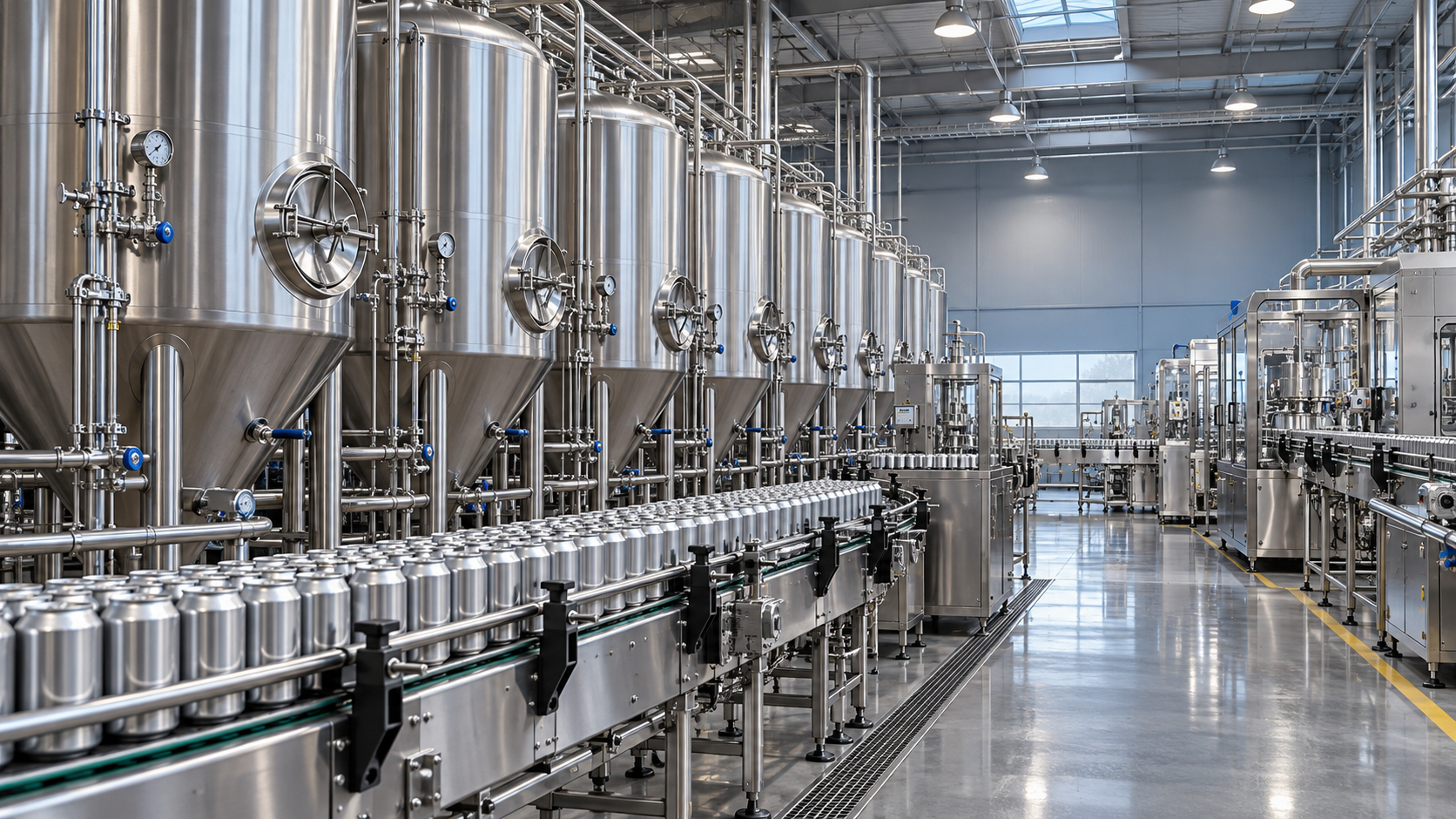
Assessing a beer factory’s production capacity involves more than checking its annual output. For procurement professionals, the right evaluation also considers brewing equipment, packaging capacity, product variety, quality control, and the ability to meet delivery schedules.
These factors are especially important when sourcing craft beer for restaurants, supermarkets, bars, or retail distribution. This guide explains how to assess production capacity and identify whether a supplier can support your order volumes, customization requirements, and long-term growth.
Start With the Capacity Available for Your Order
The most useful capacity figure is not the factory’s maximum annual output. It is the volume available for your products, packaging formats, and delivery dates.
A supplier may have substantial brewing capacity but limited availability during your preferred production window. Existing customer commitments, maintenance, and seasonal demand can reduce usable capacity.
Before contacting suppliers, define your forecast by product, package size, destination, and delivery month. Include expected promotions, seasonal peaks, and the likely frequency of replenishment orders.
Ask each supplier to confirm available production slots against that forecast. Separate an indicative estimate from a reserved slot, which may require an agreed order or deposit.
For example, a factory producing 100,000 hectoliters annually is not necessarily able to supply 5,000 hectoliters of a specific beer in your busiest month.
The relevant question is whether brewing, maturation, packaging, materials, and shipping capacity align within your required timeframe, while allowing for realistic production losses and unexpected delays.
Understand How the Factory Measures Capacity
Beer production capacity is commonly expressed in hectoliters per batch, month, or year. One hectoliter equals 100 liters, so confirm units before comparing supplier figures.
Ask whether reported capacity refers to theoretical equipment output, planned production under normal operating conditions, or actual finished beer produced during a documented period.
Theoretical output assumes equipment runs at its rated speed or maximum cycle rate. It rarely reflects cleaning, changeovers, maintenance, staffing limits, or demand fluctuations.
Actual output is more useful when supported by production records. However, low historical output may reflect limited demand rather than an inability to produce more.
Request both recent monthly output and a realistic forward capacity plan. A monthly view reveals seasonal peaks and constraints that an annual average can conceal.
Compare figures on the same basis: finished, saleable volume in the required package. Brewing volume alone does not account for process losses or packaging restrictions.
Check Brewing and Fermentation Capacity Together
Brewhouse size indicates how much wort the factory can produce per batch, but batch size alone does not determine how much finished beer it can deliver.
Ask about batch volume, brews per day, operating days, and planned downtime. Check whether the stated schedule matches available staff, utilities, and maintenance arrangements.
Fermentation and maturation tanks often determine the pace of production. Their number, working volume, occupancy, and cleaning time affect how frequently batches can be released.
Different beer styles require different tank schedules. A product needing longer maturation can occupy capacity that a faster-turning product would release sooner, reducing monthly output.
Request a tank schedule for a representative month, showing your proposed products alongside existing commitments. This helps identify whether available capacity is genuinely compatible with your order.
Utilities also matter. Insufficient cooling, steam, water treatment, or wastewater capacity can prevent a factory from running its brewhouse and tanks at their nominal limits.
For new recipes, ask whether pilot trials or a first commercial batch will be needed. These steps can affect both capacity allocation and launch timing.
Verify Packaging Capacity for Your Sales Channels
A brewery can have enough finished beer but still miss an order because its canning, bottling, or kegging line cannot meet the required production schedule.
Confirm which packaging formats are produced on site and which are outsourced. For outsourced work, identify the packaging partner and understand how its schedule is secured.
Ask for the line’s rated speed and typical achieved output for your container size. Include downtime, cleaning, product changeovers, label changes, and planned maintenance.
For a simple estimate, multiply achieved units per hour by available production hours, then convert the result into liters. Compare that figure with your order volume.
For example, 8,000 cans per hour over 10 available hours produces 80,000 cans before any additional losses. At 330 milliliters each, that equals 26,400 liters.
This calculation is useful only if the hourly rate already reflects normal stoppages. Otherwise, reduce the estimate using documented efficiency and packaging loss assumptions.
Check whether cans, bottles, caps, labels, cartons, and pallets will be available on time. Customized materials can have longer lead times and separate minimum order quantities.
Finally, confirm finished-goods storage and dispatch capacity. A completed order still needs sufficient warehouse space, loading arrangements, and transport bookings to reach your destination.
Assess Whether Product Variety Will Affect Output
Purchasers sourcing several beer styles should examine how the factory handles recipe changes, ingredient availability, tank scheduling, and packaging changeovers across the full product mix.
A production plan for one lager may look efficient, while an order split across wheat, fruit-flavored, and specialty beers can require additional batches and scheduling flexibility.
Ask the supplier to quote minimum order quantities by recipe and packaging format. Confirm whether those minimums apply per production run, per label, or per order.
For fruit-flavored or other specialty products, discuss ingredient sourcing, flavor consistency, allergen controls where relevant, and whether additional handling affects line availability or cleaning time.
For sugar-free or low-calorie claims, agree on the product specifications and testing approach. Confirm that the proposed claims and labels are permitted in the destination market.
Functional specialty beer claims also need careful review. An ingredient’s presence does not automatically support a health claim, and advertising rules vary by jurisdiction.
For OEM or ODM projects, clarify who owns the recipe, artwork, and specifications. Agree on approval stages before the supplier commits production capacity or purchases materials.
Evaluate Quality Control and Compliance at Scale
Capacity has limited value if increased output compromises consistency. Ask how the beer factory maintains specifications when production volumes rise or multiple batches are blended.
Request the agreed product specification, including relevant targets for alcohol content, flavor, appearance, microbiological quality, and shelf life, as appropriate to the product and market.
Review sampling and testing arrangements for raw materials, brewing, finished beer, and packaging. Confirm which tests are performed internally and which rely on external laboratories.
Ask for batch traceability procedures linking ingredients and packaging materials to finished goods. The supplier should also explain its product hold, complaint, and recall procedures.
Review applicable food safety certifications and audit reports, checking their scope, validity, and coverage of the relevant production site. Certification alone does not guarantee product conformity.
For export orders, agree who is responsible for label review, market-specific documentation, import requirements, and any required laboratory evidence before production begins.
Include acceptance criteria in the supply agreement. Define how nonconforming goods will be investigated, who bears testing costs, and whether replacement, credit, or another remedy applies.
Test Delivery Reliability Against a Realistic Order Plan
Ask the supplier to map the entire order timeline, from forecast and purchase order to ingredient procurement, brewing, maturation, packaging, quality release, and dispatch.
Separate production lead time from total delivery lead time. Customs clearance, international freight, port congestion, and local distribution can add significant time after the beer leaves the factory.
Request evidence of past delivery performance, preferably for comparable products and volumes. Understand how on-time delivery is defined and whether partial shipments count as complete deliveries.
Discuss forecast accuracy and the notice required for changes. A supplier may accommodate small volume adjustments but need more time for new recipes or printed packaging.
For seasonal peaks, agree on reservation deadlines and material commitments. Consider whether a rolling forecast, safety stock, or phased deliveries would reduce the risk of shortages.
Clarify the agreed delivery terms, handover point, and responsibilities for freight, insurance, and customs. These details affect both landed cost and control over delivery timing.
Ask for Evidence Before Making a Capacity Commitment
A supplier’s presentation is a starting point, not proof of available capacity. Request documents that show how its stated figures relate to actual operations and your requirements.
Useful evidence includes recent monthly production totals, equipment lists, packaging performance records, maintenance schedules, and an indicative production plan for your proposed order.
During a site visit or remote audit, verify key equipment and ask operators how changeovers, cleaning, quality checks, and unplanned downtime affect the daily schedule.
Check whether the site shown in the documents is the site that will produce your beer. If subcontractors are involved, assess their roles and controls too.
Commercial confidentiality may limit access to customer schedules. In that case, ask for a redacted capacity plan or a written confirmation tied to your forecast.
A trial order can test communication, quality, documentation, and delivery performance. It does not by itself prove the supplier can sustain a much larger recurring volume.
Before scaling up, review the trial results and obtain a revised production plan. Make sure the proposed increase does not depend on unconfirmed equipment or hiring.
Compare Suppliers Using Cost, Capacity, and Risk
Evaluate suppliers against the same forecast and specifications. A low unit price is less attractive if minimum orders, freight, inventory, or delayed launches increase total cost.
Compare quoted prices alongside tooling or artwork charges, testing fees, packaging minimums, payment terms, and any costs associated with holding stock or reserving capacity.
Consider the impact of each supplier’s constraints on your business. A supermarket promotion may require a firm delivery window, while a bar group may prioritize flexible replenishment.
For important products, discuss contingency plans for equipment breakdowns, material shortages, and rejected batches. Ask what recovery time is realistic and how customers will be informed.
Where continuity is critical, consider qualifying a second source or keeping agreed safety stock. Check whether a backup supplier can reproduce the recipe and packaging specifications.
Document the final decision in a scorecard covering available capacity, quality, delivery, customization, total landed cost, and risk. Weight each category according to your purchasing priorities.
Questions to Discuss With a Potential Beer Factory Partner
When discussing an order with Jinpai Beer, buyers can outline their target beer styles, sales channels, forecast volumes, packaging preferences, destination markets, and desired launch dates.
Jinpai Beer offers craft beer products and OEM and ODM services for wholesale and customized supply. Buyers should request project-specific quotations, specifications, lead times, and capacity confirmation.
For distributors, restaurants, supermarkets, bars, and retailers, the discussion should also cover minimum order quantities, artwork approval, documentation, and the process for managing future volume increases.
Conclusion: Make the Decision on Deliverable Capacity
A capable beer factory is one that can produce your specified beer, pack it correctly, meet agreed quality standards, and deliver the required volume on schedule.
Use annual output as context, then verify monthly availability across brewing, tank space, packaging, materials, and logistics. Support the decision with records, realistic forecasts, and clear contract terms.
The strongest supplier choice is not necessarily the largest facility. It is the partner whose demonstrated capacity and operating practices match your order today and foreseeable growth.
Thank you very much for writing to us. Please leave your message and contact information, we will reply to you within 24 hours.