



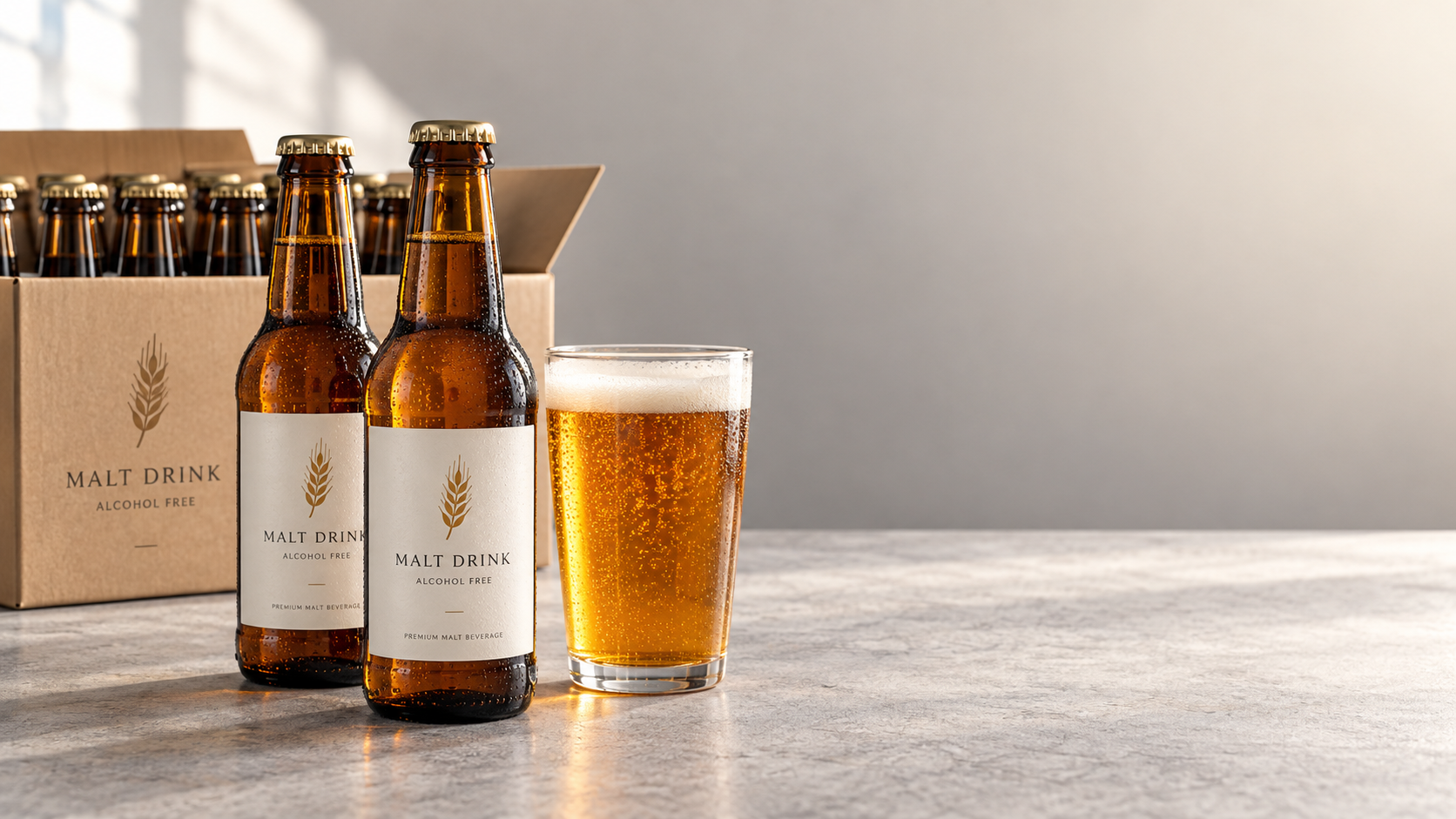
Interest in alcohol-free drinks is not enough to justify a nonalcoholic malt beverage launch. The commercial question is whether a specific product can win a recurring drinking occasion at a price that supports distribution, replenishment and acceptable margins. Trial driven by curiosity can fill an initial order without establishing durable demand.
The strongest assessment separates demand for a beer alternative from demand for a sweet malt refreshment. These products may share ingredients, but they compete against different drinks and attract different expectations. Combining them in one market estimate can make an opportunity appear larger while obscuring which proposition customers will actually buy.
Define the market by the drink being replaced
“Nonalcoholic malt beverage” is not a single, commercially uniform category. It can describe beer-like products with bitterness and fermented character, sweet unfermented malt drinks, or flavored products positioned closer to soft drinks. A market report covering one group may offer little evidence for another.
A useful starting point is a precise proposition: who would drink it, on what occasion, instead of what, and why? A beer-like beverage for weekday dinners faces different competition from a sweet malt drink served with lunch. The former may be evaluated against alcoholic beer and alcohol-free alternatives; the latter against carbonated drinks, juices or other meal accompaniments.
This distinction also changes how competition should be measured. A beverage does not need another malt-based product nearby to face strong substitution. If consumers choose sparkling water for the same occasion, sparkling water belongs in the demand assessment.
Read alcohol-free trends without borrowing their growth
Alcohol moderation, interest in ingredient transparency and the search for satisfying nonalcoholic social drinks are relevant demand hypotheses. None establishes the addressable market for a particular malt beverage. Category-level enthusiasm becomes commercially meaningful only when it connects to a local occasion, an acceptable formulation and a viable route to purchase.
Even a reliable growth figure for alcohol-free beer cannot simply be applied to sweet malt drinks or transferred between countries. Retail classification, cultural familiarity, pricing and distribution can differ substantially. Published market estimates should therefore be checked for category boundaries, geographic coverage, reporting period, and whether they measure volume or value.
Value growth alone is especially easy to misread. Higher prices or a shift toward premium packs can increase sales value without an equivalent increase in consumption. For a new brand, evidence of unit movement, repeat buying and distribution productivity is more useful than a broad headline about category expansion.
A stronger local signal is sustained availability accompanied by replenishment. Multiple products on a shelf demonstrate assortment, not necessarily demand. Products remaining available across repeated observations, receiving renewed orders and selling without continuous deep discounts provide a more meaningful basis for evaluation.
Identify occasions that can produce repeat purchases
Demographic descriptions such as “health-conscious adults” are too broad to guide a launch. They say little about purchase frequency or competitive displacement. Occasion-based research is more actionable: an evening meal without alcohol, a social gathering, a refreshment break, or a familiar accompaniment to food.
Recruit research participants according to recent behavior rather than general interest. Someone who has recently bought an alcohol-free beer or malt drink can explain an actual purchase decision. Someone who merely likes the concept may provide useful feedback, but should not carry the same weight in a demand forecast.
Interviews should establish what was purchased, where, at what price, and what alternative would otherwise have been chosen. Ask what prevented another purchase as well. An unavailable chilled pack, excessive sweetness, weak flavor or an inconvenient multipack can each suppress repeat demand for different reasons.
Also distinguish additional consumption from substitution. If the product replaces an existing drink, it must outperform that alternative on a relevant dimension. If it creates a new occasion, the evidence needs to show that the occasion occurs frequently enough to support replenishment—not simply that consumers can imagine it.
For consumers avoiding alcohol on religious or personal grounds, a beer-like identity may be an obstacle rather than an advantage. Product composition, production method, certification expectations and brand imagery need separate assessment; a nonalcoholic label alone does not establish acceptance.
Audit competitors at the point of purchase
A useful competitor review records more than brand names and retail prices. Capture pack size, price per liter, promotional price, alcohol declaration, sugar and energy information, flavor, shelf location, chilled availability and stock status. Repeat observations help distinguish a temporary promotion from a stable commercial position.
Shelf placement reveals how a retailer expects shoppers to understand the product. Placement beside beer creates one comparison; placement beside soft drinks creates another. Online taxonomy matters too: a product listed under an unexpected category may be technically available but difficult to discover.
Customer reviews can expose formulation and packaging issues, but they are not a representative demand survey. Use them to generate questions—whether the drink tastes too sweet, lacks body or arrives damaged—then test those questions directly. Review counts should not be treated as market-share estimates.
Channel interviews add another layer: whether orders are initial listings or replenishments, what stock remains, and whether sales depend on promotion. Commercial terms may be confidential, but without some understanding of sell-through, shipment figures risk overstating consumer demand.
Test the product and price together
Concept approval is a weak substitute for tasting. In beer-like products, reducing or avoiding alcohol can change body, aroma and flavor balance. Sweet malt drinks face a different challenge: sweetness may support initial appeal while limiting how much consumers want to drink repeatedly. These are formulation questions with direct implications for demand.
A practical research sequence separates sensory response from brand influence. Blind tasting helps establish whether the liquid is competitive. Branded tasting then tests whether the packaging, alcohol statement and positioning improve understanding or create misleading expectations.
Serving conditions should reflect the intended channel. A chilled sample in a tasting session does not represent a product purchased from an ambient shelf and consumed later. Compare the proposed serving size as well; a few favorable sips do not prove that a full can is satisfying.
Price testing should use realistic alternatives and an explicit option to buy nothing. Asking whether a product is “worth” a price invites a different response from asking someone to choose between that product, a familiar competitor and keeping their money. Where feasible, paid trials provide stronger evidence than stated willingness to purchase.
Retail price must also work backward through the channel. Taxes where applicable, importer and distributor economics, retail margin, freight, storage, promotions and expected losses all affect the amount available to cover production and brand costs. A consumer-acceptable price is not automatically a commercially viable price.
Check whether the proposition can survive local requirements
Alcohol-related terminology is jurisdiction-specific. “Nonalcoholic,” “alcohol-free” and “0.0%” should not be treated as interchangeable across markets. Before using consumer research to validate a label, confirm the destination’s applicable product classification, alcohol declaration rules and labeling requirements.
The same applies to low-sugar, low-calorie, functional or religious-certification positioning. Each claim needs an appropriate basis. Removing a claim after concept testing can materially change the proposition, leaving earlier purchase-intent results less useful.
Production method also affects commercial feasibility. Restricted fermentation, dealcoholization and unfermented formulations can produce different sensory profiles and require different stability controls. Low or absent alcohol does not eliminate microbiological risk; process validation, packaging integrity and shelf-life evidence remain necessary.
For cross-border supply, assess remaining shelf life at sale rather than factory shelf life alone. Transit, clearance, warehousing and replenishment buffers consume selling time. A product that performs well in a fresh tasting but cannot retain its intended quality through the distribution cycle has not demonstrated viable demand under launch conditions.
Use a controlled launch to distinguish curiosity from demand
A limited launch should reproduce the intended business model closely enough to expose its weaknesses. Complimentary samples test acceptance, not purchasing. A heavily discounted online campaign tests a promotional offer, not necessarily a sustainable shelf proposition.
Select a limited set of outlets or delivery areas where stock availability, price and promotion can be tracked. Keep the range narrow enough to interpret results. Launching many flavors simultaneously can spread sales across too many stock-keeping units and make it difficult to identify whether the core product has traction.
The most useful measures connect consumer behavior to replenishment:
- Sales per active outlet per week: calculated with in-stock availability visible, so supply interruptions do not masquerade as weak demand.
- Repeat purchase: measured over a period consistent with the expected drinking occasion, rather than an arbitrary short window.
- Reorders: separated from opening orders and checked against remaining inventory.
- Promotion dependence: assessed by comparing supported sales with purchases at the intended regular price.
- Contribution after variable costs: including channel charges, fulfillment, discounts and attributable losses.
Interpret these measures together. Strong trial with weak repeat points toward a product, expectation or occasion problem. Good repeat among a small group but low overall sales may indicate a viable niche with limited reach. Strong sell-through but inadequate contribution suggests that demand exists, while the proposed commercial model does not yet work.
For online sales, distinguish introductory single-pack purchases from replenishment orders. Shipping costs can make repeat buying unattractive even when consumers like the drink. Multipacks may improve delivery economics, but they also increase the commitment required from someone trying an unfamiliar product.
Set the launch threshold before placing the larger order
There is no universal repeat-purchase rate or outlet velocity that makes a malt beverage launch attractive. The threshold depends on contribution per unit, fixed launch costs, inventory exposure, minimum production quantities and the time allowed to establish distribution.
A useful starting calculation is fixed launch expenditure divided by contribution per unit, producing the volume needed to recover that expenditure. It is not a complete investment model: working capital, payment timing, returns and ongoing overhead still matter. Its value is in exposing how much consumption the proposition must support.
Test that requirement against conservative assumptions, not only the best pilot outlets. Slower replenishment, weaker promotional response or a longer import cycle can change inventory needs materially. An OEM/ODM arrangement may reduce the need for production assets, but minimum runs, packaging commitments and deposits still create exposure before demand is proven.
A broader launch is better supported when the product earns repeat purchases at the intended price, outlets replenish without accumulating stock, and the resulting volume can support both channel economics and production commitments. If those conditions are absent, a narrower geographic or channel launch—or a revised formulation—can be more rational than increasing distribution. The decisive evidence is not how many people welcome an alcohol-free option, but how reliably they choose this one again.
Thank you very much for writing to us. Please leave your message and contact information, we will reply to you within 24 hours.