



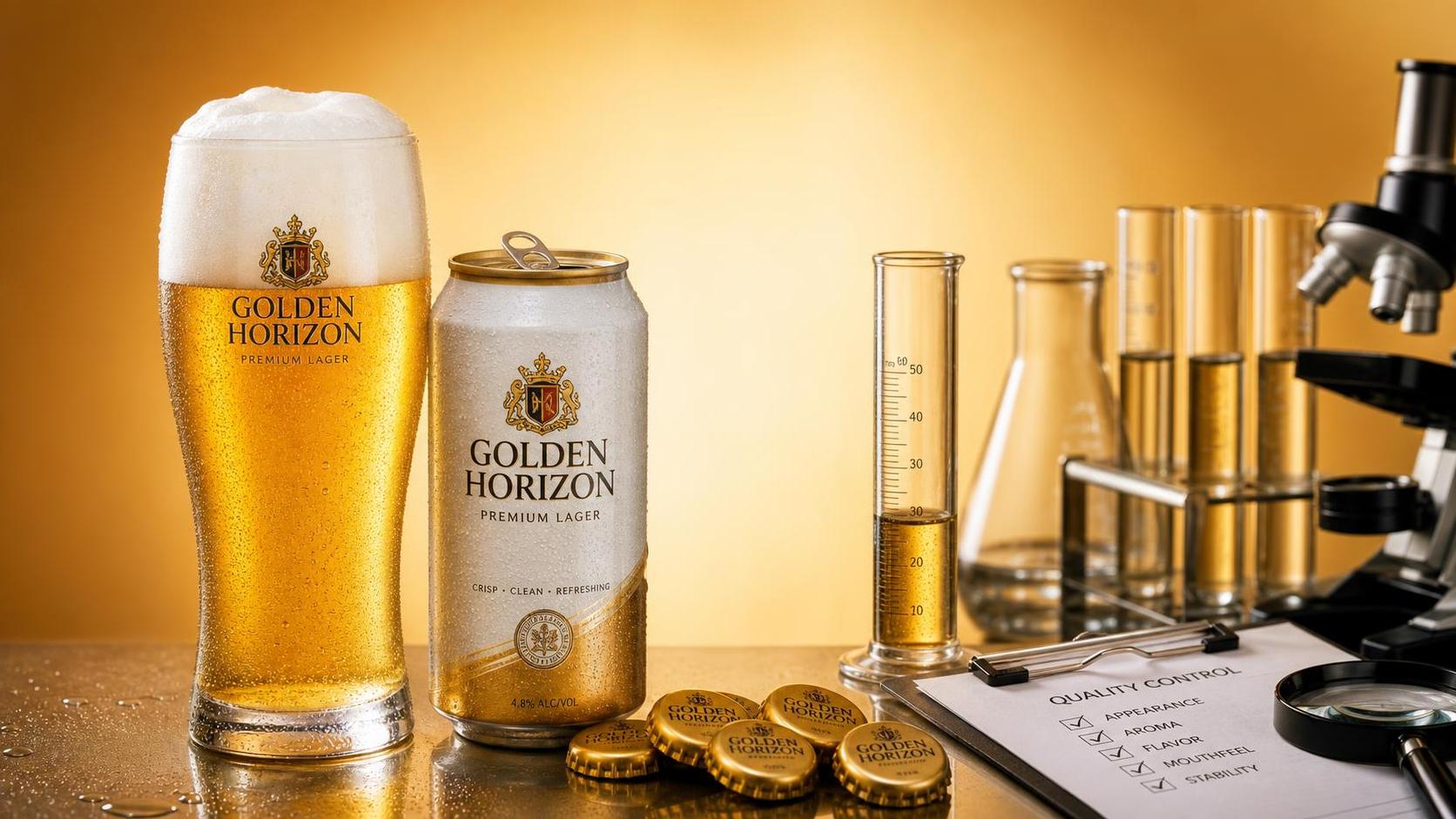
What Standards Help Define Good Lager Beer in Taste, Appearance, and Stability?
For quality control and safety managers, a good Lager beer is not just “clean and easy to drink.” That description is too loose to protect a brand, pass audits, or hold consistency across batches. In practice, you need a working checklist that covers sensory profile, physical appearance, package performance, microbiological control, and shelf-life behavior. The standard is not one single document. It is a combination of product specification, process discipline, testing method, and market expectation.
If you are reviewing finished beer, qualifying an OEM/ODM supplier, or tightening internal release criteria, these are the points worth checking closely. They are also the areas buyers tend to notice first, even when they do not describe them in technical language.
Start with what “good” means for this specific lager
Before testing anything, define the product style target. “Lager beer” covers a wide range, from very light, neutral international styles to fuller, malt-forward pale lagers. A quality team gets into trouble when it judges every lager against one generic expectation. A beer can be low in ester, moderate in bitterness, and highly drinkable, yet still fail if the agreed product profile calls for a crisper finish or stronger malt note.
A practical specification should at least lock down alcohol content, original extract or gravity basis if used internally, bitterness target, color range, carbonation range, clarity standard, and sensory descriptors that are allowed, required, or unacceptable. If those boundaries are vague, later arguments about taste are usually just process problems wearing a sensory label.
Taste should be clean, but “clean” needs detail
The first real checkpoint is balance. Good Lager beer usually shows a clean fermentation profile, moderate to low fruity esters, controlled sulfur character depending on style, and no rough finish. Malt should be present enough to support body. Hop bitterness should be measured and felt, not harsh or lingering in a coarse way.
- Look for flavor stability between early-release and near-end-of-shelf samples. A lager that tastes fine fresh but turns papery, dull, or sweet-heavy too quickly has not met the standard in any commercial sense.
- Watch for diacetyl. Even low levels can make a clean lager feel heavy or poorly matured. Sensory review should be backed by a validated internal method where relevant.
- Check acetaldehyde, especially in beers that read as green apple or unfinished. This is often missed when teams focus only on obvious microbiological defects.
- Bitterness quality matters as much as bitterness number. An IBU result alone does not tell you whether the finish is smooth or astringent.
For technical teams, that means sensory panels should not stop at “pass/fail.” Use a short vocabulary list that production, QC, and commercial teams all understand in the same way. Otherwise, complaints like “not fresh,” “too sharp,” or “thin” never get traced back to process conditions.
Appearance is not cosmetic; it is a process signal
In lager, appearance often exposes process variation faster than flavor does. Good beer should pour with expected brightness or intended haze, depending on the product definition, and the color should stay within the approved range. For classic filtered lager, cloudiness is usually treated as a defect unless the product was intentionally positioned otherwise.
A few things are worth separating:
Foam deserves more attention than it often gets. Buyers in restaurants and bars will judge quality in seconds from the pour. Weak foam may not always be a safety issue, but it can point to packaging contamination, glass-rinse residue in line trials, or unstable protein composition. In retail, it becomes a perception problem quickly.
Shelf stability is where many “good” lagers fail
Fresh beer can hide a lot. Stable beer cannot. If your market includes export, e-commerce, or mixed online and offline distribution, stability has to be judged under transport and storage stress, not only at packaging release.
The main stability checks are usually these:
- Flavor stability over time, especially oxidation notes such as cardboard, stale sweetness, or muted hop brightness.
- Physical stability, including chill haze, sediment development, and foam decline.
- Carbonation retention after handling, especially in cans exposed to warmer logistics conditions.
- Package integrity, with attention to seam, closure, crown, or can-end performance depending on format.
Dissolved oxygen control matters here. The exact acceptance limit depends on product design and plant capability, so it should come from validated internal standards rather than copied internet numbers. But the principle is firm: if oxygen pickup is poorly controlled during filtration, bright beer transfer, or filling, shelf-life complaints will arrive long before the microbiology report looks alarming.
One useful habit is to keep retain samples from multiple points: packaging day, mid-shelf review, and near-end-of-shelf review. A single retained sample at ambient storage tells you less than teams assume.
Microbiological safety is not negotiable, even for “stable” lager
Lager beer has hurdles such as alcohol, carbon dioxide, hop compounds, and in many products low pH, but that does not remove contamination risk. Spoilage organisms can still damage flavor, turbidity, package stability, and market trust. Quality managers should verify that microbiological release criteria fit the product and process, especially for filtered beer, low-alcohol variants, fruit-flavored extensions, or functional specialty lines where the risk profile may differ from classic lager.
Do not treat end-product testing as the whole system. Good control usually depends on hygienic design, CIP verification, environmental monitoring where applicable, line sanitation discipline, and quick response to trend drift. If a brewery or contract manufacturer only shows final micro results but cannot explain contamination prevention upstream, that is not a strong sign.
For market access, food safety systems such as HACCP are often a baseline expectation, and some buyers may also ask about broader certification frameworks such as ISO 22000 or FSSC 22000 depending on region and channel. Those are management-system references, not proof that a beer itself tastes right, but they do matter when assessing process control credibility.
Packaging performance belongs in the quality standard
This point gets underestimated when product teams focus on recipe and filtration. A technically sound Lager beer can still fail in trade because of filling variation, under-carbonation, leakage, oxygen ingress, dent sensitivity, or poor label durability in cold-chain display.
Check fill volume control, closure integrity, date coding clarity, and transport resistance for the actual route the product will travel. For export and private-label work, align the packaging specification with local compliance requirements in the destination market. Claims, allergen declaration, alcohol labeling rules, deposit marks, and language requirements can vary and should be verified against current regulations【待核实】by market, not assumed from one previous shipment.
Use recognized methods, not improvised judgment
When people argue about whether a lager is “good,” the real issue is often method inconsistency. Sensory should be structured. Analytical tests should be tied to documented methods. Sampling points should be fixed. If possible, line, lab, and sensory records should connect batch by batch.
Depending on your market and internal system, you may reference nationally recognized beer testing standards, food safety regulations, customer specifications, and internal release protocols. The exact standard set can differ by country, so it is better to state the applicable framework clearly than to cite a broad list without using it. For multinational supply, this is where many avoidable disputes start.
A useful supplier question is simple: which parameters are checked on every batch, which are checked by risk-based frequency, and which trigger hold or rejection? If the answer is vague, the process probably is too.
For OEM/ODM or wholesale supply, ask harder questions early
If you are sourcing Lager beer through OEM/ODM or private-label production, your standard has to travel outside your own plant. That means the checklist should include formulation control, lot traceability, change management for raw materials, and agreement on sensory reference samples. A lot of commercial friction comes from this: the buyer thinks the beer has “changed,” and the producer says every lab number is inside range. Sometimes both are technically correct because the range was too wide or the flavor target was never anchored properly.
For a company like Jinpai Beer, which supplies classic lager, wheat beer, sugar-free low-calorie products, fruit-flavored beer, and specialty functional lines through both online and offline channels, the standard-setting logic should be product-specific rather than copied across the portfolio. Lager needs its own release discipline. The cleaner the style, the less room there is to hide processing faults.
A working release checklist for quality teams
- Confirmed style specification for this Lager beer, not a generic beer standard.
- Sensory review shows clean fermentation profile and no obvious off-flavors.
- Bitterness, malt balance, carbonation, and finish match approved reference.
- Clarity, color, and foam meet the defined appearance target.
- Microbiological release criteria are passed and trend data show no drift.
- Dissolved oxygen and packaging-line controls support intended shelf life.
- Retain samples are stored for stability review under relevant conditions.
- Package integrity, coding, and label compliance are verified for destination market.
- Any deviation has a documented disposition, not an informal verbal release.
That is usually the difference between a lager that only tastes acceptable at the brewery and one that remains commercially reliable in distribution. If you are responsible for quality or safety, the useful standard is the one that keeps the beer clean in flavor, stable in trade, and explainable in records when somebody asks why this batch was released.
Thank you very much for writing to us. Please leave your message and contact information, we will reply to you within 24 hours.