



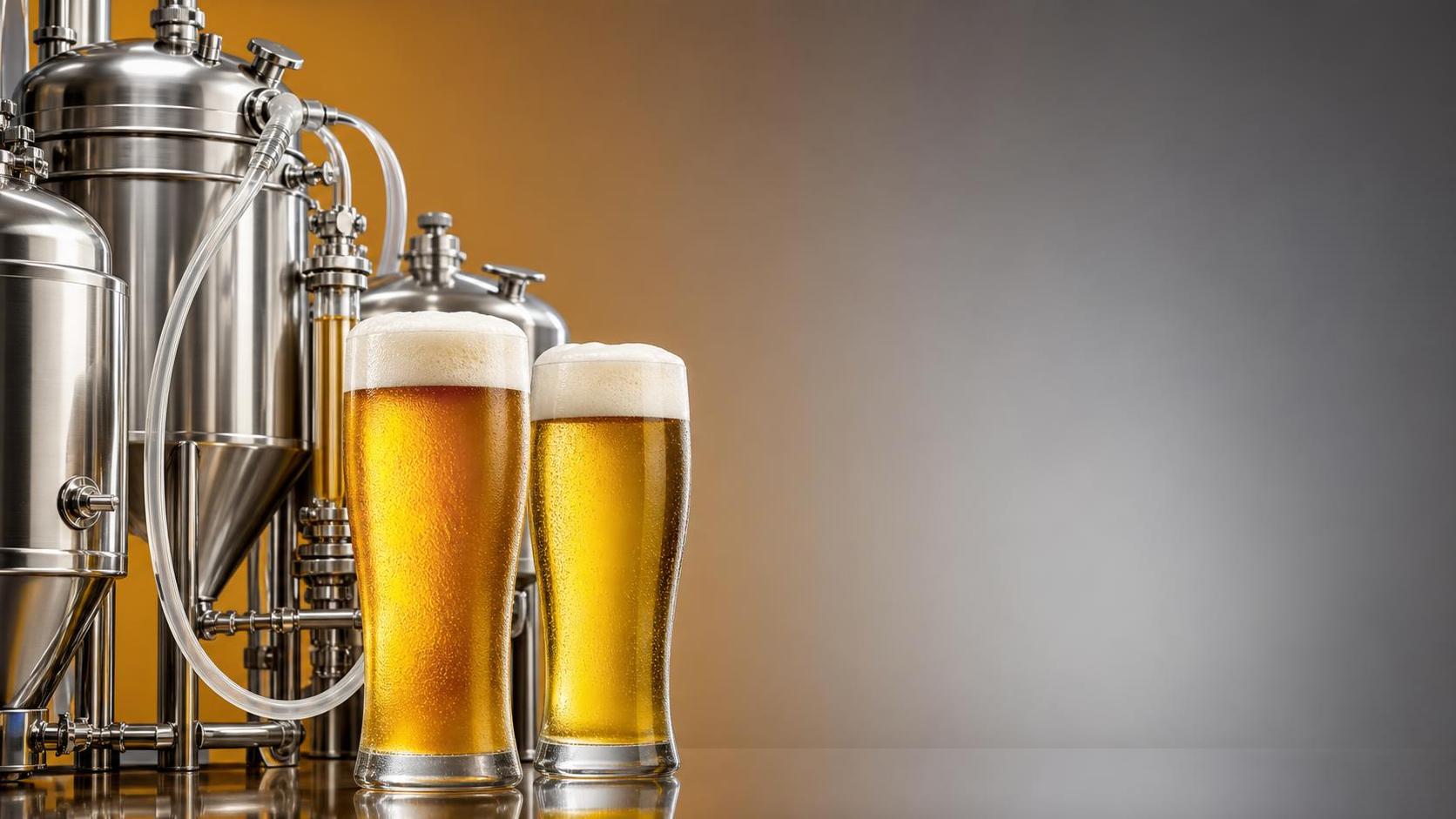
High-gravity lager is not a beer style. It is a brewing approach.
That distinction matters because many people hear the term and assume it refers to a stronger, heavier or more alcoholic lager on the shelf. In brewery practice, high-gravity lager usually describes beer produced from a more concentrated wort than the final packaged product requires. The brewer creates a fermentation with higher original extract and higher alcohol potential, then adjusts the beer later, often by dilution with deaerated water, to reach the target strength and flavor profile.
Standard lager, by contrast, is generally brewed closer to its final package strength from the start. The wort composition, fermentation load, hop balance and body are designed around the exact alcohol content and extract level the consumer will drink. So the practical difference is not just “more alcohol versus less alcohol.” It is a difference in process design, tank utilization, production economics and flavor management.
This is why high-gravity brewing shows up frequently in commercial-scale operations. It allows breweries to produce more saleable volume from the same brewhouse and cellar capacity. For buyers and distributors, that matters because production method can affect consistency, cost structure, shelf positioning and, in some cases, drinkability.
What “high gravity” really means in brewing terms
In brewing, “gravity” refers to the density of wort relative to water, which reflects the amount of dissolved solids, mainly fermentable sugars extracted from malt and other brewing materials. A higher-gravity wort contains more dissolved extract. If yeast ferments that wort effectively, the beer will develop more alcohol and different sensory weight than a lower-gravity wort.
High-gravity lager is built around that principle. The brewer starts with a concentrated wort, ferments it under controlled conditions, and later brings the beer to the desired specification. In a well-run operation, this is not a shortcut in the careless sense. It is a tightly managed technical method. Water quality, oxygen control, yeast health, attenuation, bitterness ratio and post-fermentation blending all become more critical than they are in a straightforward standard-strength brew.
That also explains why not every brewery uses the method in the same way. One producer may apply moderate high-gravity brewing simply to improve efficiency. Another may push concentration further and rely on more extensive process correction later. Those are not equivalent choices, and the sensory result is not automatically the same.
Where it differs from standard lager in the glass
Drinkers often want a simple answer: does it taste different? The honest answer is that it can, but the extent depends on how aggressively the process is used and how well the brewery compensates for its side effects.
A standard lager brewed directly to package strength often has a more naturally integrated balance of malt sweetness, body, bitterness and fermentation character. Because the beer is designed at its final concentration from mashing through lagering, the flavor architecture is usually easier to keep cohesive.
High-gravity lager can deliver a very clean result, but it places more stress on the system. Yeast works in a more concentrated environment. Ester formation, higher alcohols, bitterness perception and mouthfeel can shift. Once dilution is introduced, body and flavor intensity may thin out if the recipe was not built to absorb that step. A brewery that understands this will not simply brew a stronger lager and add water. It will adjust grist composition, hopping regime, fermentation management and finishing parameters so the final beer still tastes complete rather than stretched.
This is where experience shows. In practical product development, especially across lager, wheat, low-calorie or fruit-based beer lines, the question is rarely whether a concentrated process is technically possible. The harder question is whether the final product still drinks with the intended texture and flavor after scale-up, filtration, carbonation and packaging.
Why breweries use it anyway
The answer is capacity. High-gravity brewing can increase output without a proportional increase in brewhouse size or fermentation space. If a brewery can produce a more concentrated beer and adjust it later to final sales strength, each tank can effectively support more finished volume. For large-scale operations, that can be commercially meaningful.
It can also provide flexibility. A base high-gravity lager may be brought to slightly different final alcohol levels or channel-specific specifications, assuming the brewery has the process control to do that consistently. This is one reason the method is relevant not only to mass-market lager production but also to OEM and ODM projects, where product positioning may vary by market, price band or retail format.
For suppliers working with supermarkets, restaurant groups, bars and international distributors, production flexibility matters almost as much as flavor. Different markets ask for different alcohol strengths, calorie targets, labeling frameworks and taste expectations. A brewery with strong R&D and stable process control can use high-gravity methods as part of a broader manufacturing strategy, especially when managing multiple SKUs such as classic lager, sugar-free low-calorie beer or functional specialty beers.
A useful comparison
Common misunderstandings worth clearing up
One misunderstanding is that high-gravity lager is automatically lower quality. That is too simplistic. Poorly managed high-gravity brewing can produce beer that feels thin, harsh or less integrated. Well-managed high-gravity brewing can still yield stable, clean, commercially successful lager. The process itself is not the problem; weak formulation and weak execution usually are.
Another misconception is that all strong lagers are “high-gravity lagers.” Not necessarily. Some lagers are intentionally brewed and packaged at higher alcohol content with no dilution step, because the product style itself calls for greater intensity. In that case, “high gravity” may describe the wort, but the commercial meaning is different from a brewery efficiency strategy built around concentration and later adjustment.
There is also confusion between high-gravity brewing and low-calorie positioning. They are not the same thing. A sugar-free or reduced-calorie beer may involve its own formulation logic, enzyme use or fermentation strategy. High-gravity methods can intersect with those goals in manufacturing, but they do not define them.
How buyers and partners should evaluate it
If you are sourcing beer rather than brewing it, the useful question is not whether high-gravity brewing is being used at all. The better question is how the brewery controls the final result. Ask about flavor consistency between batches, oxygen management, water treatment, attenuation control and whether recipe design was built specifically for the process. These points tell you much more than the phrase itself.
For OEM and private-label projects, this becomes even more relevant. A brewery producing across multiple categories, including lager, wheat beer, fruit-flavored beer and functional specialty products, needs process discipline to keep each SKU aligned with its intended profile. High-gravity brewing can support efficiency and customization, but only if the supplier understands where the method fits and where it should be limited.
That boundary matters. Some products tolerate process concentration better than others. Clean, approachable lager can be suitable when the brewery knows how to rebuild balance after dilution. Beers where mouthfeel, yeast expression or layered malt structure carry more of the sensory identity may require a more cautious approach.
So what should you take from the term?
High-gravity lager is best understood as a production method with commercial advantages and technical tradeoffs. It is different from standard lager because the beer is not simply brewed straight to final package condition. Instead, the brewery works from a more concentrated base and relies on process control to deliver the intended finished beer.
For anyone comparing suppliers, assessing product quality or trying to understand brewing language more clearly, that is the useful lens. Do not treat the term as a style cue. Treat it as a clue about how the beer was made, what the brewery is optimizing for and how much technical competence is required to make the final lager taste complete rather than merely efficient.
Thank you very much for writing to us. Please leave your message and contact information, we will reply to you within 24 hours.