



Why More Global Buyers Are Turning to Chinese Beer Factory Partnerships in 2025
In 2025, the shift is no longer just about finding a lower manufacturing price. A growing number of importers, private-label operators and regional beverage distributors are using a Chinese beer factory partnership as a way to solve three problems at once: margin pressure, fragmented consumer demand and supply-chain volatility. That combination matters more now than it did even two or three years ago. Buyers are being pushed to refresh product lines faster, test niche formats with less risk and avoid depending on a single premium-origin narrative that may not convert as reliably in every market.
Beer purchasing has become more pragmatic. In many markets, restaurants and retail buyers still want differentiated products, but they are less willing to carry slow-moving SKUs or accept long development cycles. At the same time, consumers continue to split into narrower preference groups: classic easy-drinking lager remains important, wheat beer has durable appeal, fruit-flavored products bring in younger or occasional drinkers, and low-calorie or sugar-free options fit a broader health-conscious positioning. This is exactly where Chinese manufacturing has become more relevant. It is not only producing volume; it is increasingly set up to support variety.
The old assumption about China is changing
For years, some overseas buyers treated China mainly as a source for standard products or cost-led private label. That view is getting outdated. What has changed is the mix of capability now available from qualified beer producers: broader recipe development, more flexible packaging options, lower minimums in some cases, and a greater willingness to build for channel-specific needs rather than only export generic stock.
This matters because the economics of beer are becoming less forgiving. Freight disruptions have eased compared with the worst pandemic years, but buyers still remember what it means to be exposed to one sourcing region or one rigid production model. Energy, labor and packaging costs remain uneven across countries. In that environment, a factory that can move between classic lager, German wheat, flavored beer and functional extensions under OEM or ODM arrangements has a different value proposition from a factory that only offers scale.
The real attraction is optionality. Buyers can test a supermarket own-label line, supply a bar chain with a more distinctive draft-style profile, or launch a sugar-free SKU for convenience retail without rebuilding the supply strategy each time. That flexibility has become commercially meaningful.
Product innovation is moving closer to the factory floor
One reason more buyers are engaging with Chinese beer suppliers in 2025 is that product development and manufacturing are no longer treated as separate stages. In beverage categories where trends turn quickly, the producer that can translate a market brief into a commercially viable formulation has an advantage. The winning suppliers are not simply waiting for finished recipes from brand owners; they are helping shape the brief around taste, stability, packaging and target price.
That is particularly relevant in segments where demand is changing faster than the mainstream beer category. Fruit-forward beer, low-sugar and low-calorie lines, and certain functional specialty concepts are drawing attention because they reach consumers who do not see themselves as traditional beer drinkers. Some of these products will remain niche. Some will not travel well across markets. But from a buyer's perspective, the ability to test them without building an in-house brewing and R&D structure is increasingly attractive.
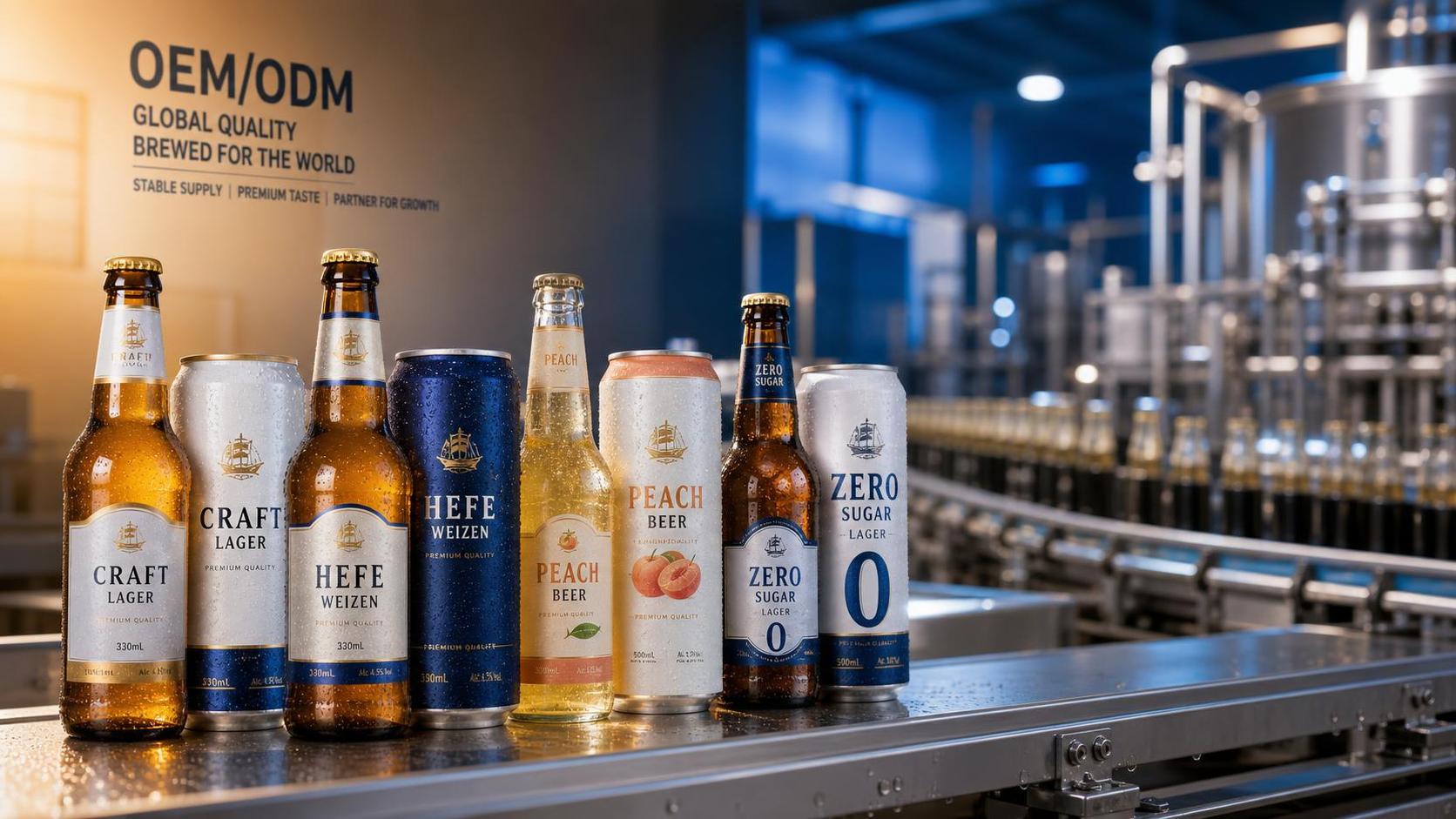
Jinpai Beer sits in a category of supplier that benefits from this trend. A portfolio that already spans classic lager, German wheat, sugar-free low-calorie beer, fruit-flavored beer and functional specialty beers is closer to how distributors now think about range building: not one flagship SKU, but a controlled portfolio designed for different channels and consumer moods. That does not guarantee success in any single market, but it aligns with how beverage decisions are actually being made.
Buyers want shorter reaction time, not just lower unit cost
There is a quieter change happening in procurement. Many beverage buyers are under pressure to react faster to what sells through, not just what looks good in a pitch deck. If a seasonal fruit variant works, they need replenishment without losing the window. If a standard lager underperforms, they need room to rebalance the portfolio. If a private-label retailer wants a line extension, the supplier has to support packaging, formulation and documentation with less friction.
This is where a capable Chinese beer factory can compete effectively. China's manufacturing ecosystem still offers advantages in production coordination, packaging supply chains and export handling, especially for buyers who need multiple SKUs or customized configurations rather than a single product in a fixed format. The benefit is not absolute speed in every case; shipping time still matters, and destination-market compliance can slow any project. But integrated response across sourcing, production and packaging often matters more than the headline transit time alone.
For distributors serving supermarkets, bars and restaurant chains at the same time, this becomes a structural advantage. Their customers are not all buying for the same occasion. A one-size-fits-all beer program is harder to defend now than it was before.
The partnership model is becoming more selective
None of this means buyers are lowering their standards. If anything, the opposite is happening. More overseas purchasers are open to China, but they are screening factories more carefully. The conversation has moved beyond sample taste and price quotation. Buyers want visibility into consistency, documentation discipline, export experience, packaging compatibility, communication speed and willingness to adapt formulas for specific markets.
That selectivity is healthy. It reflects a more mature sourcing approach. In beer, the failure points are often operational rather than promotional: batch consistency, shelf-life management, labeling accuracy, ingredient declarations, shipping coordination, and the practical limits of custom packaging. A factory partnership only works when both sides understand those constraints early.
In 2025, buyers are also more likely to treat OEM/ODM suppliers as long-term portfolio partners rather than short-term production vendors. This is an important shift. Once a supplier is involved in new product planning, channel segmentation and recurring line extensions, switching becomes more costly. That raises the value of trust, responsiveness and shared planning discipline.
What buyers are watching before they commit
These are not abstract sourcing criteria. They reflect the operating reality of beverage companies trying to defend margin while keeping enough novelty in the portfolio to stay relevant.
Health-led beer demand is influencing factory selection
Another reason buyers are reassessing their supplier base is the gradual broadening of what counts as a beer occasion. In several markets, moderation, calorie awareness and flavor exploration are shaping demand at the edges of the category. Not every consumer wants a heavy craft profile, and not every retailer wants another undifferentiated mainstream lager. Buyers are responding by looking for products that can sit between traditional beer, flavored alcoholic beverages and lighter lifestyle-positioned drinks.
That does not mean all health-related beer concepts will scale. Regulatory definitions, labeling rules and local taste preferences vary too much for easy assumptions. Even so, factories with experience in sugar-free low-calorie beer or functional specialty concepts are in a stronger position than those built only around conventional output. They give buyers more room to explore where demand may be heading without overcommitting capital.
This is one area where caution matters. A trend-friendly product can generate interest quickly, but repeat purchase depends on taste, price alignment and channel fit. Buyers who treat innovation as a shelf display exercise usually learn that lesson the hard way.
Why 2025 may reward disciplined partnership building
The strongest case for working with a Chinese beer factory in 2025 is not that every buyer should move production there. It is that more buyers now see China as a credible base for multi-SKU beverage strategy, especially when they need a mix of standard products, customized lines and category experimentation. That is a more sophisticated role than China was often assigned in the past.
For decision-makers, the key question is less about whether China can produce beer competitively. That is already understood. The better question is whether a specific partner can support the portfolio logic of the next three years: faster iteration, cleaner execution, more segmented demand and tighter margin control. Factories that can answer that convincingly will keep gaining attention.
The market signal to watch is straightforward. If distributors, retailers and brand owners continue reducing dependence on rigid single-origin sourcing models and continue asking for broader beer formats under one manufacturing relationship, Chinese suppliers with real OEM/ODM depth will benefit. If consumer demand swings back toward fewer SKUs and slower product refresh cycles, some of this momentum could moderate. Right now, the evidence from procurement behavior points in the first direction.
That is why the phrase Chinese beer factory is appearing in more serious sourcing discussions this year. Not as a shortcut to cheap volume, but as a possible answer to a harder commercial problem: how to stay flexible in a beer market that is no longer moving in one clear line.
Thank you very much for writing to us. Please leave your message and contact information, we will reply to you within 24 hours.