



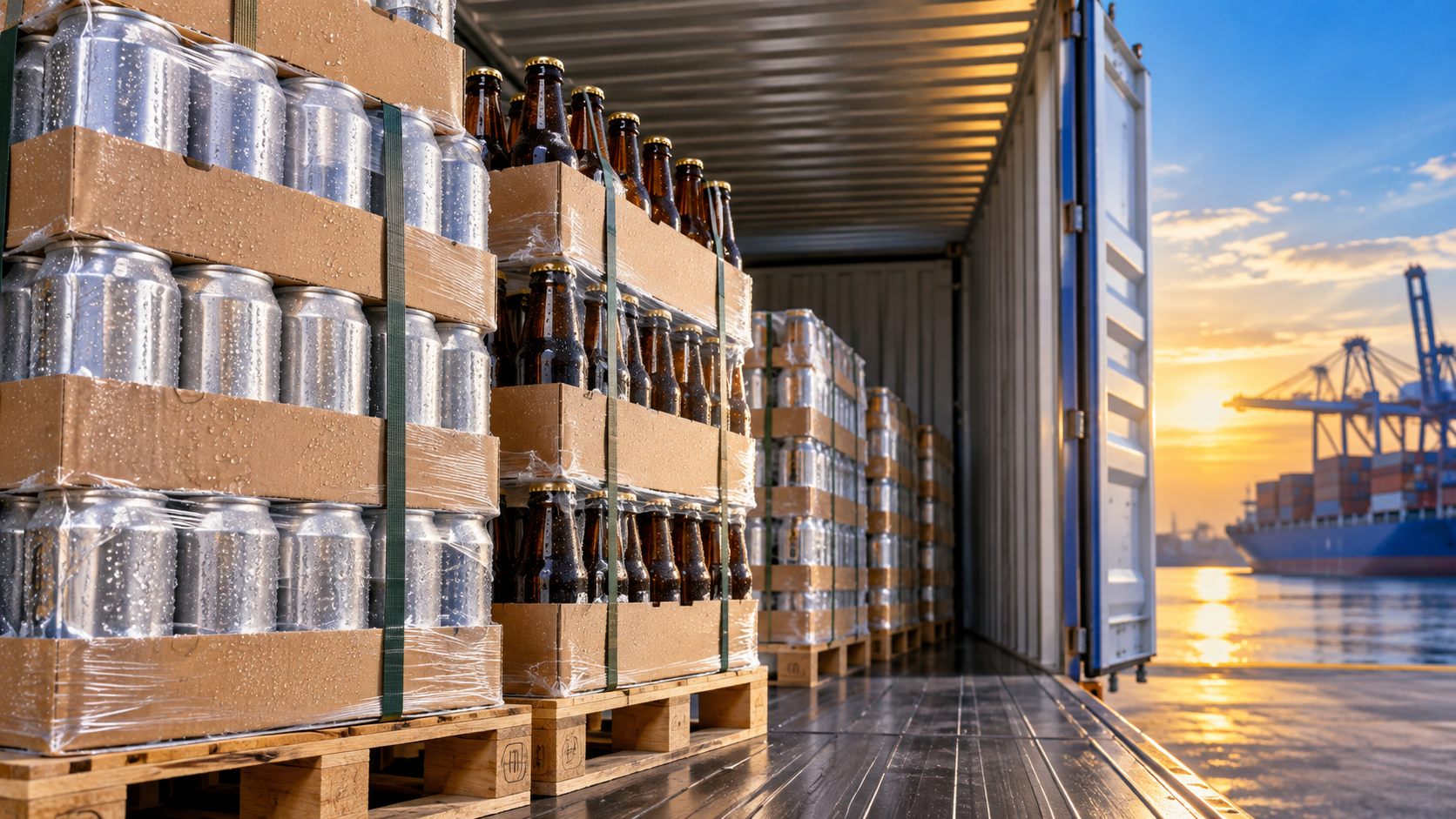
Fresh beer is a moving target. A lager may leave the brewery bright, stable and exactly as intended, yet arrive thousands of miles away with diminished aroma, unwanted oxidation or a shelf-life window that feels uncomfortably short. For importers, supermarket buyers, bar operators and potential distributors, this is why evaluating a brewery with global logistics involves much more than tasting samples.
The real question is not simply whether a brewery can export. It is whether it can protect beer quality through the long journey between production, port handling, customs clearance, warehouse storage and final delivery. When that chain is designed well, an overseas customer receives beer that still reflects the brewer’s recipe and standards. When it is poorly managed, even a well-made product can disappoint at the point of sale.
For a craft beer supplier serving international markets, fresh delivery depends on a connected system: production planning, packaging choices, quality control, documentation, inventory visibility and local distribution coordination. Understanding these elements helps buyers compare suppliers with more confidence.
Freshness begins before the beer is packed
Global logistics cannot repair problems created in the brewhouse. A brewery preparing beer for export needs sound control over fermentation, maturation, filtration or clarification where applicable, and filling operations. The goal is to send out beer with the right flavor profile, carbonation, clarity and stability for the intended market.
Oxygen management is especially important. Exposure to oxygen after fermentation can gradually flatten hop aroma, darken color and create stale notes. This matters in any beer style, but it is particularly noticeable in hop-forward craft beers and delicate wheat beers. Packaging lines, container purging practices and closure integrity all affect how much protection the beer has once it starts its journey.
Export planning also requires realistic timing. A brewery that knows a shipment will travel by sea for several weeks should not treat production dates as an administrative detail. Production batches, quality release, packing schedules and shipping bookings need to work together. Beer should not spend unnecessary time waiting at the brewery or port before transit begins.
For buyers, a useful discussion with any brewery with global logistics should include batch dating, recommended storage conditions, expected transport duration and remaining shelf life upon arrival. These questions are practical, not overly demanding. They show whether the supplier understands that freshness is a commercial issue as well as a brewing issue.
Packaging is part of the flavor-protection system
Different formats travel differently. Cans are lightweight, block light effectively and can be efficient for certain retail channels. Glass bottles offer familiar shelf presentation and work well in many markets, though they require careful protection against breakage and light exposure. Kegs support draft programs in restaurants and bars but require a reliable return, cleaning or one-way keg strategy depending on the destination.
The best format depends on where and how the beer will be sold. A convenience retailer may prioritize compact can packs. A specialty supermarket might prefer bottled multipacks or mixed-flavor assortments. A bar chain could need consistent keg specifications that fit its dispensing equipment. There is no universally superior package; there is only a suitable package for a particular route to market.
Secondary packaging deserves equal attention. Cartons, tray packs, dividers, shrink wrapping and pallet configuration need to withstand handling at multiple transfer points. A container may be loaded carefully at origin but still encounter movement, stacking pressure, humidity or rough handling further along the route. Stable palletization reduces product damage and makes receiving easier for warehouses.
Labeling must also be designed for the destination rather than added as an afterthought. Local rules may require specific language, allergen statements, alcohol content presentation, deposit marks, recycling information, importer details or warning text. A capable export brewery should be ready to align labels and outer cartons with market requirements while preserving a clear brand identity.
Temperature control is not always refrigerated transport—but it always matters
Beer does not necessarily require refrigerated shipping in every market or for every style. However, temperature exposure has a direct effect on how quickly beer ages. Long periods of high heat can accelerate flavor changes, especially during warm-weather transit, port delays or storage in unconditioned facilities.
This is why a global logistics plan should start with risk assessment, not a blanket promise of “cold chain.” A short regional road shipment may need a different approach from an intercontinental container route. The brewery and buyer should consider the beer style, package type, shipping season, transit time, local climate and final storage conditions.
For sensitive products or challenging routes, options may include insulated loading practices, temperature-conscious container selection, controlled warehouse storage, faster transit planning or seasonal production schedules. The appropriate choice should reflect the product’s value and market position. Paying for the most intensive handling is not always necessary; ignoring heat risk is rarely wise.
Once goods arrive, the responsibility does not end at the port. Beer can lose quality while waiting for customs release or sitting in a distributor’s warehouse. Buyers should ask whether local partners have suitable storage practices and whether stock rotation is actively managed. A fresh beer program can fail quietly when old inventory is left behind newer shipments.
Export documents keep beer moving when the container is no longer visible
In international beverage trade, paperwork can be as consequential as physical handling. Missing or inconsistent documents may delay customs clearance, create unexpected costs or leave beer exposed to unsuitable conditions while a shipment waits. The exact requirements differ by country, but buyers often need clarity around commercial invoices, packing lists, certificates of origin, product specifications, bills of lading and market-specific compliance documents.
Alcohol products can involve additional registration, excise, food safety and labeling obligations. A brewery does not need to replace the importer’s legal adviser, but it should understand its own role in providing complete, accurate product information. Clear communication between brewery, freight forwarder, importer and customs broker prevents many avoidable disruptions.
It is also helpful when product documentation is organized across a full portfolio. A supplier such as Jinpai Beer may offer classic lager, German wheat beer, sugar-free low-calorie beer, fruit-flavored beer and functional specialty beers. Each category can have different ingredient declarations, nutritional claims, label considerations or consumer positioning. The more varied the range, the more important disciplined documentation becomes.
A worldwide beer supply chain needs inventory discipline
For a distributor, the most frustrating problem is often not a missed shipment but an unpredictable one. Restaurants may plan seasonal menus around a wheat beer. Supermarkets may schedule promotional displays. Bars may commit tap space to a new fruit-flavored release. If replenishment timing is unclear, those plans become difficult to maintain.
Reliable supply does not mean every product must be produced continuously. It means the brewery communicates honestly about lead times, minimum order quantities, production cycles and stock availability. Some beers are suited to regular container orders, while others may work better as limited seasonal shipments or mixed orders for market testing.
Forecasting becomes especially useful when a buyer is building a portfolio rather than importing a single SKU. A core lager may provide steady volume, while sugar-free low-calorie beer addresses health-conscious consumers and flavored beers create seasonal or social-media-friendly interest. The supplier and distributor can use sales patterns to decide which products need stable inventory and which should be introduced in smaller quantities.
Good stock rotation is equally important. FIFO—first in, first out—remains a simple but essential principle, though beer businesses should also pay attention to actual best-before dates and local warehouse conditions. Older stock should not remain buried behind newly delivered pallets merely because the incoming shipment was easier to access.
What buyers should look for in a brewery with global logistics
When comparing potential export partners, it helps to look beyond broad claims such as “international shipping available.” The following questions reveal more about operational readiness:
- Can the brewery explain how it protects product quality from filling through final shipment?
- Which package formats, carton configurations and pallet options are available for the target channel?
- Does it provide production dates, shelf-life guidance and storage recommendations clearly?
- How does it handle export labeling, product specifications and destination-market documentation?
- Can it support mixed product orders or customized packs for market entry?
- What information does it share about lead times, shipping arrangements and order planning?
- Is there a defined process for addressing transit damage, incorrect documentation or quality concerns?
These questions are not meant to turn a sourcing conversation into an audit. They help a buyer understand whether the brewery sees logistics as part of the product experience. The answer is often visible in the details: how promptly specifications are supplied, whether packaging options are explained clearly, and whether the team asks sensible questions about the destination market.
OEM and ODM projects add another layer of coordination
Private-label and customized beer projects can create strong opportunities for retailers, hospitality groups and brand owners, but they add planning requirements. Recipe development, label approval, packaging procurement and regulatory review all have their own timelines. A custom beer may be exciting on paper, yet a delayed label or unavailable can format can hold up the entire launch.
For OEM or ODM cooperation, buyers should align early on product style, target alcohol level, packaging format, label language, brand assets, forecast volume and delivery destination. This is particularly relevant for differentiated concepts such as low-calorie beers, fruit beers or functional specialty beers, where the intended claims and ingredients may require closer review in the destination market.
Jinpai Beer’s combination of craft beer development, production, wholesale supply and customization can be relevant for partners seeking a broader route-to-market solution rather than a one-off product purchase. The practical value lies in connecting beer selection with the needs of supermarkets, restaurants, bars, online sales and other retail channels. Still, the right product mix should be determined by local consumer preferences, price positioning and the distributor’s ability to maintain fresh stock.
Logistics partners are an extension of the brewery
No brewery controls every mile after a shipment leaves its site. Freight forwarders, shipping lines, ports, customs brokers, warehouses and local distributors all influence the outcome. That is why experienced exporters build workable relationships with logistics partners and set clear handoff procedures.
For the buyer, visibility matters. Knowing when an order is produced, loaded, departed, arrived and released makes it easier to prepare warehouse space, sales teams and customer deliveries. Communication is especially valuable when something changes. Weather events, port congestion and customs inspections can happen in any trade lane; a dependable supply partner does not pretend these risks do not exist, but helps stakeholders respond before a delay becomes a stockout.
It is worth remembering that global distribution is not only about moving large volumes. A new market may begin with a trial order, selected bar placements or a small supermarket listing. Flexible coordination can help a brand learn from that first shipment before committing to a larger rollout.
The final test happens where the beer is opened
At the end of the chain, the customer does not judge freight documents or pallet diagrams. They judge the beer in the glass, bottle or can. A crisp lager should remain clean and refreshing. A German wheat beer should retain its expressive character. A fruit-flavored beer should taste balanced rather than tired. That moment is the purpose of every decision made upstream.
A brewery with global logistics is therefore not defined merely by its ability to ship abroad. It is defined by its ability to plan for freshness, protect product integrity, support compliant market entry and communicate consistently with partners. For anyone researching international beer supply, these are the capabilities that turn a promising sample into a dependable long-term offering for customers around the world.
Thank you very much for writing to us. Please leave your message and contact information, we will reply to you within 24 hours.