



What Certifications Should a China Beer Factory Have?
When evaluating a China beer factory, certifications are more than formal documents—they are key indicators of product safety, production consistency and export readiness. For technical assessment teams, understanding which certificates a brewery should hold can reduce sourcing risks and improve compliance confidence. This article outlines the essential certifications that matter when selecting a reliable beer manufacturing partner for OEM, ODM, wholesale and global distribution.
If you are screening a brewery for private label, contract production or long-term supply, do not start with the product brochure. Start with the documents that tell you whether the factory can legally produce, whether its food safety system is actually controlled, and whether its paperwork can support customs clearance in your target market. That is usually where weak suppliers are exposed.
The first layer: basic legal and production qualifications
For a beer manufacturer in China, the first check is not optional certification but legal production qualification. A factory should be able to provide its business license and the food production license that covers the relevant beverage category. In China, this is one of the clearest baseline checks. If a supplier is relying on a third-party factory while presenting itself as a manufacturer, the paperwork usually shows it.
Ask for the company name on the business license, the production site address, and the name shown on the food production license. These should match the operating entity and the actual plant you are assessing. Small mismatches are not always fatal, but they need explanation. A trading company can be a valid export partner, yet it is not the same as a factory.
For technical teams, this matters because later documents such as test reports, audit certificates and export declarations should connect back to the same legal entity or clearly documented related entities.
Food safety system certification: treat this as core, not decorative
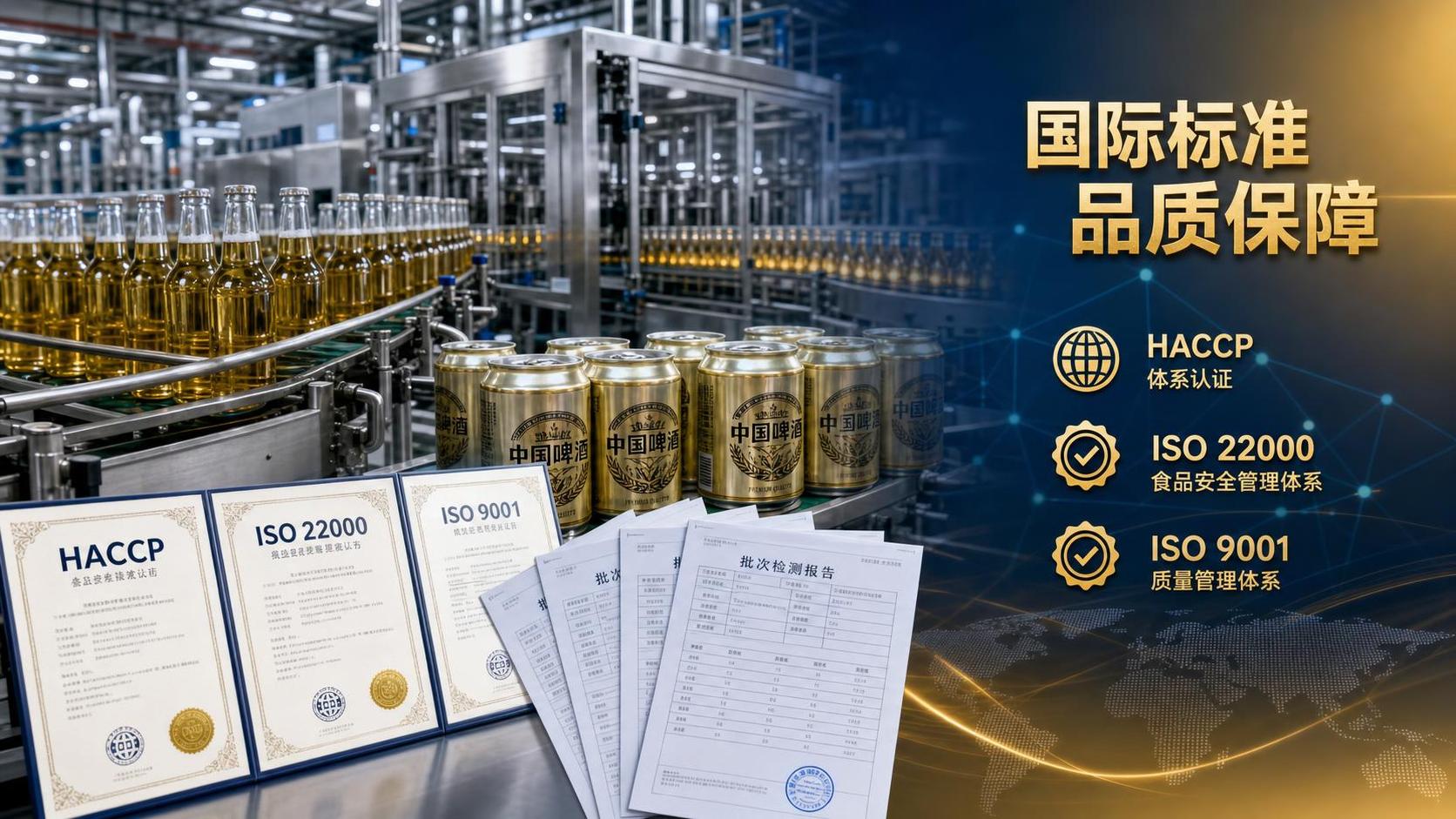
If a China beer factory does not have a structured food safety management certification, the discussion should become much stricter. In practice, the certificate most buyers ask for is HACCP or ISO 22000. Some factories hold both. Either can be useful, but the value is in how the scope is written and whether it actually covers beer production, packaging and related processes.
HACCP is especially relevant because beer is a consumable product with microbiological, allergen, packaging and process control risks. ISO 22000 adds a broader food safety management framework. On paper, both look familiar. During supplier review, the practical questions are better:
- Does the certificate scope explicitly mention brewing, beverage production or food manufacturing relevant to beer?
- Is the certificate issued to the same factory entity you are buying from?
- Is it current, and can the issuer be verified?
- Was the last audit recent enough to give you confidence that the system is active rather than shelved?
One common mistake is accepting any ISO certificate as proof of food safety. ISO 9001 alone is not enough for beverage risk control. It shows a quality management framework, not a food safety system.
ISO 9001 still matters, just for a different reason
For OEM and ODM beer projects, especially when recipes, packaging formats and label variants multiply, ISO 9001 is useful because it usually points to better document control, change management and complaint handling. It does not replace food safety certification, but it can reduce the mess that often appears in customized production.
If your project includes sugar-free low-calorie beer, fruit-flavored beer or functional specialty beer, formulation control becomes more sensitive. Technical teams should ask how the factory manages version control for specifications, approval of raw material substitutions, and batch traceability between formula, tank record and finished goods release. A valid ISO 9001 certificate does not prove all of that, but it gives you a reason to ask for the supporting records.
Export-facing documents: necessary, but market dependent
A brewery that says it exports should be comfortable providing export support documents. These are not always “certifications” in the strict sense, but in real sourcing work they are just as important. Depending on destination market, you may need some combination of certificate of origin, health certificate, sanitary certificate, ingredient statement, product specification sheet, shelf-life statement, packing list format, and batch test report.
There is no single global checklist that fits every country. Import rules for alcoholic beverages differ widely, and local registration or label approval can sit with the importer rather than the factory. So the right question is not “Do you have all export certificates?” The better question is: “What export documentation can you routinely issue for my destination market, and what part requires the importer or local agent?”
If the factory answers in vague terms, slow down. Experienced exporters usually know where the line is between factory documents and importer-side compliance.
Look closely at product testing, not just system certificates
A good China beer factory should be able to provide routine product test records for key indicators. The exact testing panel depends on the beer type and target market, but in practice buyers often review items such as alcohol content, original wort concentration, microbiological status, CO2 control, net content, packaging integrity and label compliance. For specialty beers, additional review may be needed for sweeteners, flavor ingredients or functional additives, depending on the formula and local rules.
You do not need to demand every report on day one. What you do need is confidence that the factory has a repeatable release process. Ask whether testing is done in-house, by a third-party lab, or both. Then verify whether the methods and reporting format are suitable for your market. Some importers need third-party reports for first orders or customs discussions; others only need manufacturer COA-style documents plus occasional external verification.
Be careful with broad claims around “functional” beer. Any health-related positioning, nutrient claim or special formulation statement should be checked against destination-market labeling law. The factory may produce the liquid competently and still be unable to support the claim legally. That part is often misunderstood.
Halal, organic and other special certifications: only ask when the product or market really requires them
Not every brewery needs every special certificate. Technical assessors sometimes receive inflated supplier decks listing possible credentials that are irrelevant to the actual project. Keep it practical.
If you are shipping to markets that require or strongly prefer Halal certification, ask for the valid certificate and the exact product scope. Do not assume a factory-level certificate automatically covers all SKUs. If you are sourcing organic beer, you need to verify the applicable certification chain carefully, including ingredients and processing controls. Organic equivalency rules vary by market, and cross-border acceptance may need case-by-case review【待核实】.
The same logic applies to claims around gluten-free, vegan, non-GMO or similar market-facing statements. These are not casual marketing add-ons. They require evidence, scope clarity and local legal review.
Packaging compliance is where many otherwise qualified factories stumble
A beer plant may have clean process control and still create trouble through packaging nonconformity. For cans, bottles, crowns, labels and outer cartons, technical teams should ask whether the factory has documented incoming material inspection and compatibility checks. This becomes more important for OEM work with custom artwork, multilingual labels and retailer-specific barcode requirements.
For export beer, label compliance usually needs confirmation on these points:
- mandatory declarations in the destination market
- allergen presentation where applicable
- alcohol statement format
- date coding readability and durability
- lot traceability linking finished goods to production records
This is often not covered by one standalone certificate. It is checked through procedures, samples and pre-shipment approvals. Treat it as part of your certification review, because customs issues often start here.
A quick way to sort essential and optional documents
What experienced buyers usually ask for after the certificates
This is the part many checklists skip. Once the certificates look acceptable, ask for evidence that the system is alive:
- A recent internal or external audit summary, with sensitive details redacted if needed.
- A sample batch record showing traceability from raw materials to finished goods.
- A current specification sheet for one core beer and one customized beer.
- A complaint or nonconformity handling example, anonymized if necessary.
You are not asking for secrets. You are checking whether the factory can operate in a disciplined way when something goes wrong. That tells you much more than a certificate on the wall.
For OEM, ODM and wholesale beer, the practical standard is simple
A reliable China beer factory should have valid legal production documents, a credible food safety management certification, and enough testing and export paperwork to support your destination market. For more complex projects, ISO 9001, solid change control and packaging compliance discipline become increasingly important. Special certifications only matter when your channel, claim or country actually requires them.
For breweries such as Jinpai Beer, which cover classic lager, German wheat, sugar-free low-calorie beer, fruit-flavored beer and functional specialty beer, the real evaluation point is not the size of the product range. It is whether the factory can document control across that range consistently for OEM, ODM, wholesale and global distribution.
If you are building a supplier approval file, keep your checklist tight: verify legal production status, review HACCP or ISO 22000 carefully, confirm what export documents the brewery can actually issue, and test the factory’s traceability with one real sample set of records. That is usually enough to separate a presentation-ready supplier from a production-ready one.
Thank you very much for writing to us. Please leave your message and contact information, we will reply to you within 24 hours.