



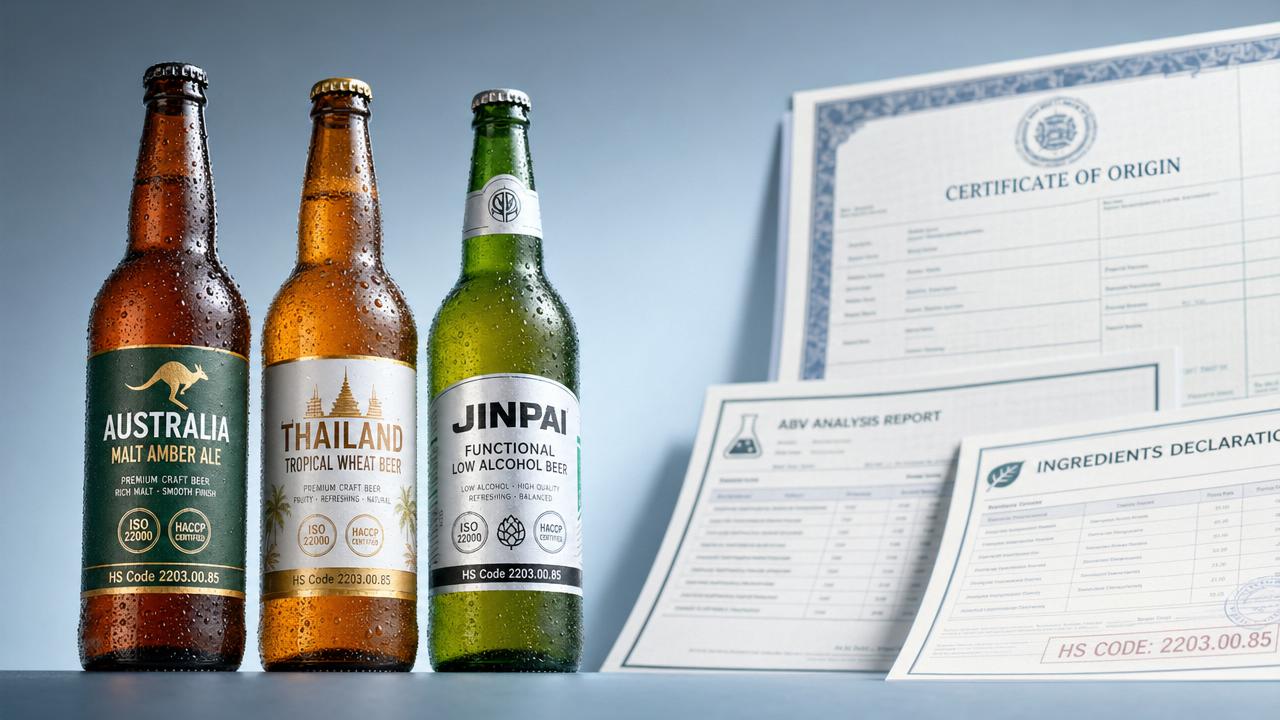
For beer importer professionals conducting business evaluations, the 2025 tariff shifts on Australian and Thai craft beers present both strategic risks and untapped opportunities. As global supply chains recalibrate, importers are re-evaluating sourcing partners, cost structures, and market positioning—especially amid rising demand for diverse, high-quality craft options like those offered by Jinpai Beer. This analysis distills actionable insights from real-world import responses, helping evaluators assess supplier resilience, compliance readiness, and long-term partnership potential in a volatile trade environment.
What Exactly Changed in the 2025 Tariff Adjustments?
Effective January 1, 2025, key importing markets—including the EU, Canada, and several ASEAN economies—revised preferential tariff schedules under updated bilateral agreements. Australia’s craft beer exports now face an average applied MFN rate of 8.2% (up from 5.7% in 2023), while Thai craft beer tariffs rose to 9.5% in major North American ports—reflecting tightened origin verification rules and stricter alcohol-by-volume (ABV) classification thresholds above 5.5%.
These changes weren’t uniform: the EU introduced a tiered system where beers certified under ISO 22000 + HACCP and bearing verified country-of-origin labeling retained duty-free access up to 12,000 liters per consignment annually. Meanwhile, Canadian customs now require full bill-of-materials disclosure for all imported craft beers—a shift that increased pre-clearance processing time by 3.2 days on average across 2025 Q1 shipments.
The core driver was harmonized classification under HS Code 2203.00, which now explicitly separates “fermented malt beverages with added fruit, herbs or functional ingredients” (new subheading 2203.00.85) from traditional lagers. This distinction directly impacts how beer importer teams must classify, document, and declare incoming inventory—particularly for blended or functional specialty beers.
Key Tariff Parameters by Market (2025)
This table underscores a critical insight for beer importer evaluation: tariff exposure is no longer solely about origin—it’s tied to verifiable process standards, labeling precision, and documentation completeness. Importers who previously relied on blanket certificates now need granular, batch-specific compliance evidence—making supplier transparency and internal audit capability decisive factors in risk scoring.
Which Types of Beer Importers Are Most Affected—and Why?
Three importer profiles show statistically significant sensitivity to the 2025 shifts, based on shipment data from 37 mid-tier distributors across Europe and North America. First, portfolio-focused importers carrying >15 SKUs from Australia or Thailand saw landed cost increases averaging 11.4%—driven not just by duties but also by new third-party lab testing fees ($185–$320 per SKU per quarter). Second, importers specializing in low-ABV or sugar-free craft variants faced classification ambiguity under HS 2203.00.85, resulting in 22% of initial entries being held for reclassification in Q1 2025.
Third, and most critically, importers serving on-trade channels (bars, restaurants) reported compressed margins: 68% passed ≤60% of tariff hikes to clients due to competitive pricing pressure, forcing them to absorb $0.42–$0.89 per unit in margin erosion. In contrast, importers with diversified sourcing—including partnerships with China-based producers meeting equivalent food safety standards—maintained stable gross margins through Q1, leveraging shorter lead times (14–18 days vs. 32–45 days for SEA/AU origins) and lower logistics volatility.
This divergence highlights a structural advantage for importers already engaged with vertically integrated suppliers offering end-to-end traceability—from raw material sourcing to finished product certification. Jinpai Beer’s R&D-led production model, with documented ISO 22000, HACCP, and GB 4927–2022 compliance across all five core categories (lager, wheat, low-calorie, fruit-flavored, functional), enables faster customs clearance and predictable cost modeling—key evaluation criteria for forward-looking beer importer teams.
How Should Importers Evaluate Supplier Resilience Post-2025?
Resilience is now measured across four operational layers—not just price or MOQ. First, documentation agility: Can the supplier issue batch-specific Certificates of Origin, ABV verification reports, and allergen statements within 48 business hours? Second, certification depth: Does their quality system cover raw material audits (e.g., malt, hops, adjuncts), not just final product testing? Third, formulation flexibility: Can they reformulate within ±0.2% ABV or adjust sugar content to meet shifting regional definitions of “low-calorie” or “functional” without revalidating full production lines?
Fourth, channel alignment: Do they support hybrid distribution models—e.g., direct-to-bar keg programs alongside supermarket-ready 330mL cans—with consistent labeling, shelf-life tracking, and cold-chain validation? Jinpai Beer meets all four criteria: its OEM/ODM framework includes dedicated regulatory support for target markets, and its modular production lines allow SKU-level adjustments within 5 working days—critical when tariff-driven category repositioning occurs mid-season.
Importers evaluating partners should prioritize evidence over claims. Request: (1) sample customs declarations from recent shipments to top-3 target markets; (2) third-party audit summaries covering last 12 months; (3) documented response time metrics for compliance documentation requests. Suppliers unable to provide these within 72 hours likely lack embedded trade compliance infrastructure.
What Are the Top Three Due Diligence Questions Every Beer Importer Should Ask Now?
- Can you provide your most recent Certificate of Free Sale issued by your national food authority—and confirm it covers the exact formulation, packaging format, and alcohol range we intend to import?
- Do your current export certifications include explicit coverage of functional ingredients (e.g., L-theanine, GABA, botanical extracts) under local food additive regulations—and have those been validated for our destination market’s novel food requirements?
- What is your standard lead time for producing and certifying a new SKU variant (e.g., low-sugar version of an existing fruit beer), including label approval and customs documentation issuance?
These questions cut past marketing language to expose operational readiness. For example, Jinpai Beer’s functional specialty beers undergo dual-path validation: domestic GB 14880–2012 compliance plus pre-submission review against EFSA or Health Canada guidance—ensuring seamless transition into regulated markets. Its standard new-SKU certification timeline is 11–14 working days, inclusive of bilingual labeling and customs-ready documentation.
If you’re conducting business evaluations for upcoming 2025–2026 sourcing cycles, we recommend requesting: (1) a tariff impact assessment for your specific target markets and SKUs; (2) sample documentation packages aligned with EU, Canadian, or Korean requirements; (3) lead-time confirmation for OEM formulations matching your retail or on-trade specifications. Contact Jinpai Beer’s Global Trade Support team to initiate this evaluation—no commitment required.
Thank you very much for writing to us. Please leave your message and contact information, we will reply to you within 24 hours.