



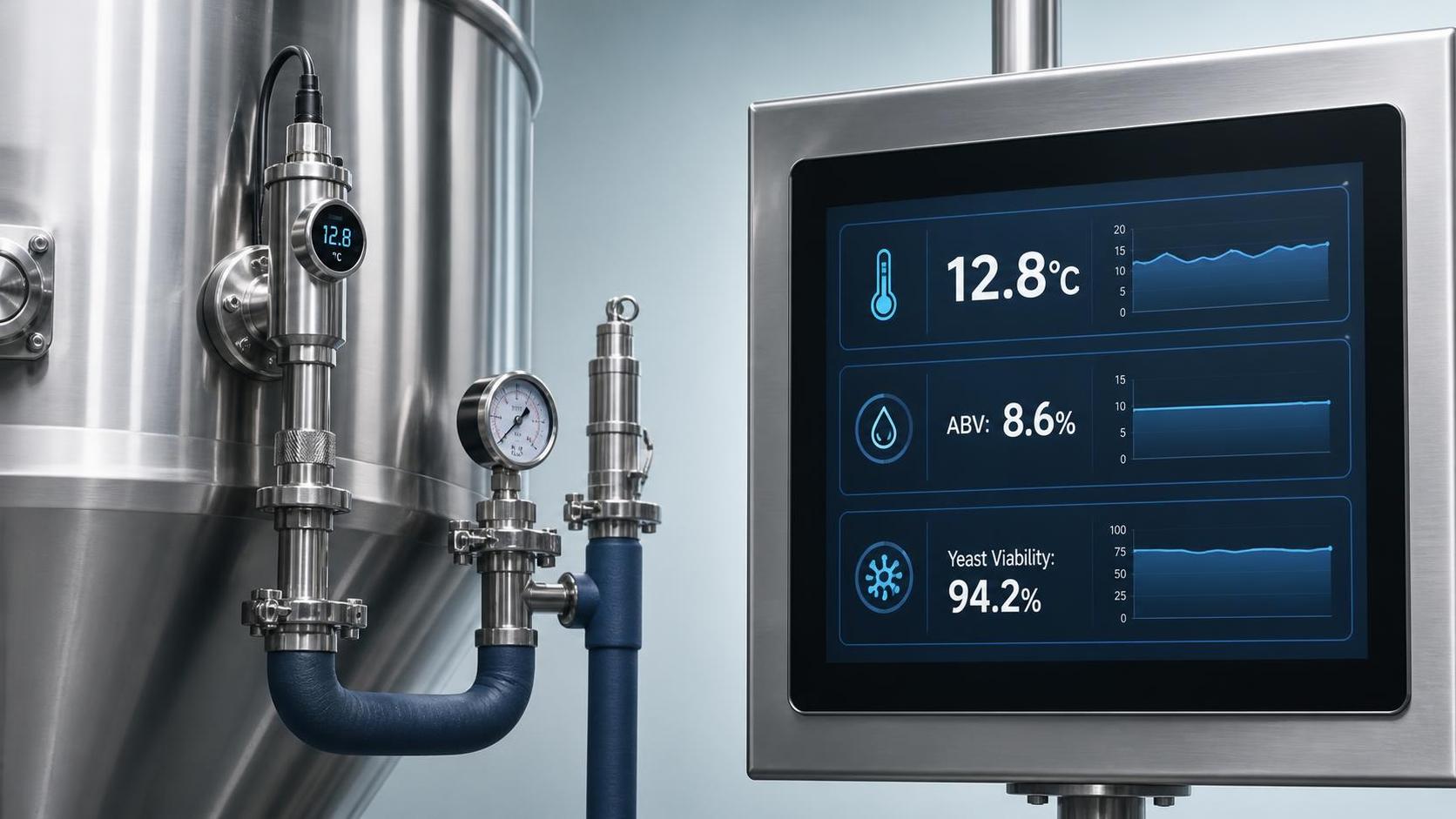
When technical evaluators—brewing engineers, contract manufacturing partners, or quality assurance leads—begin scoping production capacity for high-strength lager programs, they rarely start with a simple question like “Can this facility make strong lager?” Instead, the real assessment unfolds across three tightly interlocked dimensions: how fermentation temperature is managed, which yeast strains are deployed—and how they’re nurtured, and how ABV is not just achieved, but reliably held within narrow, market-aligned bands. These aren’t isolated parameters. They’re operational signatures—each revealing whether a facility operates as a standard lager brewery… or functions as a true strong lager beer factory.
Standard lager breweries excel at consistency—but within a well-defined thermal and alcoholic envelope. Fermentation typically runs cold: 4–6°C, often over 12–21 days. This favors clean, crisp profiles and minimizes ester formation. Yeast strains—usually Saccharomyces pastorianus variants like W-34/70 or Saflager W-34/70—are selected for flocculation, attenuation, and chill tolerance—not ethanol resilience. ABV hovers predictably between 4.0% and 5.2% vol. Deviations trigger process alarms. That’s not a limitation—it’s design intent. These breweries serve mass-market lagers where stability, cost efficiency, and shelf-life uniformity outweigh stylistic range.
A strong lager beer factory, by contrast, treats elevated alcohol not as an exception—but as a baseline condition. At Jinpai Beer’s craft brewing facility, strong lager isn’t a seasonal experiment. It’s a core production stream—engineered from the ground up for repeatable output between 7.0% and 12.0% vol, without haze, solvent notes, or sluggish attenuation. That requires rethinking every stage—not just adjusting numbers on a control panel.
Take fermentation temperature first. In conventional lager production, cold fermentation suppresses yeast metabolism to limit fusel alcohols and preserve delicate malt character. But pushing ABV beyond 6.5% demands more than suppression—it demands managed metabolic activity. Too cold, and yeast stalls before full attenuation; too warm, and off-flavors dominate. Jinpai’s strong lager protocols operate in a deliberate “warm-lager” zone: 12–18°C, precisely modulated per batch phase. Early fermentation ramps gently to accelerate sugar uptake; mid-fermentation holds steady to sustain viability under rising ethanol pressure; late-stage cooling (to 8–10°C) encourages clarification without shocking cells into premature dormancy. This isn’t guesswork—it’s thermally mapped across tank geometry, wort density, and strain-specific respiration curves.
Which brings us to yeast—not just *what* strain, but *how it’s treated*. Standard lager yeasts begin losing viability above 7% ABV. Their cell membranes stiffen; nutrient uptake slows; autolysis risk climbs. A strong lager beer factory doesn’t substitute one strain for another and call it done. It deploys proprietary hybrids—often multi-generation descendants of Bavarian and Czech lager isolates—selected not only for ethanol tolerance (up to 14% vol in lab trials), but for clean sulfur metabolism, predictable flocculation at high gravity, and robust diacetyl reabsorption even under thermal stress. More critically, yeast handling diverges sharply: higher pitching rates (1.2–1.5 million cells/mL/°P), staggered oxygenation (not just at start-up, but at 30% and 60% attenuation), and strain-specific micronutrient blends—including zinc, magnesium, and unsaturated fatty acids—that reinforce membrane fluidity when ethanol concentration peaks. This isn’t “feeding yeast.” It’s sustaining a living bioreactor under sustained physiological load.
ABV control—where many facilities rely on dilution or forced attenuation—is approached here as a function of *process fidelity*, not post-fermentation correction. Wort fermentability is tuned pre-boil via mash profile (higher β-glucanase rests, controlled protein breakdown), not just gravity adjustment. Real-time dissolved oxygen, pH, and ethanol sensors feed predictive models that adjust cooling rates and agitation intensity mid-ferment—keeping yeast in its optimal metabolic window. The result? Batch-to-batch ABV deviation stays within ±0.15% vol across 10,000-liter runs. That level of repeatability matters deeply to OEM/ODM partners launching regional SKUs with strict label compliance requirements—or global retailers demanding identical sensory profiles across EU, APAC, and North American distribution lanes.
None of this happens in isolation. Modular conical fermenters—designed for both thermal ramping and gentle CO₂ recirculation—enable rapid changeover between classic lager, German wheat, and 10.2% ABV black lager batches without cross-contamination risk. Clean-in-place (CIP) sequences adapt dynamically: longer caustic contact time for high-gravity residue, followed by targeted acid rinse to neutralize mineral deposits from elevated calcium sulfate usage in strong lager mashes. Even packaging lines reflect the difference: inline dissolved oxygen meters verify <15 ppb pre-fill for high-ABV formats, where oxidative staling accelerates exponentially.
For technical evaluators weighing supplier capability, the distinction isn’t about “can they brew strong lager?” It’s about *how much of the process chain they own—and how granular their control is*. A brewery that outsources yeast propagation, relies on generic nutrient blends, or lacks real-time fermentation analytics may hit target ABV—but often at the cost of clarity, shelf stability, or batch-to-batch nuance. A strong lager beer factory integrates microbiology, thermal dynamics, and data infrastructure into a single operational language. It treats each 1% ABV increase not as a challenge to overcome—but as a parameter to refine.
This depth of integration also reshapes what “customization” means. When a partner requests a sugar-free, low-calorie strong lager at 8.5% ABV, the response isn’t “we’ll try.” It’s a review of enzymatic profiles to maximize fermentable dextrins while minimizing residual glucose—paired with yeast strain selection validated for clean attenuation below 1.006 FG. When a bar chain needs a fruit-infused strong lager with stable turbidity and no pectin haze, the answer draws from co-fermentation trials, pH-buffered fruit puree dosing protocols, and centrifugation thresholds calibrated for high-alcohol colloidal systems. These aren’t add-ons. They’re extensions of the same foundational discipline.
Ultimately, selecting a production partner for strong lager isn’t about checking boxes on a spec sheet. It’s about observing how they talk about yeast—not as inventory, but as a cultivated system; how they describe temperature—not as a setpoint, but as a kinetic variable; how they define ABV—not as a number on a certificate, but as a consequence of dozens of synchronized decisions. Jinpai Beer’s approach reflects that mindset: not scaling up a lager recipe, but building a parallel architecture—one where strength isn’t compromise, but clarity, balance, and drinkability are non-negotiable—even at 11.3%.
For evaluators mapping technical fit, the strongest signal isn’t in marketing claims or facility photos. It’s in the questions asked during a process audit: “How do you validate yeast health *after* 9% ABV is reached?” “What’s your protocol when fermentation slows at 75% attenuation—and why does it differ from your 4.8% lager run?” “Show me the last three ABV variance reports—and how you adjusted nutrient timing based on them.” Those conversations reveal whether a facility is optimized for volume—or engineered for strength, without sacrifice.
Thank you very much for writing to us. Please leave your message and contact information, we will reply to you within 24 hours.