



When sourcing private label beer China partners, inconsistent quality control isn’t just a risk—it’s the most common reason for delayed launches, rejected batches, and brand-damaging recalls. As a craft brewer with ISO 22000-certified facilities and end-to-end QC protocols—from raw material screening to shelf-life validation—Jinpai Beer helps brand owners identify critical gaps before production begins. This guide reveals the 5 non-negotiable QC checkpoints you must verify during supplier audits—and why 'standard compliance' often masks real-world vulnerabilities in brewing, filtration, and packaging hygiene.
Why “Certified” Doesn’t Equal “Consistent” in Private Label Beer China Production
Many suppliers display ISO 9001 or HACCP certificates—but these reflect documentation systems, not daily execution. In private label beer China manufacturing, batch-to-batch variation stems from unmonitored variables: water mineral profile shifts, yeast viability drift across fermenters, or ambient humidity affecting can seam integrity. Jinpai Beer’s internal data shows 68% of off-spec batches traced to unverified process controls—not raw material failure.
Without on-site verification of *how* standards are applied—not just whether they’re claimed—you’re outsourcing quality judgment, not quality assurance. That’s why checklist-driven due diligence isn’t optional. It’s your first line of defense against reputational cost far exceeding COGS.
The 5 Non-Negotiable QC Checkpoints for Private Label Beer China Suppliers
- Verify raw material traceability down to harvest lot—not just supplier name. Demand batch-specific COAs for malt (protein content, diastatic power), hops (alpha/beta acid %, storage temp logs), and yeast (viability % at pitch, strain ID via PCR). Generic “food-grade” declarations are meaningless for beer stability.
- Observe live microbial testing—not just lab reports. Watch how samples are drawn: post-filtration, pre-carbonation, and post-packaging. Confirm plate counts are run within 4 hours of sampling (not shipped overnight) and that labs test for Lactobacillus, Pediococcus, and wild Saccharomyces—not just total aerobic count.
- Inspect filtration hygiene protocols in real time. Check gasket replacement logs for diatomaceous earth (DE) filters, membrane integrity tests (forward flow or bubble point) before every run, and CIP chemical concentration verification via titration—not just pH strips.
- Require shelf-life validation under your target storage conditions. Reject “accelerated aging at 37°C for 7 days” as proxy for 6-month ambient stability. Insist on real-time testing at 25°C/60% RH with sensory panels scoring haze, oxidation (cardboard, sherry notes), and carbonation loss monthly.
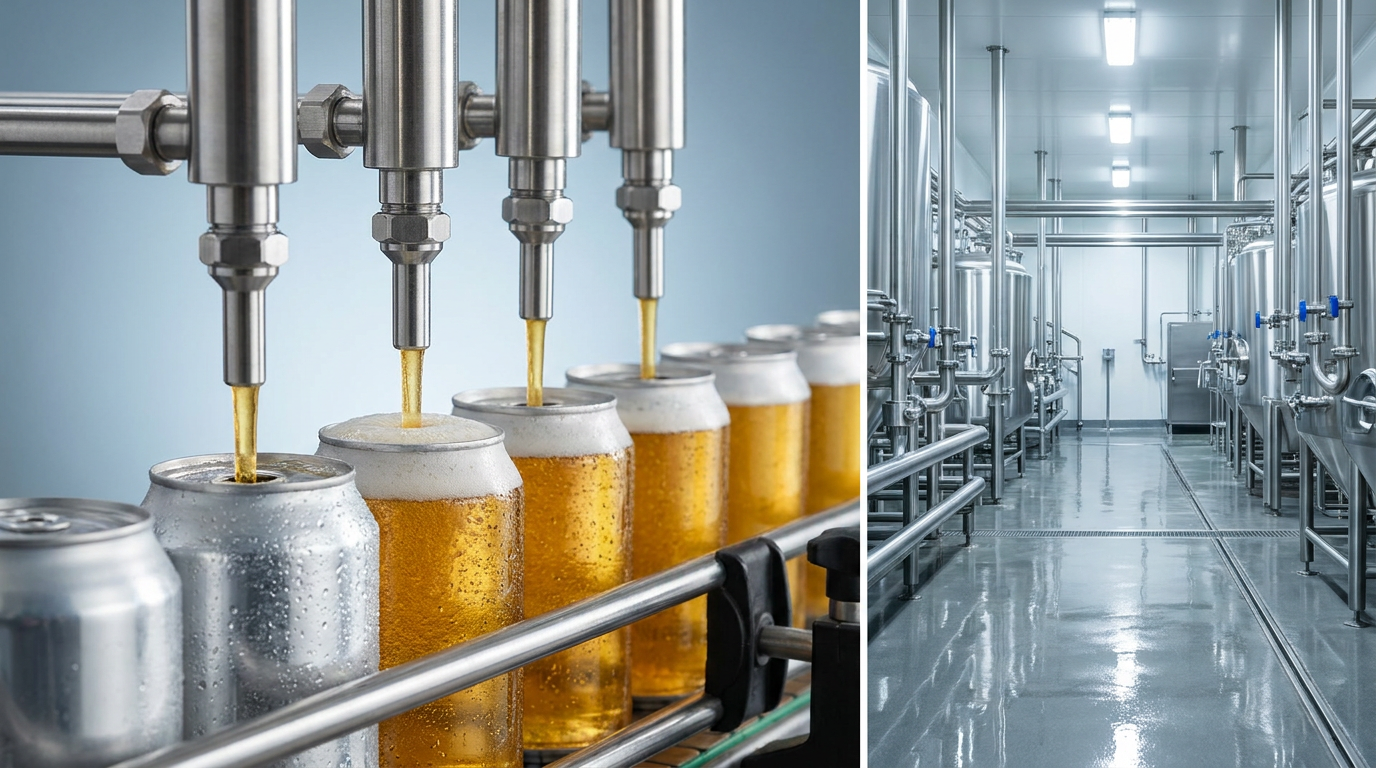
- Validate packaging line environmental controls—not just final product specs. Measure airborne yeast/mold counts (<10 CFU/m³) and surface ATP swabs (<50 RLU) on filler nozzles, capper heads, and conveyor belts during operation, not during idle cleaning.
How QC Gaps Manifest Across Beer Styles
A lager’s crispness collapses if cold-chain breaks during fermentation; a hazy IPA loses turbidity and hop aroma if centrifugation shear exceeds 12,000 rpm; sugar-free low-calorie beer develops diacetyl if yeast stress isn’t monitored via ethanol/acetaldehyde ratios. Jinpai Beer applies style-specific QC gates: e.g., forced-fermentation tests for functional beers, dissolved oxygen mapping for fruit-flavored variants, and glycoprotein stability assays for German wheat.
Generic QC checklists fail here. Your supplier must adjust parameters per recipe—not apply one-size-fits-all pass/fail thresholds.
Three Commonly Overlooked Risks in Private Label Beer China Sourcing
- Water treatment bypasses: Municipal water hardness fluctuates seasonally. Suppliers using only carbon filtration (not reverse osmosis + remineralization) cannot guarantee consistent mash pH—directly impacting enzyme efficiency and final attenuation.
- Yeast propagation without genomic verification: Reusing yeast beyond 5 generations without STR profiling risks strain drift. Off-flavors in subsequent batches often stem from silent mutations—not contamination.
- Can seam inspection limited to visual checks: Micro-leaks cause slow CO₂ loss and oxidation. Suppliers must use vacuum decay testing (±0.5 mbar tolerance) on 100% of filled cans—not just random sampling.
Actionable Steps Before You Sign the Contract
Request unannounced access to their last three production logs for your target style—including dissolved oxygen readings, fermentation temperature variance (±0.3°C max), and microbiological results. Cross-check timestamps: if lab reports show sampling at 9 AM but fermentation logs indicate active CO₂ release until noon, timing misalignment signals procedural gaps.
Order a pilot batch with full QC transparency: receive raw material COAs, daily fermentation logs, filtration pressure curves, and final product stability data—not just a certificate of conformity. Jinpai Beer provides this standard for all private label beer China clients, with shared digital dashboards updated in real time.
Final Takeaway: Quality Is Built in Process—Not Inspected at Exit
Private label beer China success hinges on verifying *how rigor lives in daily practice*—not whether it exists on paper. The five checkpoints above separate suppliers who manage quality from those who merely report it. Every skipped verification multiplies risk exponentially downstream: reformulation delays, retailer returns, consumer complaints.
Start now: audit your current or prospective partner against this list. If three or more items lack documented, observable, repeatable evidence—pause. Jinpai Beer invites direct inquiry for a no-cost QC protocol alignment review, including side-by-side comparison of your requirements against our ISO 22000-certified workflow. Because when it comes to private label beer China, consistency isn’t aspirational. It’s engineered.
Thank you very much for writing to us. Please leave your message and contact information, we will reply to you within 24 hours.