



Private label beer manufacturer demand is surging—especially in non-alcoholic lager lines, which saw 40% YoY growth in 2023. For beer brand owners seeking agility, differentiation, and margin control, partnering with a certified craft-focused private label beer manufacturer like Jinpai Beer unlocks rapid market entry, R&D-backed innovation (e.g., sugar-free, functional, fruit-infused variants), and scalable OEM/ODM support—all backed by global distribution readiness. This isn’t just about outsourcing production; it’s about strategic brand acceleration.
Why Non-Alc Lager Is Driving Private Label Beer Manufacturer Demand
The 40% year-on-year growth in non-alcoholic lager lines isn’t an anomaly—it reflects a structural shift in consumer behavior across key markets: EU, North America, and APAC. Health-conscious millennials and Gen Z consumers now account for over 68% of NA beer trial volume, per Euromonitor’s 2023 Beverage Trends Report. They’re not compromising on taste or experience—they expect craft-level complexity without alcohol’s physiological impact.
This trend directly pressures brand owners: launching an in-house NA lager requires reformulating fermentation kinetics, stabilizing carbonation at sub-0.5% ABV, and validating shelf life under real-world retail conditions—all within 90–120 days to stay competitive. Most independent brands lack the pilot-brewing infrastructure, sensory labs, or regulatory filing capacity to execute this alone.
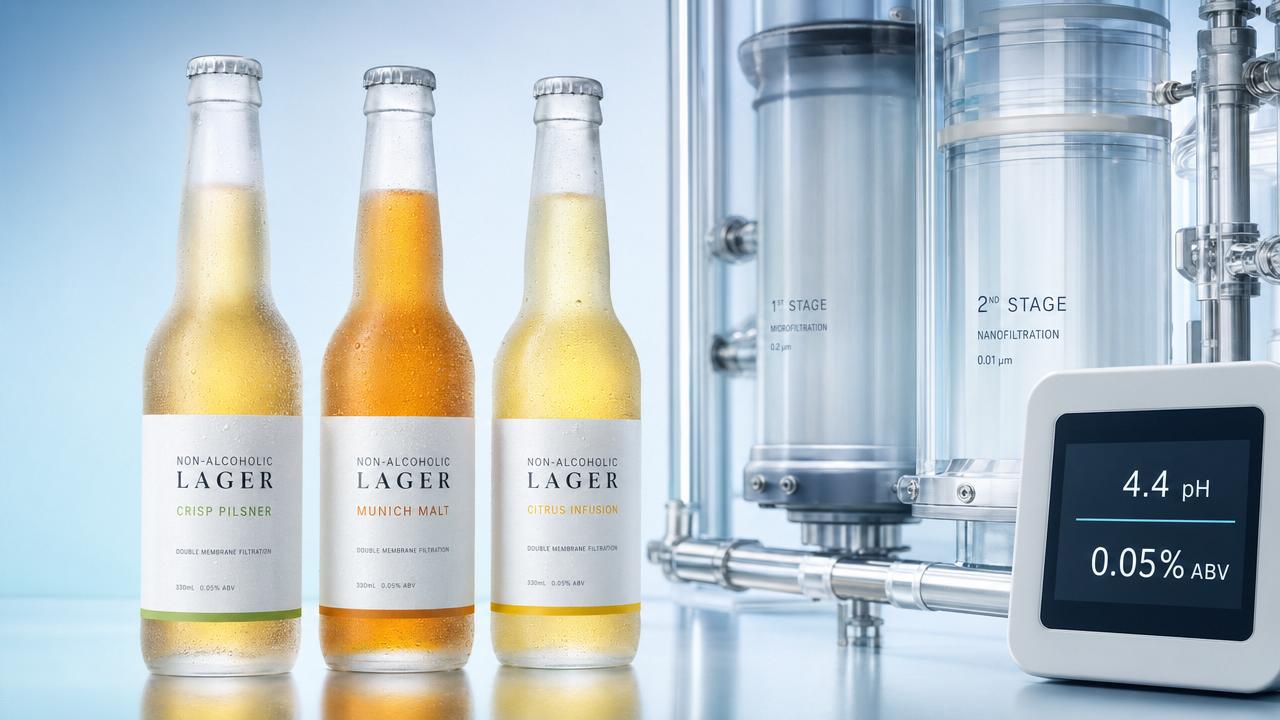
That’s where a specialized private label beer manufacturer becomes mission-critical—not as a vendor, but as an extension of your product team. Jinpai Beer’s NA lager platform includes three validated base profiles (crisp pilsner-style, malt-forward Munich, and citrus-adjunct ready), each pre-tested for stability at 25°C for ≥180 days and compliant with EU Regulation (EC) No 1169/2011 labeling standards.
Core Technical Requirements for Scalable NA Lager Production
- Alcohol removal via vacuum distillation or cold filtration—Jinpai uses dual-stage membrane separation to retain volatile hop oils while achieving ≤0.05% ABV
- pH stabilization between 4.2–4.6 to inhibit microbial regrowth during cold-chain transit
- Carbonation consistency ±0.05 vol across 10,000-unit batches (validated via inline CO₂ sensors)
- Label-ready compliance: All NA lagers meet FDA 21 CFR §101.30 and EU “alcohol-free” definition (≤0.5% ABV)
How to Evaluate a Private Label Beer Manufacturer Beyond Price
Price is rarely the bottleneck—lead time, formulation flexibility, and certification portability are. A low-cost supplier quoting $0.85/unit may require 12-week MOQ commitments, offer no co-packing for fruit purees, and lack BRCGS Food Safety certification—making them unsuitable for supermarket listings in Germany or Canada.
Brand owners should assess five non-negotiable dimensions before signing an OEM agreement. These go beyond standard capability checklists and align with real-world go-to-market constraints:
This table reveals why many brand owners pivot after their first engagement: scalability isn’t just about volume—it’s about how quickly you can test, iterate, and certify new variants. Jinpai’s modular brewhouse design allows simultaneous production of classic lager, German wheat, and sugar-free NA lager on shared CIP lines—cutting cross-contamination risk and reducing changeover time to under 4 hours.
From Concept to Shelf: The 5-Phase OEM Launch Timeline
Time-to-shelf remains the top barrier for new beer brands. Internal brewing delays average 18–22 weeks from concept to first retail delivery. A streamlined private label beer manufacturer compresses that into five tightly coordinated phases—each with defined deliverables and owner checkpoints.
- Phase 1 – Brief & Feasibility (3–5 business days): Technical review of target ABV, sweetness profile, packaging format, and regional compliance requirements
- Phase 2 – Recipe Validation (7–10 days): Pilot batch + lab analysis (IBU, SRM, residual sugar, microbiological safety)
- Phase 3 – Regulatory Alignment (5–8 days): Label copy sign-off, allergen declaration, and country-specific nutritional panel formatting
- Phase 4 – Trial Production (12–15 days): 500–2,000-unit run with full traceability batch records
- Phase 5 – Commercial Scale-Up (18–22 days): First 10,000-unit order with logistics coordination for DDP or FCA terms
This end-to-end timeline averages 45–55 days—nearly 60% faster than traditional brewery partnerships. Crucially, Jinpai Beer embeds quality gates at Phases 2 and 4: no batch proceeds without your signed sensory approval and third-party lab verification.
Why Brand Owners Choose Jinpai Beer for Strategic OEM Partnerships
It’s not just about having a brewery—it’s about having a partner who treats your brand equity as their own. Jinpai Beer supports beer brand owners through three distinct value layers:
- Product Layer: Full portfolio coverage—from classic lager and German wheat to functional specialties (e.g., magnesium-enriched NA lager, probiotic-infused fruit beer)—all brewed on dedicated stainless-steel lines with zero shared yeast carriers
- Commercial Layer: Global channel readiness: pre-vetted logistics partners in 22 countries, bilingual label templates (EN/ES/FR/DE/CN), and direct integration with Shopify, Magento, and SAP S/4HANA for inventory sync
- Strategic Layer: Co-branded trend reports (e.g., “2024 Functional Beer Demand Index”), quarterly innovation briefings, and priority access to limited-edition hop varieties (Citra X3, Sabro Cryo™)
If you’re evaluating private label beer manufacturer options for your next NA lager launch—or scaling an existing line—we invite you to request a tailored OEM assessment. Specify your target market, desired packaging (can/bottle/keg), volume range (500–50,000 units/month), and any functional or dietary claims (sugar-free, vegan, low-calorie). We’ll return a technical feasibility summary, compliance roadmap, and sample timeline within 48 business hours.
Ready to accelerate your brand?
Contact Jinpai Beer today for: • Free NA lager formulation consultation • BRCGS-certified facility tour (virtual or onsite) • Customized MOQ and lead-time modeling • Label compliance review for your top 3 target markets
Thank you very much for writing to us. Please leave your message and contact information, we will reply to you within 24 hours.