



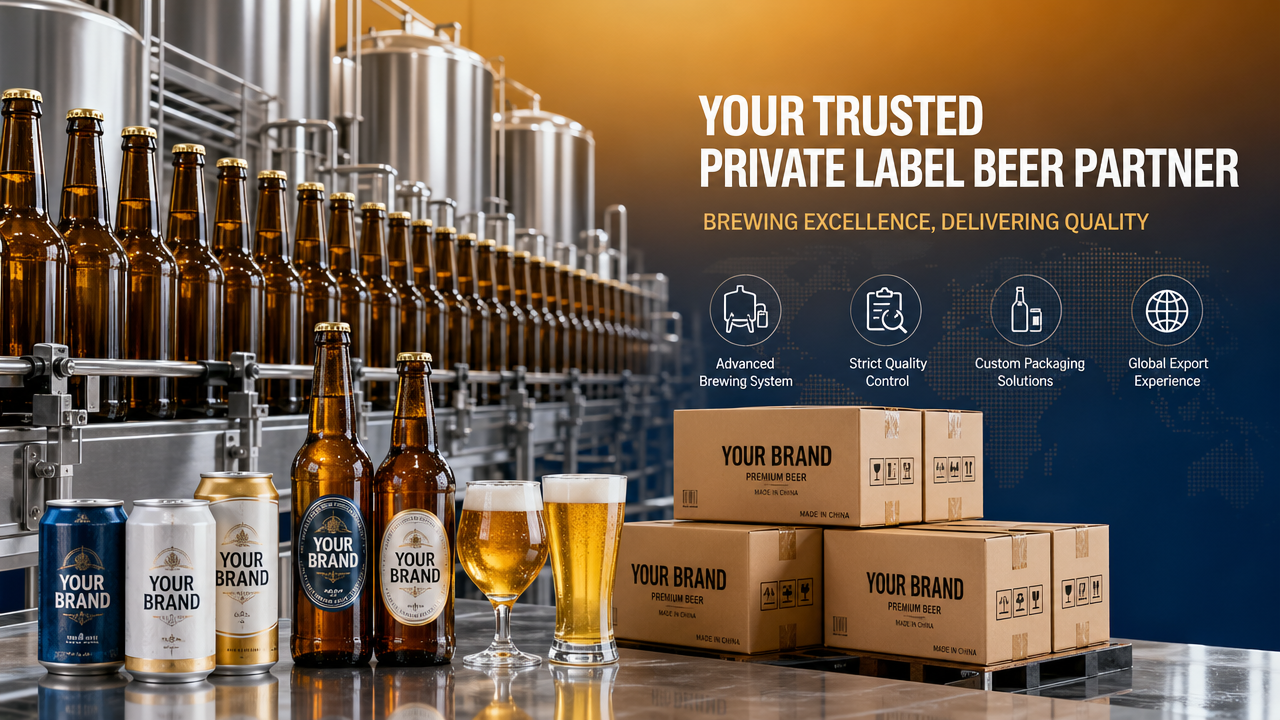
Choosing a private label beer manufacturer is not just about getting the lowest quote. The first checks should focus on whether the brewery can actually brew consistently, meet export requirements, develop recipes that match your market, and supply your business without disruption. For buyers, brand owners, distributors, and retail decision-makers, these points matter far more than a sample that tastes good once. If you are comparing a beer manufacturer in China, the safest approach is to verify technical capability, compliance, customization capacity, and long-term reliability before discussing volume discounts.
What should you check first in a private label beer manufacturer?
The first priority is brewing capability. Many buyers start with packaging, label design, or price per unit, but those come after one basic question: can the manufacturer produce stable beer quality at commercial scale?
Ask for clear evidence of:
- Actual brewery production lines and fermentation capacity
- Beer styles already produced for different markets
- Batch consistency controls
- Quality inspection procedures for alcohol, bitterness, color, and microbiological safety
- Shelf-life testing and packaging compatibility
A reliable private label beer manufacturer should be able to explain not only what it can brew, but how it maintains consistency from pilot sample to bulk production. This is especially important for importers, supermarket buyers, and distributors who cannot afford complaints caused by unstable flavor, haze issues, carbonation inconsistency, or leakage during shipping.
Can the factory legally export and support your target market?
After brewing capability, export compliance is the next critical filter. A good beer product means little if customs clearance, labeling rules, or documentation become a problem.
Before moving forward, buyers should confirm whether the manufacturer can provide:
- Valid export qualifications
- Food production licenses and factory certifications
- Ingredient and specification sheets
- Certificate of origin, health certificates, and other shipping documents when required
- Labeling support for local market regulations
For decision-makers, this check reduces operational risk. For distributors and agents, it protects channel reputation. For retailers, it helps avoid delays, product holds, and relabeling costs. A professional beer manufacturer China partner should understand that compliance is part of the service, not an afterthought.
Does the manufacturer support recipe development or only standard products?
Not every buyer wants the same thing. Some need a fast-moving standard lager with competitive pricing. Others want a differentiated product for restaurants, bars, retail chains, or online sales. That is why recipe development should be checked early.
A capable OEM/ODM brewery should be able to support:
- Classic mainstream beer styles for volume sales
- Custom flavor, aroma, bitterness, and alcohol level adjustment
- Sugar-free or low-calorie concepts for health-focused consumers
- Fruit beer or specialty beer for younger and trend-driven markets
- Packaging selection based on positioning and price strategy
This matters because your commercial success depends on product-market fit, not just production. For example, some channels respond better to easy-drinking wheat styles, while others need stronger visual differentiation or functional positioning. A manufacturer with broad craft and commercial beer development experience can help align the liquid with the channel.
In some cases, a buyer may start from an existing style and adapt it into a market-ready SKU, such as Whole wheat lager Beer, if the target audience prefers a smoother and more approachable profile.
How do you judge supply stability beyond the first order?
Many sourcing problems do not appear in sampling; they appear after the first successful order. That is why supply stability should be reviewed before signing the deal.
Ask practical questions such as:
- What is the normal lead time for repeat orders?
- How does the brewery handle peak season demand?
- Can it secure stable raw material supply for malt, hops, cans, bottles, and cartons?
- What is the minimum order quantity for different packaging formats?
- How are production slots reserved for long-term customers?
For business buyers, stable supply directly affects cash flow, promotion schedules, distributor confidence, and shelf continuity. A manufacturer that offers good pricing but weak planning can create much higher hidden costs later.
What packaging and customization details should buyers verify early?
Private label success depends not only on the beer itself, but also on how well the final product fits your market. Packaging errors can delay launch or weaken brand perception.
Check whether the manufacturer can support:
- Can and bottle formats suitable for your channel
- Private label design implementation
- Outer carton customization for transport and retail display
- Language adaptation for labels and consumer information
- Sampling for packaging appearance before mass production
This is where experienced OEM/ODM support becomes valuable. A factory that understands restaurants, bars, supermarkets, and retail distribution will usually ask better questions about your end use, instead of only offering generic options.
How can you compare manufacturers without being misled by price?
Price matters, but it should be judged in context. The lowest quote may exclude quality controls, export support, recipe work, better packaging materials, or reliable logistics coordination.
When comparing suppliers, evaluate total decision value across these factors:
- Brewing consistency and beer quality
- Export documentation and market compliance
- Customization flexibility
- Production lead time and replenishment reliability
- Communication efficiency and problem-solving ability
- Long-term support for brand growth
This method is especially useful for procurement teams and company leaders who need to reduce risk, not just lower purchase cost. A better supplier relationship often creates stronger long-term margin through fewer claims, fewer delays, and better repeat sales.
Why do global buyers work with an export-ready Chinese beer factory?
For many overseas buyers, working with a Chinese brewery can offer a strong combination of manufacturing flexibility, scalable production, and product customization. The key is choosing a partner with real brewing capability and export experience.
Jinpai Beer focuses on the R&D, production, and distribution of craft beer, covering classic lager, German wheat, sugar-free low-calorie beer, fruit-flavored beer, and functional specialty beers. With OEM/ODM services, wholesale supply, and customized solutions, the company supports global distributors, agents, retailers, restaurants, supermarkets, and other sales channels looking for dependable contract brewing and private label beer production.
For buyers seeking a practical beer manufacturer China solution, the right partner should help from recipe selection to packaging execution and shipment coordination. Whether you need a standard line or a tailored product similar to Whole wheat lager Beer, the real value lies in reliable delivery and market-fit support.
Final checklist before you choose a private label beer manufacturer
Before making your final decision, confirm these five essentials:
- The brewery has proven brewing and quality control capability
- The factory can legally export and provide required documentation
- It can support recipe development or product adaptation for your market
- Its production and raw material system can support repeat orders reliably
- Its communication, packaging, and service process match your business needs
In short, the first thing to check is not price, but whether the manufacturer is truly capable of being a long-term supply partner. When brewing strength, export compliance, customization, and supply stability are in place, pricing discussions become more meaningful. That is how buyers reduce risk, launch faster, and build a beer brand with confidence.
Thank you very much for writing to us. Please leave your message and contact information, we will reply to you within 24 hours.