



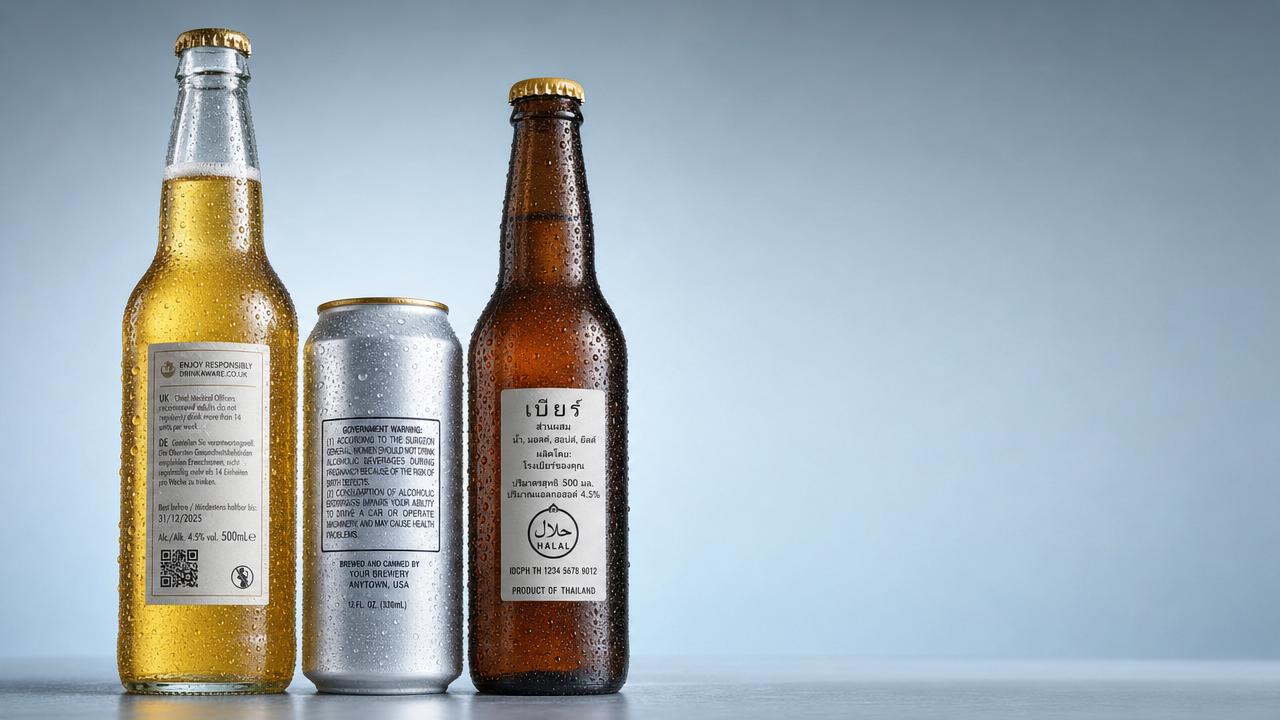
For project managers overseeing global beverage supply chains, understanding the operational realities of Chinese beer factory OEM service is critical to on-time delivery and compliance. Lead time variability, minimum order quantity (MOQ) requirements, and evolving labeling regulations—especially for export markets like the EU, US, and ASEAN—can significantly impact project timelines and cost planning. At Jinpai Beer, our craft-focused OEM/ODM platform balances flexibility with rigor: we support low-MOQ pilot batches, provide transparent lead time windows backed by in-house brewing capacity, and ensure labeling compliance across key jurisdictions. Let’s break down how these three constraints shape successful partnerships.
When does lead time dictate your go-to-market schedule?
Lead time for Chinese beer factory OEM service is rarely fixed—it reflects raw material sourcing, fermentation cycles, packaging line availability, and customs documentation readiness.
At Jinpai Beer, standard lead time for a new craft beer OEM batch is 45–60 days from confirmed artwork and deposit. This includes 14 days for recipe validation and stability testing, 21–30 days for active fermentation and conditioning, and 7–10 days for labeling, bottling/canning, and pre-shipment inspection.
Urgent orders (e.g., festival launches or limited-edition drops) can be expedited to 30 days—but only with advance notice, pre-approved formulations, and priority slot allocation.
How MOQ affects your market entry strategy
Minimum order quantity is often the first operational filter for international partners evaluating Chinese beer factory OEM service.
Unlike mass-producers requiring 20,000+ units per SKU, Jinpai Beer offers tiered MOQs aligned with product type and packaging format:
- Classic lager (330 mL cans): 5,000 units
- Fruit-flavored or functional specialty beers (500 mL bottles): 3,000 units
- Sugar-free low-calorie variants (with certified sweeteners): 2,000 units
- Pilot runs for label testing or sensory validation: 500 units (subject to formulation approval)
Lower MOQs are enabled by modular brewhouse scheduling and shared-labeling line utilization—not by compromising on traceability or batch documentation.
Which labeling rules apply—and where do they diverge?
Labeling compliance isn’t one-size-fits-all. Each target market imposes distinct requirements on language, allergen disclosure, alcohol-by-volume (ABV), health warnings, and ingredient hierarchy.
Jinpai Beer maintains jurisdiction-specific label templates verified by local regulatory consultants:
- EU exports: Must include QR-code-linked nutritional declaration, mandatory “contains sulfites” statement, and bilingual (English + destination language) font sizing ≥1.2 mm.
- US imports: Require TTB-approved formula registration, “Government Warning” statement, net contents in US customary units, and responsible party address in English.
- ASEAN markets (e.g., Thailand, Vietnam): Require local-language translation, halal certification references (if applicable), and country-of-origin in native script.
We embed label compliance into the OEM workflow—not as a final checkpoint, but as an integrated design phase.
How do these three constraints interact in real-world scenarios?
Lead time, MOQ, and labeling compliance don’t operate in isolation. Their interplay determines feasibility, risk exposure, and scalability potential.
What’s commonly overlooked when planning Chinese beer factory OEM service?
Three missteps recur across successful and stalled partnerships:
- Assuming “standard lead time” applies equally to new yeast strains or novel adjuncts—custom fermentation profiles require +10–14 days validation.
- Treating MOQ as negotiable post-contract—once production scheduling locks in, changes trigger rescheduling fees and timeline slippage.
- Submitting label drafts without jurisdiction-specific legal review—TTB rejections or EU RAPEX alerts delay shipments by 3–6 weeks.
These aren’t bottlenecks—they’re design parameters. Planning around them prevents cascade delays.
Next steps to align your project with Jinpai Beer’s OEM framework
Start with clarity—not commitment.
- Share your target market(s), volume forecast, and packaging preference—we’ll confirm feasible MOQ and lead time within 48 hours.
- Submit draft label copy for preliminary compliance scan (free, no obligation).
- Request access to our digital OEM portal: real-time production tracking, document repository, and formulation version control.
Jinpai Beer doesn’t just fulfill Chinese beer factory OEM service—we co-engineer launch readiness. With full in-house brewing, QA/QC, and regulatory operations, we turn constraints into calibrated advantages.
Explore tailored solutions for restaurants, supermarkets, bars, and retail channels worldwide. Contact our OEM team today to begin your compliant, on-schedule, scalable craft beer partnership.
Thank you very much for writing to us. Please leave your message and contact information, we will reply to you within 24 hours.