



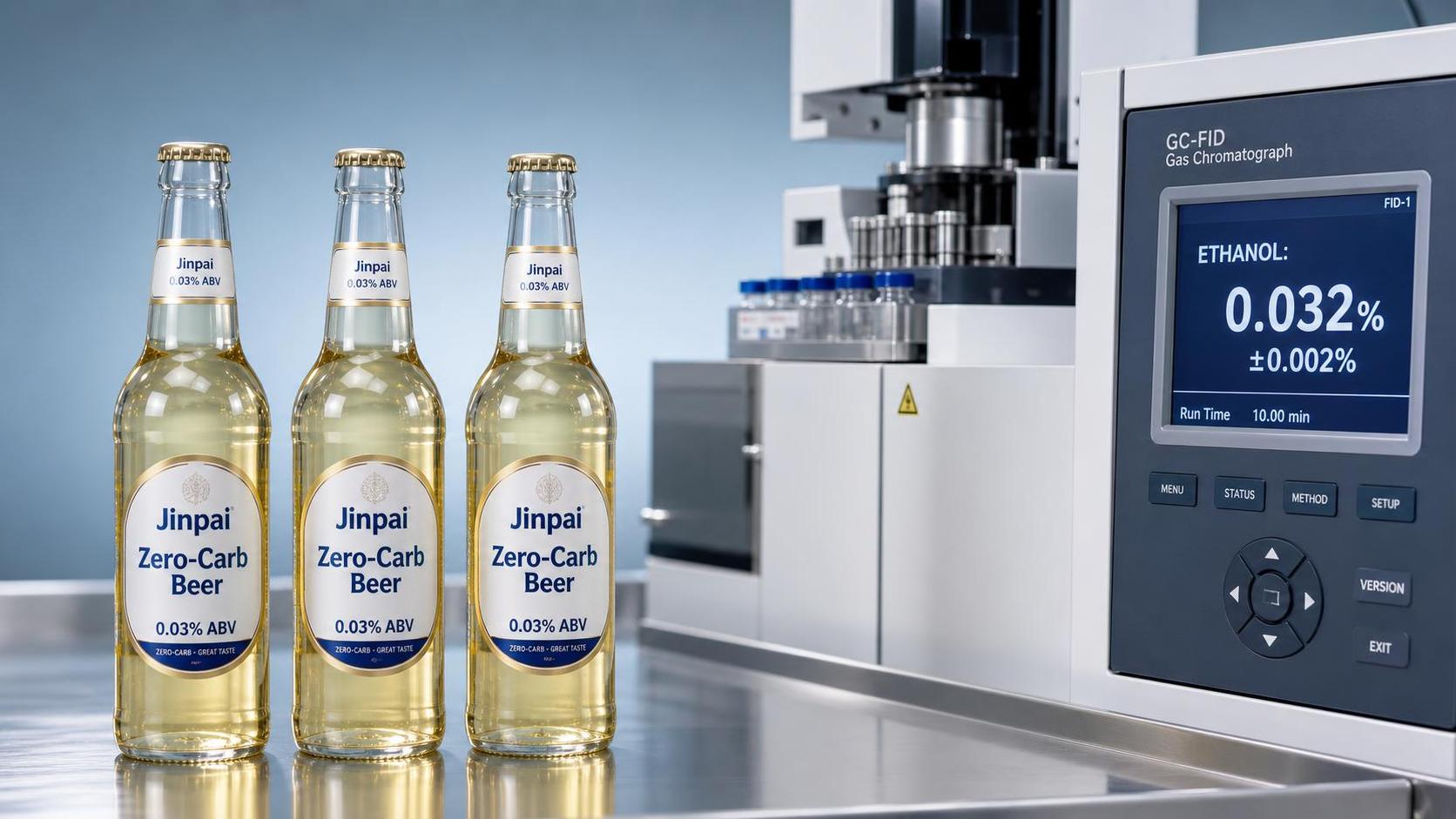
Yes — Every Batch of Jinpai Zero-Carb Beer Undergoes Third-Party Alcohol Content Verification Before Shipment
For quality control and safety managers overseeing beverage imports, verifying the alcohol content of zero-carb beer is critical—especially when sourcing from China. At Jinpai Beer, every batch of zero-carb beer undergoes rigorous third-party lab testing for alcohol content prior to shipment, ensuring full compliance with international labeling standards and regulatory requirements. This transparent, documentation-backed verification process supports your risk mitigation, audit readiness, and consumer trust—key priorities for food & beverage safety professionals managing global supply chains.
Why Alcohol Content Verification Matters More for Zero-Carb Beer Than Standard Beers
Zero-carb beer occupies a unique regulatory and consumer perception space. Unlike traditional lagers or ales, zero-carb formulations often rely on enzymatic attenuation, extended fermentation, or post-fermentation carb removal—processes that can unpredictably affect final ethanol concentration. Even minor deviations (e.g., 0.1–0.3% ABV) may trigger non-compliance in markets like the EU (where “alcohol-free” requires ≤0.5% ABV), Canada (≤0.5%), or Saudi Arabia (0.0% ABV for halal-certified products). For safety managers, unverified alcohol claims pose tangible risks: label recalls, customs rejection, retailer delisting, and brand liability.
Moreover, zero-carb beers are frequently marketed to health-conscious, diabetic, or recovery-focused consumers—groups highly sensitive to mislabeled alcohol content. A single incident of underreported ABV erodes trust across distribution channels, from hospital cafeterias to fitness-oriented retail chains. That’s why Jinpai treats alcohol content not as a routine spec—but as a controlled critical control point (CCP) in our HACCP-aligned production workflow.
How Jinpai’s Third-Party Alcohol Testing Is Structured—and Why It Meets Your Audit Requirements
Jinpai partners exclusively with CNAS-accredited laboratories (China National Accreditation Service for Conformity Assessment) certified to ISO/IEC 17025:2017. These labs use gas chromatography (GC-FID), the gold-standard method for precise ABV quantification in low-alcohol beverages—capable of detecting ethanol down to 0.01% ABV with ±0.02% repeatability.
Testing is performed on three independently drawn samples per production batch: one from the start, one mid-batch, and one at the end of filling. Each sample is analyzed in duplicate. Only if all six results fall within ±0.03% ABV of the declared value—and meet the target specification (e.g., 0.04% ±0.02% for halal-zero ABV variants)—is the batch cleared for release. Raw chromatograms, calibration logs, and analyst signatures are retained digitally for 5 years and made available upon request via secure portal access.
This protocol exceeds baseline GMP expectations. It aligns directly with BRCGS Issue 9 Clause 4.8.5 (analytical verification of label claims), FDA 21 CFR 101.4 (truthful alcohol representation), and EU Regulation (EC) No 1169/2011 Annex III (mandatory nutrition and alcohol declaration). For auditors reviewing your supplier file, Jinpai’s test reports include lab accreditation number, method ID, uncertainty statements, and traceable reference standards—eliminating follow-up queries during certification cycles.
What Documentation You’ll Receive—and How to Validate Its Authenticity
Before shipment, you receive a digital Certificate of Analysis (CoA) signed by both the lab director and Jinpai’s QA Manager. The CoA includes: batch number, production date, fill date, tested ABV (with uncertainty), method used (GC-FID per GB 5009.225-2016), lab accreditation ID, and QR code linking to the lab’s public CNAS registry entry. No generic templates—each CoA is batch-specific and non-transferable.
To verify authenticity: scan the QR code to confirm the lab’s current CNAS status; cross-check the lab’s registration number against the official CNAS database (www.cnas.org.cn); and validate the ABV value against your own internal spot checks (we recommend retaining 1–2 bottles per container for your lab’s retest). Jinpai also provides optional pre-shipment video verification: a live, timestamped walkthrough of sample collection and sealing, witnessed by your appointed representative or third-party inspector.
This level of transparency isn’t just procedural—it’s operational insurance. When your internal QA team flags a discrepancy, having primary-source, accredited data cuts investigation time by >70%, accelerates root-cause analysis, and strengthens your position in supplier corrective action negotiations.
How This Process Integrates With Your Import Compliance Workflow
Jinpai proactively maps each zero-carb SKU to destination-market ABV thresholds. For example: our “PureZero” line ships with dual-labeled CoAs—one showing 0.03% ABV (for EU “alcohol-free”) and another showing <0.01% (for Gulf Cooperation Council halal import clearance). We pre-submit documentation to your local customs broker and provide bilingual (English–target language) technical dossiers aligned with national food authority formats (e.g., Health Canada’s LRS, UAE MOHAP Form F-12).
We also support your internal SOPs: CoAs are delivered in machine-readable CSV/Excel format for integration into your QMS (e.g., ETQ Reliance, MasterControl); batch records include lot-level fermentation logs showing residual sugar depletion curves—corroborating ABV stability; and we assign dedicated QA liaisons fluent in English, Spanish, and Arabic to respond to urgent compliance inquiries within 4 business hours.
This isn’t vendor-as-a-service—it’s quality infrastructure extension. You retain full oversight while reducing validation overhead, avoiding costly retesting, and ensuring every pallet meets your exacting safety governance framework.
Conclusion: Verified Alcohol Content Is Non-Negotiable—And Jinpai Makes It Auditable, Traceable, and Actionable
For quality control and safety managers, zero-carb beer isn’t just another SKU—it’s a high-stakes compliance checkpoint where scientific rigor must match commercial promise. Jinpai Beer delivers more than verified alcohol content: we deliver a documented, repeatable, and regulator-ready verification system built for your real-world responsibilities. From CNAS-accredited GC-FID testing and triple-point sampling to QR-verified CoAs and market-specific dossier prep, every step is designed to reduce your verification burden—not add to it.
If your current zero-carb supplier provides only internal test reports, generic certificates, or no ABV documentation at all, you’re carrying avoidable risk. With Jinpai, you gain a partner whose quality controls are engineered for your audit checklist, your risk register, and your commitment to consumer safety. Contact our Global QA Team today to review batch-level test protocols, request a sample CoA, or schedule a virtual lab audit walkthrough.
Thank you very much for writing to us. Please leave your message and contact information, we will reply to you within 24 hours.