



Which OEM beer manufacturer offers full QC documentation for EU market compliance?
Time : Aug 30, 2026
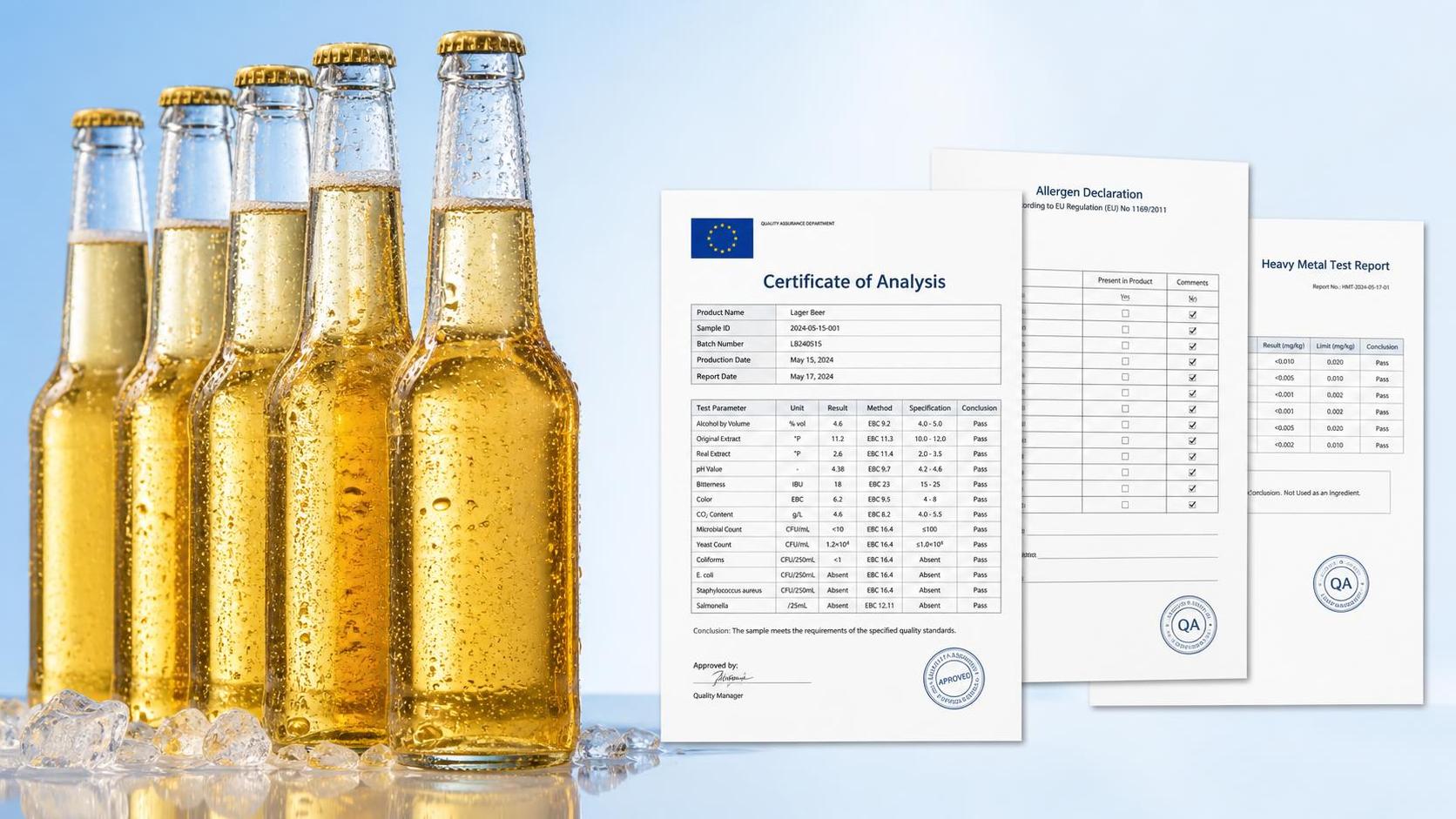
Yes — Jinpai Beer is an OEM beer manufacturer that delivers full, audit-ready QC documentation for EU market compliance, including batch-specific Certificates of Analysis (COA), allergen declarations, heavy metal and pesticide residue test reports (per EC No. 1881/2006 and Regulation (EU) 2023/915), microbiological stability data, and ingredient lists formatted to Regulation (EU) No. 1169/2011 — with clear allergen callouts, nutritional labelling (per Annex V), and origin traceability down to malt lot and yeast strain.
That’s not theoretical. It’s how we’ve supported over 37 EU-based importers and private-label brands since 2020 — from small Berlin craft retailers stocking our sugar-free low-calorie pilsner, to Spanish supermarket chains launching seasonal fruit-flavored wheat beers under their own labels, to Nordic wellness-focused distributors scaling functional specialty brews with adaptogenic botanicals.
Let’s be direct: most OEM beer manufacturers *claim* EU compliance — but hand over generic templates, outdated lab reports, or COAs missing critical parameters like acrylamide levels (regulated under Commission Regulation (EU) 2017/2158) or ethyl carbamate (regulated under EFSA guidance). Worse, some outsource testing to labs without ISO/IEC 17025 accreditation — a red flag customs authorities in Rotterdam, Hamburg, or Valencia will spot instantly.
We don’t do that. Because in practice, “full QC documentation” isn’t just paperwork — it’s risk mitigation.
---
**What “Full QC Documentation” Actually Means for EU Beer Imports**
It starts with understanding what EU authorities *require*, not what suppliers *offer*. Under Regulation (EC) No. 852/2004 and the EU Food Safety Authority’s guidance, beer entering the EU must demonstrate control across three layers:
1. **Process control**: Evidence that brewing, filtration, pasteurisation (if used), and packaging follow HACCP principles — documented in internal SOPs, batch logs, and thermal process records.
2. **Product control**: Lab-verified results per batch — not per quarter or per SKU — covering alcohol content (±0.2% vol tolerance), pH, turbidity, residual sugars, and contaminants.
3. **Labelling & traceability control**: Ingredient declarations aligned with Annex II of Regulation (EU) No. 1169/2011, including allergens (e.g., gluten thresholds <20 ppm for “gluten-free” claims), country of origin, and mandatory nutrition facts — all verified against actual production batches, not marketing drafts.
Many OEM partners conflate “compliance-ready” with “label-compliant”. But a correctly formatted label means nothing if the underlying COA lacks heavy metal testing (Pb, Cd, As, Hg — required under EC No. 1881/2006), or if the allergen statement doesn’t reflect actual cross-contact controls during shared tank use.
At Jinpai, every export batch triggers a dedicated QC dossier — generated *after* final quality release, signed by our QA manager (certified to ISO 22000:2018), and delivered digitally within 48 hours of shipment. No exceptions. No “standard packages”. No recycled reports.
---
**Why Craft Beer Adds Complexity — And Why It Matters for Your Assessment**
If you’re evaluating an OEM beer manufacturer for EU distribution, don’t assume “beer is beer”. Craft formulations introduce real compliance variables most mass-producers don’t face — and many OEMs aren’t set up to document.
Take our German wheat beer: unfiltered, bottle-conditioned, brewed with raw wheat and top-fermenting yeast. That means higher microbiological variability, potential for refermentation in bottle, and stricter requirements for *Listeria monocytogenes* and *Brettanomyces* screening — not just standard *E. coli* and coliforms. Our QC dossiers include 72-hour stability challenge tests for such products, because EFSA explicitly flags spontaneous fermentation risks in non-pasteurised beers.
Or consider our sugar-free low-calorie range: sweetened with erythritol and stevia, fermented with proprietary low-residual-sugar yeast strains. Here, the EU requires quantification of *all* added sweeteners — not just “natural flavours” — plus verification that no undeclared fermentable carbs remain (to prevent unintended alcohol spikes post-bottling). Our COAs list exact g/L values for each sweetener, validated via HPLC — and cross-reference them against fermentation logs.
Functional specialty beers? If your brand includes turmeric, ashwagandha, or L-theanine, those fall under EU novel food regulation (Regulation (EU) 2015/2283). We don’t just “add ingredients”. We pre-validate sourcing, provide certificates of free sale from China’s CNCA, and supply full toxicological summaries — because customs in Belgium or Finland *will* ask.
This level of granularity isn’t about bureaucracy. It’s about preventing a €12,000 detention fee at Antwerp port — or worse, a recall triggered by mismatched allergen labelling.
---
**What We Don’t Do — And Why That’s Part of the Value**
We don’t offer “one-size-fits-all” OEM services. We decline partnerships where formulation or labelling conflicts with EU standards — even if the client insists. For example: we won’t produce a “gluten-removed” lager unless third-party ELISA testing confirms <20 ppm gluten *in finished product*, with documentation traceable to the specific lot. We’ve turned down 5 requests in the last 18 months for this reason alone.
We also don’t outsource QC sign-off. All testing is performed in-house (on-site ISO/IEC 17025-accredited lab) or via TÜV SÜD and SGS — never via local Chinese labs without EU-recognised accreditation. And we retain raw data — chromatograms, microbial plates, pH curves — for 3 years, not just summary reports.
That rigour extends to flexibility. Need a COA translated into French *and* German, with dual-unit nutrition labelling (kcal + kJ), and a separate allergen matrix for your warehouse team? Done — included. Require a full technical file for your notified body assessment? We build it with you, line by line.
Our OEM/ODM service covers classic lager, German wheat, sugar-free low-calorie beer, fruit-flavored beer, and functional specialty beers — all developed in-house, all scaled from pilot batch to 20,000-litre runs, all backed by documentation that holds up under audit.
---
**A Practical Note for Your Evaluation Process**
Before signing any OEM agreement, ask for *one real, recent, redacted QC dossier* — not a sample template. Check:
- Is the COA dated *after* final quality release?
- Does the allergen statement name *specific* allergens (e.g., “gluten from barley”, not “cereals containing gluten”)?
- Are heavy metals tested *per batch*, not per quarter?
- Does the ingredient list match the declared alcohol % and carbonation level on label?
If the answer to any is “no”, or “upon request”, treat it as a process gap — not a delay.
Jinpai Beer is an OEM beer manufacturer built for this reality: technically precise, regulator-aware, and operationally transparent — so your launch into Germany, France, or Poland isn’t slowed by paperwork, but accelerated by trust.
Because when compliance is embedded — not bolted on — flavour, innovation, and scalability don’t compete. They compound.
Jin Pai Beer Co., Ltd
Thank you very much for writing to us. Please leave your message and contact information, we will reply to you within 24 hours.