



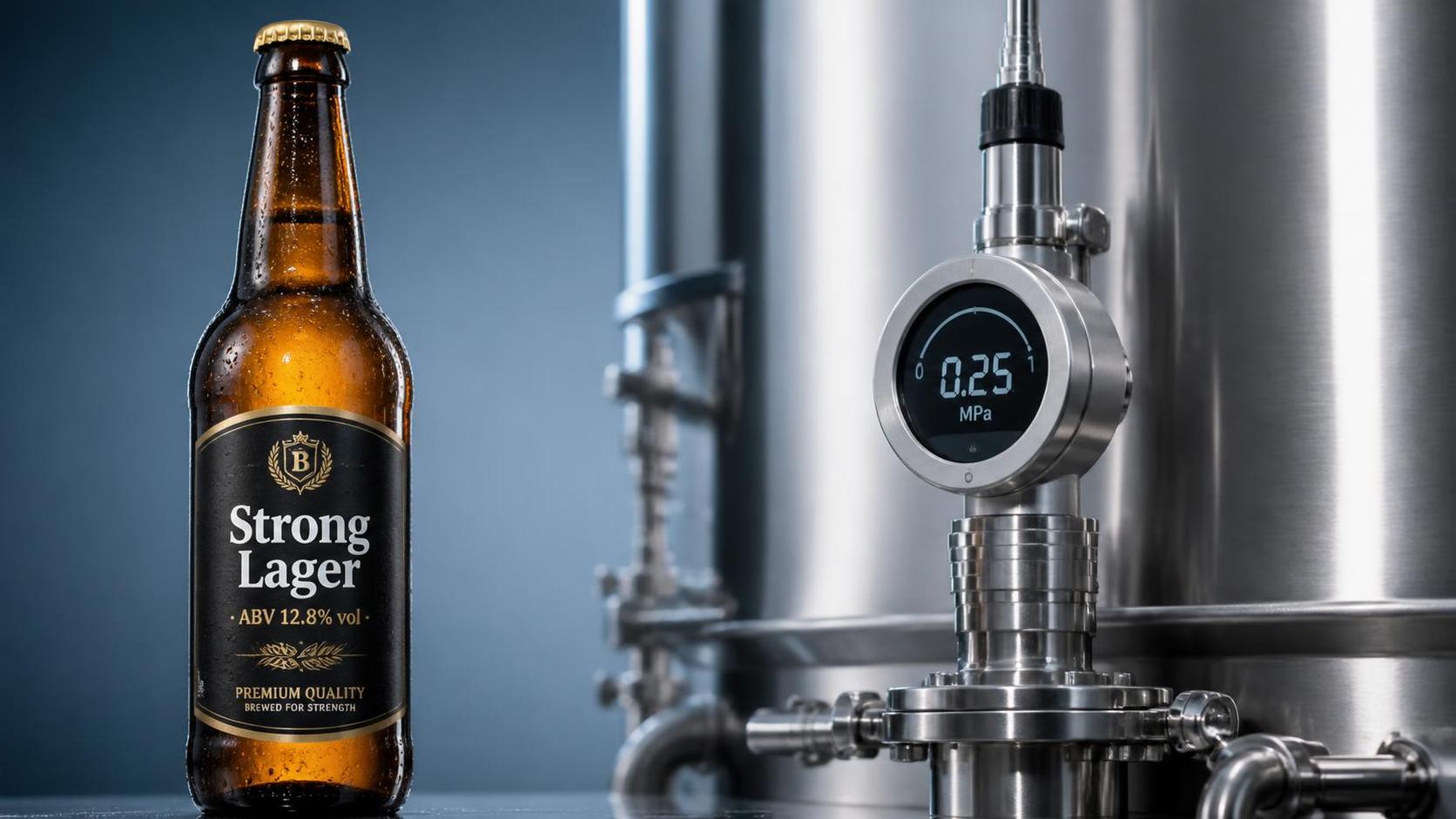
Maximum ABV for Strong Lager Beer Under China’s Food Safety Licensing: A Technical Compliance Guide
For technical evaluators assessing regulatory compliance and formulation limits, understanding the maximum allowable ABV for Strong lager beer under China’s food safety licensing framework is critical. This article examines the statutory alcohol-by-volume ceiling—rooted in GB 2758-2012 and related SC licensing requirements—and clarifies how Jinpai Beer’s R&D and production systems ensure full compliance while delivering premium, high-strength lager profiles. We address testing protocols, label declaration standards, and practical implications for OEM/ODM partners sourcing Strong lager beer for global markets.
What Is the Legal ABV Ceiling for Strong Lager Beer in China?
The short answer: there is no fixed “ceiling” defined solely by beer category name—but rather a science-based, legally enforceable upper limit tied to classification, labeling, and production licensing. Per China’s National Food Safety Standard GB 2758–2012 (Fermented Alcoholic Beverages), the maximum permitted ABV for *beer*—including Strong lager beer—is 13.0% vol. This threshold is not arbitrary; it reflects microbial stability, shelf-life validation, and ethanol’s functional role as a preservative in non-pasteurized or low-processed products.
Crucially, exceeding 13.0% ABV triggers reclassification under Chinese law: the product ceases to be “beer” and becomes “alcoholic beverage” (GB/T 17204–2021), requiring separate SC license categories, distinct raw material controls, and different hygiene management protocols. For technical evaluators, this boundary is operational—not semantic.
Why 13.0% ABV Is the De Facto Limit—and Why It Matters for Your Formulation
This limit arises from three interlocking regulatory layers: (1) GB 2758–2012’s definition of beer as “fermented alcoholic beverage made from malted cereal grains, with or without adjuncts, using brewing yeast”; (2) the SC licensing catalog (Annex of SC License Category Catalogue, issued by SAMR), which lists “Beer (Category 1503)” with explicit ABV range guidance; and (3) mandatory testing requirements under GB 5009.225–2016, where declared ABV must fall within ±0.3% vol tolerance of measured value.
For Strong lager beer development, crossing 13.0% ABV forces a license change—from SC 1503 (Beer) to SC 1501 (Distilled Spirits) or SC 1502 (Other Fermented Alcoholic Beverages)—neither of which permits traditional lager yeast fermentation at scale. Jinpai Beer’s R&D team validates all Strong lager formulations at ≤12.8% ABV to maintain buffer for batch variation, analytical uncertainty, and aging-related ethanol volatility—ensuring zero risk of noncompliance during official inspection.
How Jinpai Beer Ensures Regulatory Precision in Strong Lager Production
Jinpai Beer implements a four-tier verification system for ABV control: (1) pre-fermentation wort gravity mapping calibrated to target attenuation; (2) real-time density and refractometry monitoring during primary fermentation; (3) post-maturation GC-FID analysis per GB 5009.225–2016; and (4) third-party verification by CNAS-accredited labs prior to SC license renewal audits.
Our SC license (SC1503 21021201XXXXX) explicitly covers Strong lager beer up to 12.8% ABV—fully aligned with GB 2758–2012 and SAMR guidance Notice No. 12 of 2021 on Labeling Compliance for High-Strength Fermented Beverages. Every batch record includes ABV traceability down to raw material lot, yeast strain passage number, and fermentation profile curve—enabling instant recall readiness and audit transparency.
Labeling, Documentation, and OEM/ODM Implications
Under GB 7718–2011 and GB 2758–2012, Strong lager beer sold domestically must declare ABV *numerically*, with “% vol” unit, on the main display panel. For export-oriented OEM/ODM partners, Jinpai Beer provides dual-label templates: one compliant with Chinese SC requirements (including SC number, production date, and ABV), and another adapted to destination-market rules (e.g., EU Regulation (EU) No 1169/2011 or U.S. TTB 27 CFR Part 7).
Importantly, ABV declaration must reflect *final packaged product*, not theoretical yield. Jinpai Beer conducts post-filtration, pre-packaging ABV confirmation—accounting for CO₂ displacement, temperature-induced volume shift, and packaging headspace effects. This eliminates discrepancies that trigger labeling violations during customs clearance or retail audit.
Global Market Readiness: How Our ABV Compliance Supports Your Distribution Strategy
While China’s 13.0% ceiling may seem restrictive versus Germany’s unrestricted Reinheitsgebot or U.S. craft ABV flexibility, it confers distinct advantages for international partners: (1) SC-licensed Strong lager beer qualifies for China-EU Mutual Recognition Agreements on Food Safety; (2) consistent ≤12.8% ABV simplifies excise tax classification across ASEAN, GCC, and Mercosur markets; and (3) our validated process enables seamless transition to gluten-reduced or low-calorie Strong lager variants without reformulation delays.
For distributors targeting premium on-trade channels—bars, gastropubs, specialty retailers—Jinpai’s certified ABV stability ensures menu consistency, cellar management predictability, and consumer trust. Unlike unregulated “high-gravity” batches prone to drift, every case carries identical sensory and alcoholic impact—critical for brand equity and repeat purchase behavior.
Conclusion: Clarity, Control, and Commercial Confidence
For technical evaluators, the ABV ceiling for Strong lager beer under China’s food safety licensing is not a barrier—it is a benchmark. The 13.0% ABV limit, grounded in GB 2758–2012 and enforced through SC licensing, defines a precise, auditable, and globally interoperable operating envelope. Jinpai Beer operates deliberately within a 12.8% ABV design margin—not out of limitation, but to guarantee zero deviation across supply chain, testing, labeling, and regulatory review.
If you’re evaluating Strong lager beer for OEM/ODM partnership, wholesale distribution, or private-label launch, ABV compliance is your first gatekeeper. Jinpai Beer delivers not just certified strength—but verified repeatability, documented traceability, and regulatory agility across 27 export markets. Contact our Technical Compliance Team to request SC license excerpts, ABV validation reports, or co-formulation support tailored to your channel requirements.
Thank you very much for writing to us. Please leave your message and contact information, we will reply to you within 24 hours.