



For project managers orchestrating international beverage launches—especially those shepherding a new lager brand from concept to supermarket shelf in Europe, North America, or Southeast Asia—the question isn’t whether traceability matters. It’s how deeply it’s woven into the operational fabric of your China beer OEM partner.
Traceability isn’t a compliance checkbox. It’s the quiet backbone of trust—between you and your importer, your retailer and their food safety auditor, your brand and the consumer scanning a QR code on a bottle label. When a recall looms, a customs hold stalls shipment, or a distributor requests full batch documentation within 48 hours, what you need isn’t a spreadsheet buried in a shared drive. You need a live, auditable, end-to-end digital thread—from malt silo to pallet seal.
Jinpai Beer does support full batch traceability for export-ready lager brands—and not as an add-on module or post-production report. It’s embedded: in our brewing control system, in our QC lab workflows, in our warehouse management logic, and in the way we assign and manage every production order across our ISO 22000- and HACCP-certified facility in Shandong Province.
Let’s walk through how that works—not as theory, but as daily practice.
Every lager batch begins with raw material intake. Each delivery of German Pilsner malt, Czech Saaz hops, or proprietary yeast culture is assigned a unique lot ID upon arrival. That ID links directly to supplier certificates, COAs, and internal sensory and lab test results—moisture content, alpha acids, microbial load. Nothing moves into the brewhouse until that data clears pre-defined thresholds. No manual logbooks. No delayed uploads. The system flags anomalies in real time—so if a hop lot shows elevated aerobic plate count, it’s quarantined before milling begins.
During brewing, our automated control system logs timestamped parameters for each stage: mash-in temperature ramp, lautering duration, whirlpool hop contact time, fermentation profile (including pressure, gravity drops, and yeast viability readings every 12 hours), and cold crash timing. These aren’t just process notes—they’re immutable digital records tied to the batch ID. If a lager develops slight ester deviation in final tasting, we can isolate whether it correlates with a specific fermentation vessel, a minor pH shift during wort boiling, or even ambient humidity during dry hopping—all visible in the same dashboard.
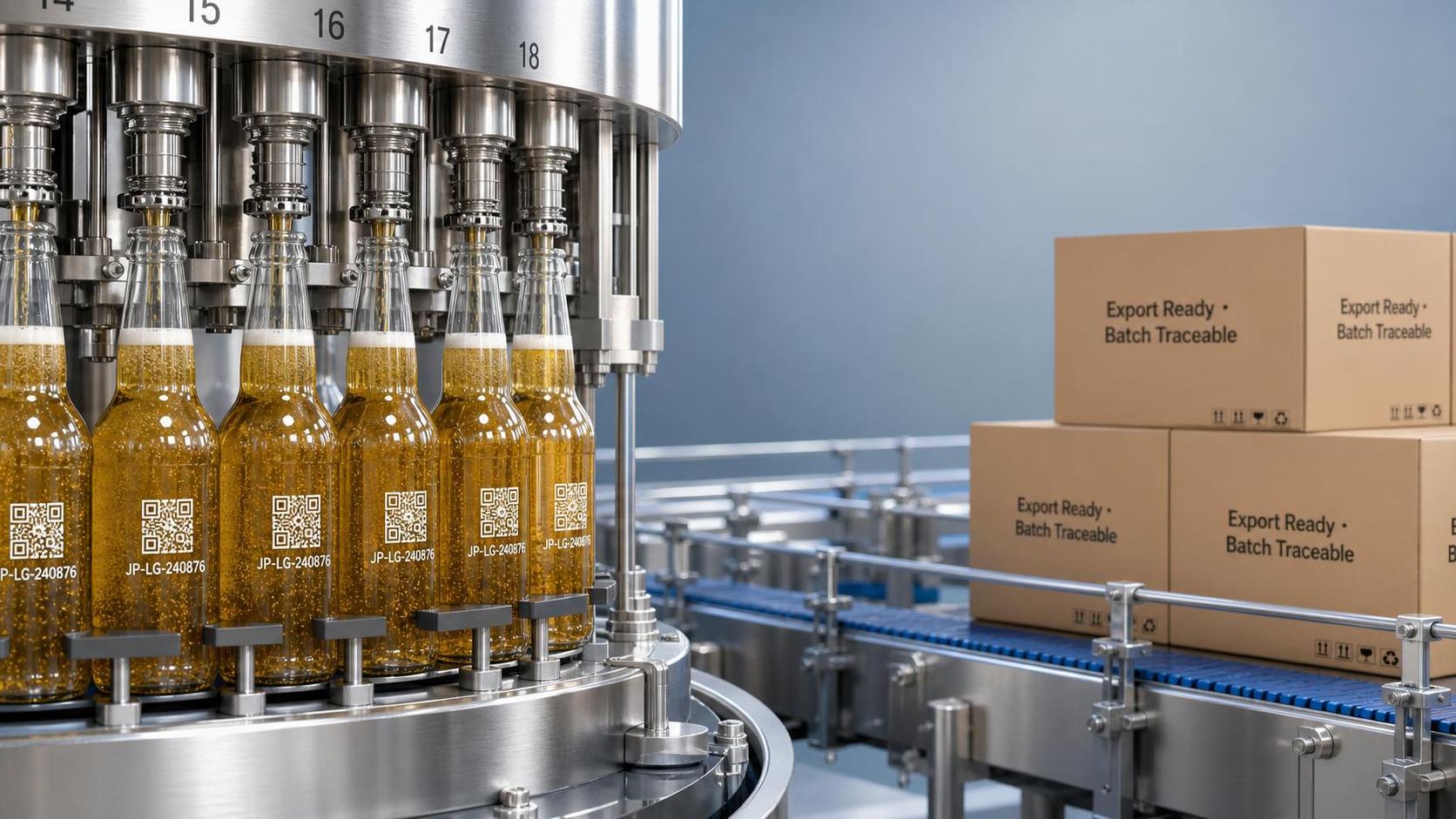
Post-fermentation, traceability becomes tactile. Bottling lines are calibrated per shift; fill volumes, crown seal integrity, and label alignment are monitored via inline vision systems. Each case receives a unique GS1-compliant barcode. That barcode doesn’t just encode product SKU and expiry—it maps backward to the exact brew day, yeast passage number, filtration run, and even the operator ID logged at line start-up. For retailers requiring lot-level recall readiness—like major EU supermarket chains or US-based craft distributors—this granularity isn’t optional. It’s expected.
And because traceability must survive transit, not just brewing, we extend it into logistics. Our WMS integrates with third-party forwarders to capture container numbers, departure dates, temperature logs (for refrigerated shipments), and port-of-entry documentation. When a shipment arrives in Rotterdam or Los Angeles, customs officers don’t see a generic “beer, 500ml bottles.” They see a verified chain: Batch #JP-LG-240876 → Brew Date: 12 Apr 2024 → Final QC Pass: 18 Apr → Cold Store Temp Log: 2–4°C maintained continuously → Export License #CN-BEER-EX-99321.
This level of integration matters most when things go sideways—not in ideal conditions. A project manager once faced a sudden ASEAN import suspension after a competitor’s lager tested positive for undeclared preservatives. Their audit trail was paper-based, fragmented across departments, and couldn’t be produced in under five days. Jinpai clients, by contrast, routinely receive full batch dossiers—including raw material COAs, in-process QC sheets, final microbiological reports, and packaging compliance statements—in under 90 minutes. Not because someone rushes to compile files—but because the data lives in one connected layer, permissioned and export-ready.
We also recognize that “traceability” means different things across markets. In the EU, it’s about Article 18 of Regulation (EC) No 178/2002: every operator must be able to identify where their products came from and where they went. In the US, FDA’s FSMA Rule 204 pushes toward electronic, rapid traceability—especially for foods on the Food Traceability List (which includes beer, though often overlooked). In ASEAN, MRA-aligned standards emphasize documented preventive controls and supplier verification. Our system doesn’t force-fit one template. It auto-generates reports aligned to each region’s regulatory language and structure—without rework, without translation delays, without version confusion.
That said, technology alone isn’t enough. We pair digital infrastructure with human accountability. Every batch has a designated Quality Steward—a trained Jinpai QA specialist who owns its traceability integrity from raw intake to final release. They sign off digitally, but they also physically review anomalies, verify sensor calibrations, and accompany external audits. When your EU Notified Body visits, they won’t be shown a polished demo environment. They’ll pull up any batch from the last 18 months—and watch as the steward traces it, live, from malt receipt to pallet manifest, in under three minutes.
For project managers weighing OEM partners, here’s what traceability maturity actually signals: it reflects how tightly quality, operations, and compliance are aligned—not as separate departments, but as interdependent functions. A brewery that treats traceability as a reporting task will deliver spreadsheets. One that treats it as a design principle delivers resilience.
It also shapes scalability. Launching in three markets? Traceability ensures consistency across batches—even when production scales from 500 to 5,000 hectoliters. Adding a sugar-free variant next quarter? The same traceability architecture captures sweetener sourcing, enzymatic conversion validation, and low-calorie stability testing—no system overhaul required. That continuity reduces your operational risk far more than any single certification ever could.
None of this replaces due diligence. We encourage partners to request live traceability demos—not just static screenshots. Ask to pull a random batch ID from last month and follow it all the way to its destination warehouse. Test the export report generator with your target market’s requirements. Observe how non-conformances are logged, escalated, and closed. Those moments reveal more than any brochure ever could.
At its core, choosing a China beer OEM isn’t about finding the lowest cost per hectoliter. It’s about identifying a partner whose systems breathe the same air as your brand’s promise: consistency, integrity, responsiveness. When a lager carries your logo across borders, its taste is only half the story. The other half is knowing—precisely, verifiably, instantly—where every molecule came from, and how it got there.
Jinpai Beer doesn’t offer traceability as a feature. We build lagers inside it.
Thank you very much for writing to us. Please leave your message and contact information, we will reply to you within 24 hours.