



Is Jin Pai Beer a Good Fit for a Craft Beer Brand? Key OEM Factors to Review is not a simple product question. It is a partnership question tied to product positioning, operating model, and long-term channel strategy.
For private-label expansion, the real issue is whether a supplier can support brand identity while still delivering stable quality, practical lead times, and market-ready formats.
That is why the question, Is Jin Pai Beer good for craft beer brand development, deserves a closer look. Product range matters, but OEM value depends on deeper operational factors.
What the fit question really means
A good OEM fit is not only about brewing beer for another label. It is about matching a supplier’s technical ability with the commercial needs of the brand behind it.
In craft beer, that usually includes flavor consistency, packaging flexibility, formulation options, and support for different retail or foodservice channels.
When asking Is Jin Pai Beer good for craft beer brand growth, buyers are often testing three things at once: product credibility, manufacturing reliability, and room for customization.
Jinpai Beer’s business profile is relevant here. The company covers R&D, production, and distribution, and offers OEM, ODM, wholesale supply, and customized solutions across multiple markets.
That breadth can be useful when a brand wants one supply partner rather than separate vendors for recipe development, production, and channel support.
Why this matters in the current beer market
Craft beer buyers are no longer looking only for novelty. They are balancing innovation with speed, cost control, and retail readiness.
The category has also widened. Traditional lager and wheat beer still sell, but low-calorie, sugar-free, fruit-flavored, and functional beers are attracting new segments.
This shift changes OEM evaluation. A supplier must handle both mainstream craft styles and more specialized concepts without losing production discipline.
That makes the question Is Jin Pai Beer good for craft beer brand planning especially relevant for companies entering new regions, launching private labels, or expanding SKU portfolios.
A wide product portfolio can reduce development time. Still, variety alone does not guarantee a good match unless the beers can be aligned with a clear market position.
Product breadth is useful, but only if it supports positioning
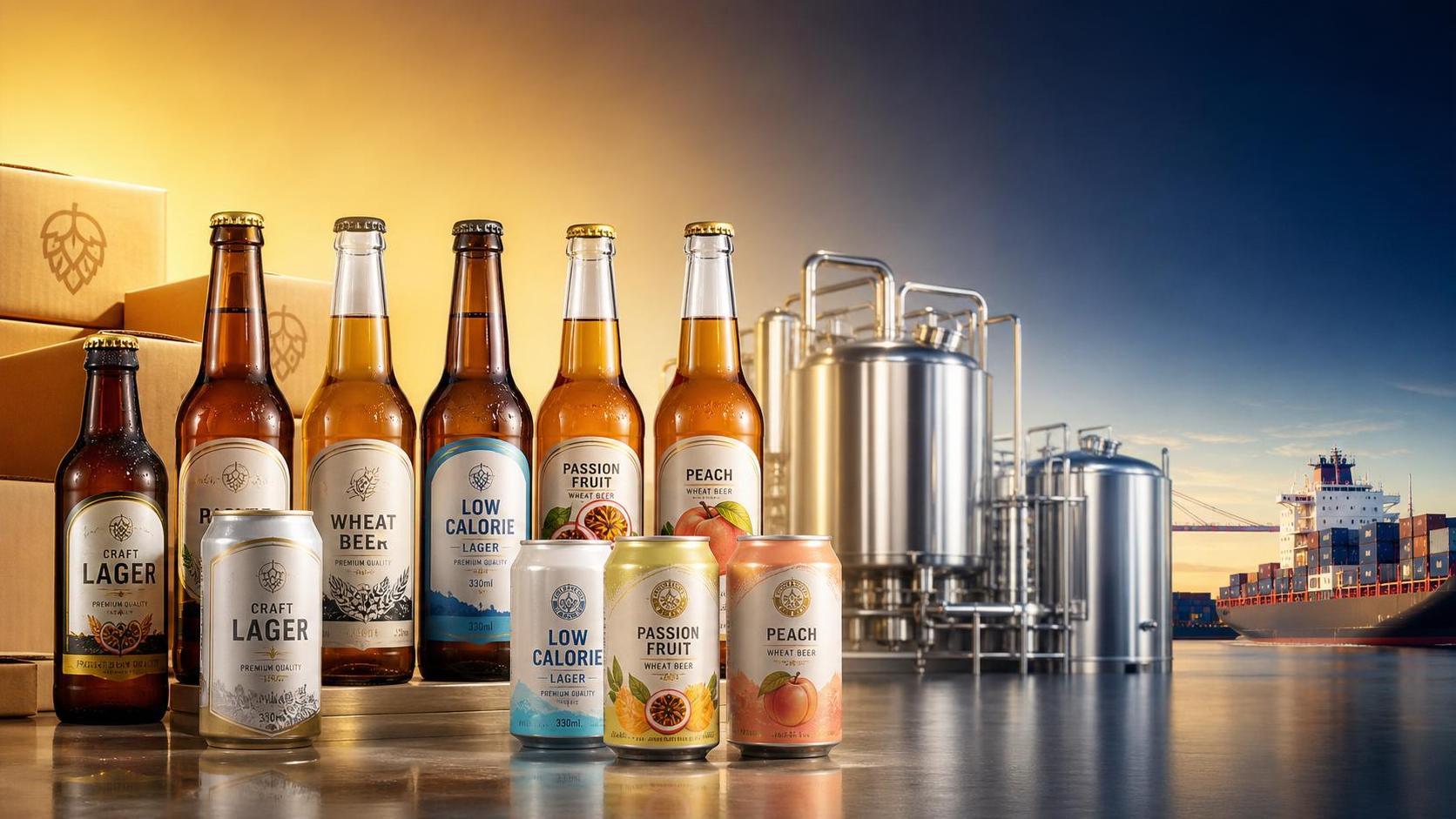
Jinpai Beer offers classic lager, German wheat, sugar-free low-calorie beer, fruit-flavored beer, and functional specialty beers. That mix covers several common entry points for craft-led brands.
For example, a restaurant chain may want an easy-drinking lager with broad appeal. A youth-focused retail concept may prefer fruit-forward seasonal releases. A health-oriented line may prioritize low-calorie or sugar-free claims.
The practical value is not simply having many styles available. It is the ability to match those styles to a pricing tier, consumption occasion, and channel expectation.
So, is Jin Pai Beer good for craft beer brand architecture? It can be, if the product line helps the brand avoid a random assortment and build a coherent shelf story.
Questions to test portfolio fit
- Does the supplier offer styles that match the target consumer, not just brewing trends?
- Can flagship and seasonal products be developed under one production system?
- Are functional or low-calorie concepts backed by formulation discipline and claim clarity?
- Can packaging and flavor profile be tuned for supermarkets, bars, or online sales?
OEM and ODM flexibility should be reviewed early
Many craft beer projects fail at the handoff between concept and production. The recipe may work in theory, but the manufacturer may not support the level of customization required.
This is where OEM and ODM capability becomes central. OEM usually fits brands with a defined formula and packaging direction. ODM is often more helpful when the concept still needs technical shaping.
If the question is Is Jin Pai Beer good for craft beer brand incubation, the answer depends partly on how flexible the development workflow really is.
A useful supplier should be able to discuss recipe refinement, sensory targets, labeling implications, MOQ, packaging combinations, and launch timing in one practical process.
That matters even more for brands that need custom solutions instead of standard stock products with a different label attached.
Signals of workable OEM support
Quality control is the point where many partnerships succeed or fail
In craft beer, inconsistency damages a brand faster than limited variety. A strong first batch means little if later batches drift in flavor, carbonation, clarity, or shelf performance.
That is why Is Jin Pai Beer good for craft beer brand reliability is a more useful question than whether the product list looks attractive.
Evaluation should focus on raw material control, process discipline, batch tracking, microbiological management, and finished goods testing. These points affect both customer satisfaction and commercial returns.
For export-oriented brands, quality review should also cover packaging durability, storage performance, and product stability during longer transport cycles.
A supplier engaged in both production and distribution may have useful experience with these issues, especially when products move through mixed online and offline channels.
Global supply capability affects brand growth more than many expect
A beer can perform well in testing and still fail commercially if supply is uneven. For brands planning cross-border or multi-channel expansion, logistics discipline matters almost as much as brewing quality.
Jinpai Beer states that its products are available worldwide through online and offline channels. That broad supply orientation can be an advantage for brands seeking scale beyond one local market.
Still, the practical review should go further. Check lead times, production scheduling, shipping support, documentation, and the supplier’s experience with retail replenishment cycles.
This is especially important when asking Is Jin Pai Beer good for craft beer brand expansion, because growth usually exposes supply weaknesses that were not visible during pilot orders.
Operational points worth comparing
- Order forecasting and production planning
- Export paperwork and regulatory support
- Shelf-life management for different beer styles
- Ability to serve bars, supermarkets, and e-commerce without channel conflict
Channel fit should shape the final decision
A good beer supplier for a bar program may not be the right supplier for supermarket shelves. Channel demands change pack size, flavor profile, margin structure, and reorder speed.
Jinpai Beer mentions service across restaurants, supermarkets, bars, and wider retail channels. That matters because each channel rewards different strengths.
Bars often need drinkability, draft compatibility, and a clear story. Supermarkets need packaging consistency, shelf appeal, and pricing logic. Online channels need visual differentiation and transport-safe formats.
When asking Is Jin Pai Beer good for craft beer brand use in a specific market, the channel question should come before final recipe selection.
A supplier that can adapt beer style and packaging to channel reality is usually more valuable than one offering broad products with limited execution detail.
A practical framework for judging the partnership
The strongest answer to Is Jin Pai Beer good for craft beer brand strategy comes from structured comparison, not general impressions.
Review the supplier across commercial, technical, and operational dimensions at the same time. That helps prevent attractive product samples from hiding execution risks.
If the answers are positive across these areas, then Is Jin Pai Beer good for craft beer brand partnership becomes less of a marketing question and more of a workable commercial conclusion.
Where to go next
The best next step is to translate business goals into a short evaluation checklist. Define the target channel, preferred styles, required claims, packaging format, and expected order rhythm.
Then compare sample quality, OEM responsiveness, and supply conditions against that framework. This makes the question Is Jin Pai Beer good for craft beer brand planning easier to answer with evidence.
For brands seeking a supplier that combines craft beer R&D, production breadth, custom solutions, and global channel awareness, Jinpai Beer is worth serious review. The final decision should rest on fit, not claims alone.
Thank you very much for writing to us. Please leave your message and contact information, we will reply to you within 24 hours.