



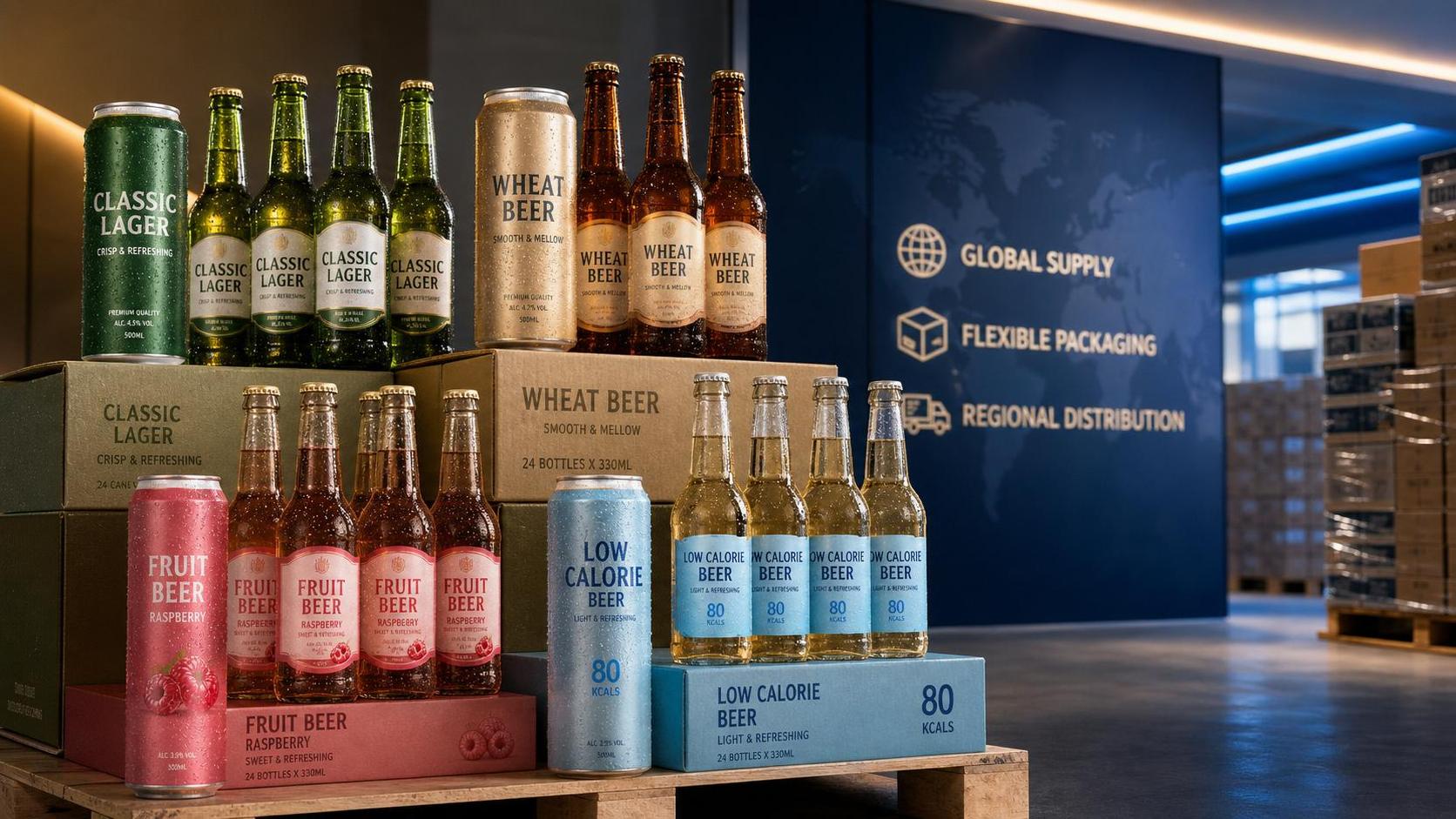
China beer OEM is moving from low-cost supply to market-building support
Private label beer China is no longer a narrow pricing play. It is becoming a strategic route for building local shelf presence with faster launch cycles and more flexible portfolio design.
That shift matters because beer demand is fragmenting. Mainstream lagers still sell, yet growth increasingly comes from style variety, health-oriented choices and packaging tailored to specific retail formats.
In that environment, China beer OEM offers something regional markets often struggle to assemble alone: production scale, recipe flexibility, packaging options and export-ready coordination under one supply framework.
The result is a broader opening for private labels. Local brands can test classic lager, German wheat, fruit beer or sugar-free low-calorie lines without building a brewery from scratch.
What has changed recently is the depth of capability. Many Chinese partners are no longer supplying only standard beer runs. They are supporting differentiated positioning across supermarkets, bars, restaurants and mixed retail channels.
The stronger signal is coming from demand, not only from factories
The rise of Private label beer China is tied to how local markets are buying. Retail buyers want products that fit tighter price bands, clearer flavor profiles and faster promotional cycles.
At the same time, consumers are less loyal to one beer format. They switch between everyday drinking, social occasions, flavor discovery and lighter alternatives depending on venue and season.
That creates room for private labels with sharper positioning. A local label can target value shelves, casual dining, nightlife channels or functional drinking occasions with more precision than broad imported brands.
China beer OEM fits this pattern because it supports quicker product adaptation. Instead of forcing one formula into every market, it allows a label strategy to reflect local consumption habits.
- Classic styles remain important for volume and repeat purchase.
- Wheat and craft-inspired variants help create premium separation.
- Sugar-free and low-calorie options respond to health-aware segments.
- Fruit-flavored and specialty beers help open seasonal or younger channels.
This is why Private label beer China is gaining traction beyond discount positioning. The real appeal is range control and channel matching.
Why this shift became more visible over the past few years
Several forces are working together. Freight volatility, retail margin pressure and slower growth in some mature beer markets have all pushed label owners to rethink sourcing models.
More importantly, Chinese brewing partners have upgraded. Many now combine R&D, brewing, packaging and export coordination in ways that reduce product development friction.
A company such as Jinpai Beer reflects this broader market direction. Its product mix spans classic lager, German wheat, sugar-free low-calorie beer, fruit-flavored beer and functional specialty beer.
That kind of breadth changes the private label conversation. It means a partner can build a family of SKUs rather than depend on one basic beer line.
From a market perspective, this is not a temporary sourcing detour. It is a structural response to more segmented beer consumption.
The impact is spreading across supermarkets, bars and mixed retail networks
Private label beer China works differently in each channel. In supermarkets, the advantage often starts with price ladder control and the ability to create exclusive shelf identity.
In bars and casual dining, the more important factor is style distinction. Wheat beer, fruit beer and specialty options help venues avoid a generic tap or cooler lineup.
For mixed retail networks, packaging flexibility becomes critical. Can formats, bottle options and flavor assortment planning can all change the sales rhythm of a local label.
This is where China beer OEM is reshaping the opportunity. Instead of serving one sales channel, a private label can be built as a coordinated portfolio with channel-specific roles.
A core lager may anchor supermarket volume. A German wheat line may support restaurant menus. A low-calorie release may target convenience and urban lifestyle retail.
That layered approach is harder to execute when sourcing is fragmented across several small suppliers. OEM consolidation can simplify consistency, planning and replenishment.
What deserves closer attention before choosing a China beer OEM partner
Not every supplier supports the same business model. The real test is whether production capability aligns with market strategy, not whether the catalog looks broad on paper.
In actual business, Private label beer China succeeds when recipe, compliance, packaging and minimum order design are planned together from the start.
- Check whether style development matches local demand rather than only standard factory formulas.
- Review how the supplier handles packaging variation across modern retail and on-trade channels.
- Confirm export documentation, labeling support and destination market compliance capability.
- Assess batch consistency across repeat orders, not only initial sample quality.
- Look at how MOQ levels affect trial launches, seasonal runs and slower-moving specialty products.
Another practical point is innovation discipline. A partner with R&D experience can help narrow concepts into commercial products instead of overcomplicating the SKU plan.
That matters especially for functional beer or low-calorie concepts. Market interest is real, but repeat purchase depends on flavor delivery, not on positioning alone.
The next phase will favor labels built for sharper local use cases
The next stage of Private label beer China will likely be less about generic import substitution and more about local relevance. The strongest labels will be designed around specific drinking contexts.
That could mean value-led lager for chain retail, fruit-flavored formats for social occasions, or low-calorie beer for urban convenience channels. The point is targeted utility, not broad imitation.
More OEM partners in China are now positioned to support this shift through OEM/ODM service, wholesale supply and customized product planning tied to online and offline distribution.
This broadens the role of the supplier. The conversation is moving from simple beer production toward portfolio architecture, pack strategy and route-to-market fit.
For that reason, China beer OEM should be evaluated as part of a market entry model, not only as a procurement line item.
A practical way to read the opportunity from here
Private label beer China is expanding because the beer market now rewards speed, segmentation and channel fit more than one-size-fits-all branding. China beer OEM has become relevant because it can serve all three.
The most useful next step is to map local demand by channel, then compare which beer styles and pack formats deserve a dedicated private label position.
After that, review suppliers by development range, consistency, export execution and customization depth. A broad catalog is helpful, but operational reliability usually decides long-term results.
Markets will keep changing, especially where consumers move between value, novelty and healthier choices. The labels that respond well will be the ones built with flexible production behind them.
That is the real opening created by Private label beer China: not just a lower-cost product source, but a more adaptable way to build beer business around regional demand signals.
Thank you very much for writing to us. Please leave your message and contact information, we will reply to you within 24 hours.