



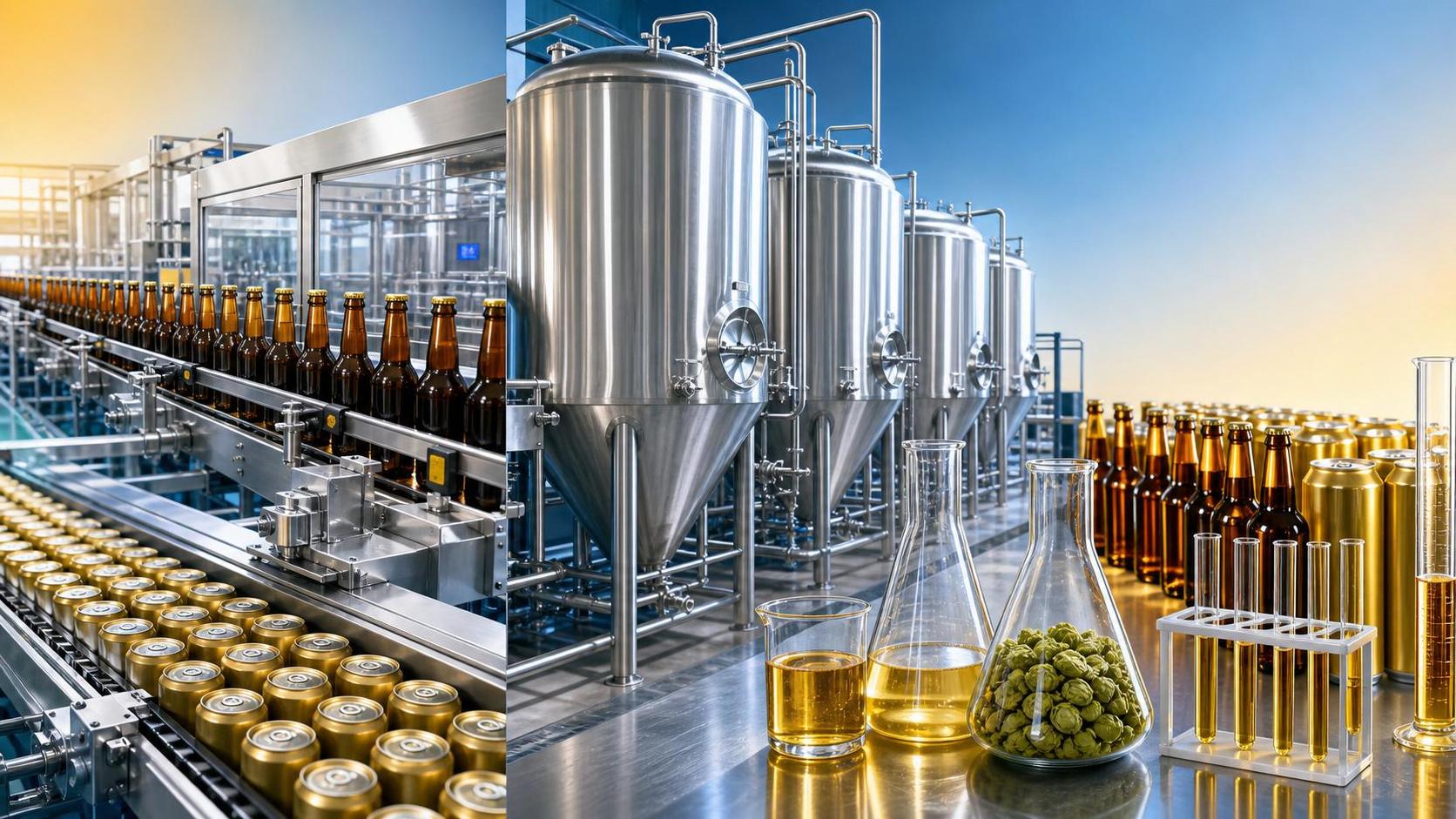
How to verify quality stability of Chinese beer factories? For importers, distributors, and private-label buyers, the answer starts with evidence, not promises. A reliable brewery should be able to prove batch consistency through documented processes, ingredient control, laboratory testing, and traceable production records.
In the beer and beverage industry, quality stability is not only about whether one sample tastes good. It is about whether every shipment can match agreed standards for flavor, aroma, alcohol level, appearance, shelf life, and microbiological safety.
That is why buyers should evaluate Chinese beer factories with the mindset of an auditor, not just a customer. The right partner will welcome technical questions, factory review, and data-based verification because stable quality is built into its operating system.
What Buyers Are Really Trying to Confirm
When people search how to verify quality stability of Chinese beer factories, they are usually not looking for generic sourcing advice. They want practical ways to reduce risk before placing large OEM, ODM, or distribution orders.
The core concern is simple: can this brewery deliver the same beer profile and product performance repeatedly, even when production volume increases, raw material lots change, or orders are shipped to different markets?
For importers and brand owners, instability causes expensive problems. These include customer complaints, uneven taste across batches, rejected shipments, labeling disputes, damaged brand reputation, and lost shelf space in retail or on-premise channels.
So the most useful evaluation standard is not whether the sales team sounds professional. It is whether the factory can show a complete and repeatable quality control chain from brewing input to final packaged product.
Start With the Factory’s Ability to Standardize Brewing
Beer quality stability begins long before packaging. It starts with whether the brewery has standardized recipes, controlled process parameters, and clear production instructions that operators follow on every batch.
Ask whether the factory uses fixed brewing specifications for each product. A dependable manufacturer should define original gravity, final gravity, bitterness, color, alcohol content, fermentation temperature, maturation time, and carbonation targets.
If the answer is vague, that is a warning sign. Factories that depend too heavily on operator experience instead of written standards are more likely to produce variation from one batch to another.
For craft beer producers, variation can sometimes be presented as a natural result of artisanal brewing. In reality, professional craft production still requires disciplined process control if the buyer expects commercial consistency.
Stable breweries also record deviations during production. If temperature shifts, yeast performance changes, or filtration pressure fluctuates, the factory should document the issue and corrective action rather than simply moving to packaging.
Check Raw Material Control, Not Just Finished Beer Claims
Many buyers focus on tasting the final beer sample, but ingredient control is often the better predictor of long-term consistency. Even a great sample means little if malt, hops, yeast, fruit base, or adjunct sourcing changes frequently without controls.
Ask the brewery how it qualifies suppliers and whether incoming materials are tested against specifications. For example, malt moisture, hop aroma condition, yeast vitality, and sugar or fruit ingredient stability all affect final beer performance.
A serious factory should also have rules for lot traceability. That means each batch of beer can be linked back to the exact raw material lots used in production. This is essential if flavor deviation or a quality complaint appears later.
For customized products such as sugar-free low-calorie beer, fruit beer, or functional specialty beer, ingredient consistency becomes even more important. These categories often involve more complex formulations and a higher risk of variation.
Buyers should also ask what happens when a preferred raw material becomes unavailable. A factory with a mature quality system will have approval procedures for substitutions instead of making unannounced formula changes.
Review Laboratory Testing Standards and Frequency
If you want real proof of stability, laboratory capability matters. A Chinese beer factory that can consistently produce export-quality beer should perform regular testing during brewing, fermentation, packaging, and finished goods release.
Key routine checks usually include alcohol by volume, original and final extract, pH, bitterness, color, dissolved oxygen, carbon dioxide, turbidity, filling volume, and microbiological indicators. These metrics help explain whether quality is stable or drifting.
Do not just ask whether the factory has a lab. Ask what it tests, how often it tests, what standards it uses, and whether records are available for review. The detail level of the answer often reveals the maturity of the quality system.
For export buyers, microbiological control is especially important. Contamination can damage flavor, shorten shelf life, create package swelling risks, and trigger import problems. A reliable brewery should have clear sanitation and microbial monitoring procedures.
It is also useful to ask for historical batch data from the same product over multiple production runs. One report proves a sample passed once. A trend record shows whether the factory can maintain performance over time.
Ask for Batch Records and Traceability Documents
One of the most effective ways to verify quality stability of Chinese beer factories is to request real production documents. Strong factories can normally provide batch records, inspection reports, and packaging release data with sensitive details managed appropriately.
These records help buyers confirm whether production is controlled consistently or managed informally. You are looking for repeatable documentation, not perfect marketing presentations.
A good batch file often shows brew date, tank number, ingredient lots, process readings, fermentation notes, filtration or blending records, quality checkpoints, and final inspection results before shipment.
Traceability is equally important after packaging. Carton code, can or bottle code, and pallet identification should allow the factory to locate production details quickly if a complaint occurs in the destination market.
If a brewery struggles to explain its coding logic or cannot retrieve batch history efficiently, it may not be prepared for large-scale international business where accountability and recall readiness matter.
Use Pilot Orders to Test Repeatability, Not Only Product Fit
Many buyers use sample approval only to decide whether they like the beer style. A smarter approach is to use pilot orders to test repeatability across time, not just taste at one moment.
After approving a sample, place a controlled trial order and compare that production batch against the original benchmark. Then, if possible, compare a later batch as well. The goal is to see whether the product remains stable across multiple runs.
Evaluate not only flavor but also foam retention, color uniformity, clarity or haze consistency, fill precision, package integrity, and shelf-life behavior under realistic storage conditions.
This is especially valuable for private-label programs. A beer that performs well in a sample but changes after scaling up can create serious commercial issues once your label is already in the market.
Buyers serving supermarkets, bars, and restaurant chains should be strict here. Channel buyers expect predictable consumer experience, and inconsistency usually causes faster delisting than slow sales do.
Inspect Packaging Stability and Export Execution
Beer quality stability is not only about brewing. It also depends on how the product is filled, sealed, coded, packed, and prepared for transport. Good beer can still fail commercially if packaging control is weak.
Ask about seam inspection for cans, cap sealing checks for bottles, dissolved oxygen control during filling, and packaging line cleanliness. These factors directly affect freshness, shelf life, and complaint rates.
For export business, the factory should also understand carton strength, palletization logic, container loading standards, and temperature-related shipping risks. A technically good beer loses value if it arrives damaged or unstable.
Private-label buyers should confirm label application accuracy, barcode readability, language compliance, and consistency between approved artwork and final packed goods. Execution errors often get blamed on supply partners, not on internal teams.
When evaluating a brewery, ask whether packaging defects are recorded and analyzed. A factory that tracks leakage, denting, coding errors, or carton failure is usually more serious about long-term stability.
Look for Quality Culture, Not Only Equipment
Modern equipment is helpful, but it does not guarantee stable output by itself. Some factories invest in impressive machinery yet still lack disciplined management, staff training, and cross-department accountability.
That is why buyers should pay attention to how the team answers technical questions. Do production, quality, and sales teams speak consistently? Can they explain root causes, tolerance limits, and corrective actions clearly?
A quality-focused brewery usually shows alignment across departments. The sales team does not overpromise, the quality team provides evidence, and the production team understands why standards matter for export customers.
You should also ask how operators are trained, how sanitation is verified, and how nonconforming products are handled. These operational habits reveal whether quality stability is embedded in the organization.
In long-term partnerships, quality culture often matters more than one-time inspection results. A factory with the right culture is far more likely to solve problems transparently and improve performance over time.
Questions Buyers Should Ask Before Choosing a Chinese Beer Factory
To make your review practical, prepare a short list of direct questions. Ask for batch-to-batch data on the same beer SKU, incoming material control procedures, routine lab test items, and examples of traceability coding.
Also ask how the factory handles ingredient substitution, customer complaints, process deviations, and shelf-life validation. The best answers are specific, documented, and supported by records rather than polished language.
If possible, request a factory audit or video walkthrough focused on brewhouse operations, fermentation area management, filtration or blending control, packaging inspection points, and finished goods storage.
For OEM and ODM projects, clarify who owns the formula standard, sample retention process, approval benchmark, and change notification procedure. This protects both commercial expectations and product consistency later.
The more transparent the brewery is during evaluation, the lower your sourcing risk usually becomes. Reliable manufacturers understand that professional buyers need proof, not reassurance alone.
Why This Matters for Importers, Distributors, and Private-Label Brands
For global beer buyers, quality stability is directly tied to margins, reputation, and growth. A factory that produces stable beer reduces returns, lowers complaint handling costs, and supports smoother expansion across multiple channels.
It also makes forecasting easier. When the product is reliable, distributors can plan promotions with more confidence, retail buyers face fewer disruptions, and brand owners spend less time solving avoidable quality disputes.
In contrast, unstable supply creates hidden costs everywhere. Sales teams must explain inconsistencies, warehouses may hold questionable stock, and management loses time handling issues that should have been prevented at the factory level.
This is why choosing a Chinese beer factory should be treated as a quality system decision, not just a price comparison exercise. Lower unit cost means little if the product cannot stay consistent in the market.
Final Takeaway
If you want to know how to verify quality stability of Chinese beer factories, focus on evidence across the full production chain. Brewing standards, raw material control, testing discipline, batch records, traceability, and packaging execution matter more than sales language.
The most dependable brewery partners are usually willing to be examined in detail because stable quality is part of how they operate. They understand that long-term export business depends on trust supported by systems and data.
For buyers sourcing craft beer, lager, wheat beer, sugar-free beer, fruit beer, or customized specialty products, the best decision comes from combining sample evaluation with process verification. That is how you reduce risk and build a supply relationship that can scale.
In the end, quality stability is not a slogan. It is a measurable capability. When a brewery can prove that capability clearly and consistently, you can move forward with much greater confidence.
Thank you very much for writing to us. Please leave your message and contact information, we will reply to you within 24 hours.