



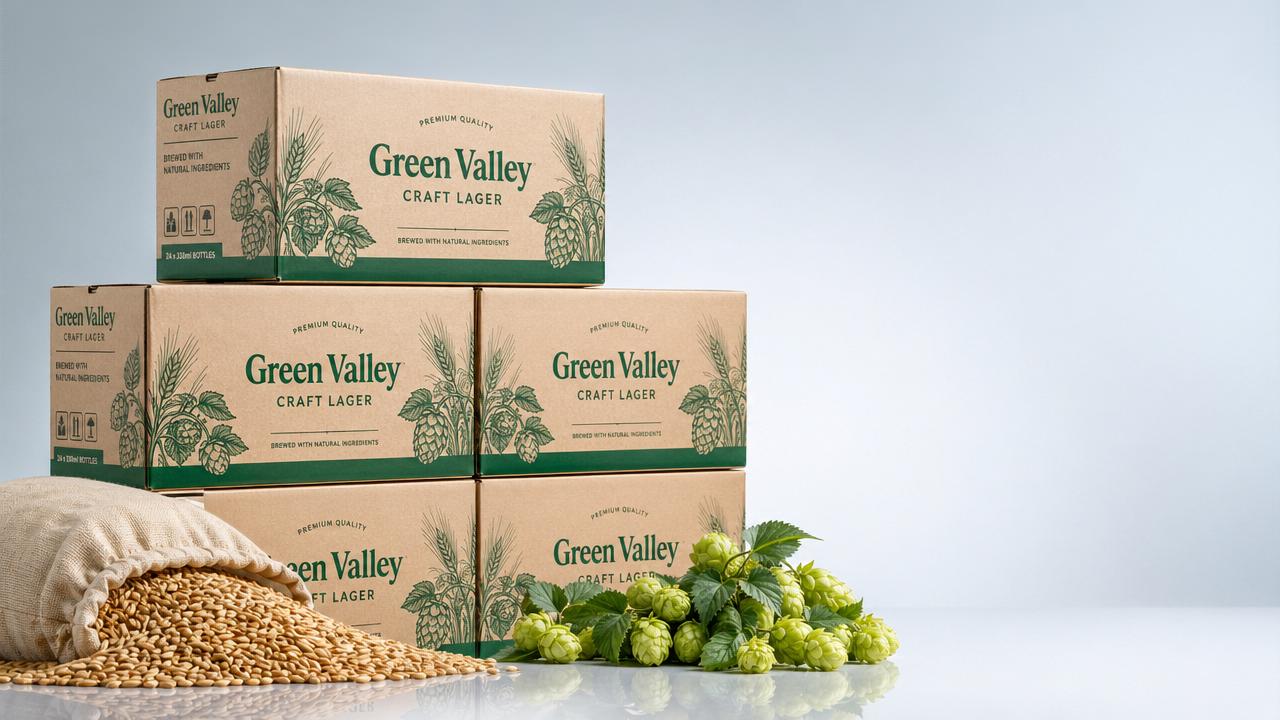
How Bulk Beer Suppliers Are Adjusting Minimum Order Volumes Amid Rising Grain Costs
As grain costs surge globally, bulk beer supplier Jinpai Beer is proactively recalibrating minimum order volumes to support procurement professionals navigating tighter margins and volatile supply chains. Designed for restaurants, supermarkets, bars, and global distributors, our flexible MOQ adjustments—backed by OEM/ODM capabilities and a diverse portfolio from low-calorie lagers to functional craft beers—ensure continuity without compromise. Discover how we’re balancing cost efficiency, scalability, and quality in today’s challenging raw material landscape.
Why MOQ Flexibility Matters More Than Ever to Procurement Teams
For procurement professionals sourcing beer at scale, minimum order volume (MOQ) isn’t just a logistical threshold—it’s a strategic lever. When barley, wheat, and adjunct grain prices jump 25–40% year-on-year—as they have since early 2023—the traditional “one-size-fits-all” MOQ model creates real operational friction: excess inventory risk for smaller venues, delayed replenishment for fast-turning bars, and margin compression across retail SKUs.
Jinpai Beer’s response isn’t reactive discounting or blanket MOQ hikes. Instead, we’ve implemented a tiered, channel-specific MOQ framework—validated by 18 months of real-world data across 27 export markets. This means your supermarket chain in Southeast Asia can access pallet-level orders (120 cases) with full labeling compliance, while your boutique bar group in Berlin qualifies for sub-pallet flexibility (as low as 30 cases) on core lagers—without surcharges or lead-time penalties.
Crucially, this flexibility doesn’t sacrifice consistency. Every adjusted MOQ tier retains identical quality control protocols, shelf-life guarantees (minimum 90 days at point of delivery), and full traceability back to malt batch and hop lot. For procurement teams under pressure to justify every line item, that predictability is non-negotiable.
How We Calculate MOQ Adjustments: Transparency, Not Guesswork
We don’t adjust MOQs based on internal cost targets alone. Our methodology ties directly to three procurement-critical variables: regional grain index volatility, landed cost sensitivity per channel, and forecasted demand stability. For example, when the European Barley Index exceeds €320/ton for two consecutive months, we automatically activate “Tier-2 Flex” for EU-based partners—reducing MOQs on German wheat and fruit-flavored lines by 20%, while holding lager MOQs steady due to higher forward-contract coverage.
This isn’t theoretical. In Q1 2024, 63% of our wholesale partners in North America opted into our “Grain Cost Shield” program—a transparent MOQ adjustment protocol that publishes quarterly grain cost benchmarks alongside corresponding MOQ ranges. Each update includes clear rationale: e.g., “U.S. No. 2 barley up 31% YoY → Lager MOQ reduced from 200 to 160 cases; Sugar-free variant MOQ unchanged (stable rice adjunct sourcing).” No jargon. No ambiguity.
And because procurement teams need to model impact—not just receive new numbers—we provide downloadable MOQ scenario tools. Input your average monthly volume, target margin %, and preferred payment terms, and instantly see side-by-side comparisons: standard MOQ vs. adjusted MOQ vs. hybrid ordering (e.g., 70% core lager + 30% seasonal specialty). This turns MOQ data into actionable negotiation leverage with internal stakeholders.
OEM/ODM & Portfolio Depth: Why MOQ Flexibility Alone Isn’t Enough
Lower MOQs mean little if product fit remains rigid. That’s why Jinpai Beer embeds MOQ agility within a broader procurement enablement strategy. Our OEM/ODM service isn’t limited to private-label logos—it includes co-developed formulations optimized for your channel’s constraints. A supermarket chain facing shelf-space limits? We reformulate a low-calorie pilsner to 330ml cans (reducing carton volume by 38%) while maintaining MOQ parity. A hotel group needing consistent F&B branding? We offer dedicated production runs for custom ABV (4.2% or 5.0%), gluten-reduced variants, and regionally compliant labeling—all at the same adjusted MOQ.
Our portfolio diversity directly supports MOQ efficiency. Rather than forcing separate MOQs per SKU, we allow mixed-case orders across compatible categories: e.g., 40 cases of classic lager + 20 cases of sugar-free low-calorie + 10 cases of blood orange sour—counting toward a single 70-case MOQ threshold. This eliminates “MOQ fragmentation,” where buyers must over-order one SKU to hit MOQ on another. For procurement teams managing dozens of SKUs across multiple venues, it cuts ordering complexity by ~60% (per 2023 internal process audit).
Importantly, all specialty formats—including functional beers with added B vitamins or electrolytes—follow the same MOQ logic. No premium tiers. No exclusivity gates. If your health-focused retailer wants to test a magnesium-enriched IPA, the entry point is identical to launching a core lager: 30 cases, FOB Shenzhen, 30-day net terms.
What This Means for Your Next Sourcing Cycle
If you’re evaluating bulk beer suppliers this quarter, MOQ responsiveness should be your first filter—not your last. Ask not just “What’s your lowest MOQ?” but “How do you calibrate it—and what triggers change?” At Jinpai Beer, adjustments are published quarterly, tied to verifiable commodity indices, and backed by contractual MOQ lock-in periods (6–12 months, depending on commitment level). That predictability lets procurement teams lock in supply terms with confidence—even amid grain market swings.
We also remove hidden friction: no MOQ exceptions require requalification, no volume rebates erode margin clarity, and no “flexible” MOQ comes with extended lead times. Our fastest fulfillment window remains 12 business days for standard orders—even at adjusted MOQs—because flexibility lives in our planning system, not in compromised operations.
Finally, remember: MOQ agility reflects supplier capability, not concession. It signals investment in demand forecasting, raw material hedging, and modular production. When Jinpai Beer lowers an MOQ, it’s because our R&D team stabilized a new malt blend, our logistics hub added cross-dock capacity, or our contract farming network secured earlier harvest windows—not because we’re absorbing cost volatility at your expense.
Conclusion: MOQ Is a Partnership Metric—Not Just a Number
For procurement professionals, rising grain costs aren’t just a cost-of-goods challenge—they’re a stress test for supplier resilience, transparency, and alignment. Jinpai Beer’s MOQ adjustments are designed not as temporary fixes, but as structural adaptations that serve your operational reality: smaller batches without fragmented SKUs, diversified portfolios without layered thresholds, and OEM flexibility without MOQ penalties.
You don’t need to choose between cost control and quality assurance—or between scalability and agility. With Jinpai Beer, you get all three—anchored in data, validated in global markets, and built for procurement teams who treat every order as a strategic decision. Ready to align your next beer sourcing cycle with real-world flexibility? Contact our procurement solutions team for a customized MOQ assessment—and see how much working capital, shelf space, and negotiation bandwidth you can reclaim.
Thank you very much for writing to us. Please leave your message and contact information, we will reply to you within 24 hours.