



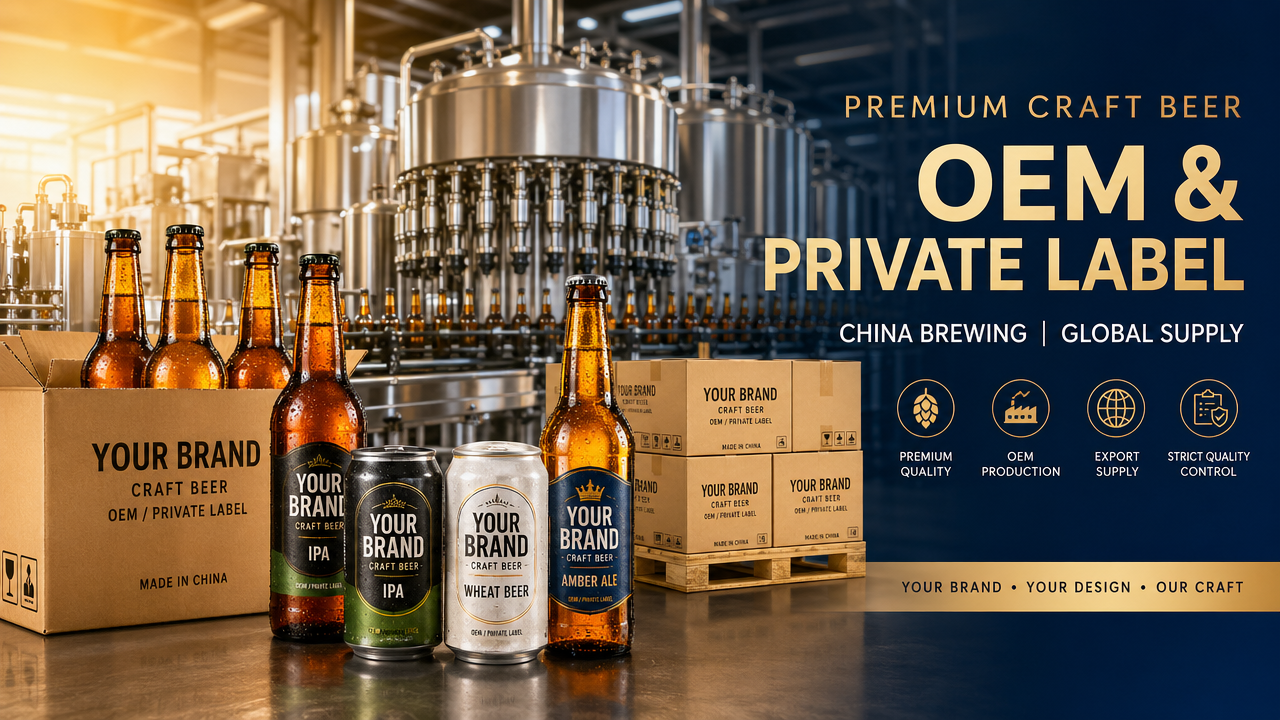
Choosing a craft beer OEM China partner can shape your brand’s quality, speed to market, and profit margins. Whether you need a private label beer manufacturer, contract brewing support, or a reliable beer manufacturer China for retail and distribution, the right Chinese beer factory can deliver scalable, export-ready solutions. This guide explores how brewery outsourcing and custom beer manufacturing fit different business goals.
If you are asking whether craft beer OEM in China is right for your brand, the short answer is: it can be a strong option if you need flexible production, faster launch timelines, cost efficiency, and export-ready supply. But it is not the best fit for every business. The decision depends on your brand positioning, target market, order volume, quality requirements, and how much control you want over formulation, packaging, and distribution.
For buyers, brand owners, distributors, and business decision-makers, the real question is not simply “Should I source from China?” It is “Can the right OEM partner help me build a competitive beer business with acceptable risk and sustainable margins?” That is the standard this article will focus on.
When does craft beer OEM China make business sense?
Working with a craft beer OEM China supplier usually makes the most sense in a few clear situations.
First, you want to launch quickly. Building your own brewery takes major capital, licensing work, equipment investment, hiring, and operational know-how. An OEM model lets you move from concept to product much faster.
Second, you want to reduce upfront investment. For importers, supermarket brands, restaurant groups, and new beverage brands, outsourcing production can lower financial risk. Instead of buying tanks and setting up production lines, you pay for manufacturing capacity, recipe development, and packaging support.
Third, you need product flexibility. A capable Chinese beer factory may offer multiple styles such as lager, wheat beer, fruit beer, low-calorie beer, sugar-free options, and functional specialty beer. This gives distributors and retailers more room to test market demand without building internal production capability.
Fourth, your business depends on scalable supply. If your brand sells through supermarkets, online marketplaces, restaurants, bars, or regional distributors, consistent volume matters. OEM production can support growth better than very small local brewing setups that may struggle with expansion.
In short, brewery outsourcing is often a practical model for businesses that care about speed, variety, and margin control more than owning the entire production system themselves.
Who should consider it—and who should not?
Not every brand has the same needs. Craft beer OEM in China is usually a good fit for:
- Private label beer brands entering a new market
- Distributors wanting exclusive SKUs for local channels
- Restaurant or bar chains launching house-brand beer
- Retailers and supermarkets building own-label beverage lines
- Importers seeking stable, export-oriented manufacturing
- Entrepreneurs testing product-market fit before heavy investment
It may be less suitable if:
- Your brand story depends heavily on hyper-local brewing origin
- You need extremely small custom batches on an ongoing basis
- You require constant in-person recipe iteration at the brewery
- Your customers are unwilling to accept overseas manufacturing
- You do not yet have a clear compliance or import plan for your target market
For premium brands, overseas OEM does not automatically weaken positioning. What matters more is quality consistency, recipe fit, packaging design, and how transparently the product is marketed. Many buyers care more about taste, value, and reliability than where the tanks are located.
What are the biggest advantages of using a beer manufacturer in China?
The strongest advantages are usually commercial, operational, and product-related.
1. Better cost structure
Compared with developing your own brewery, outsourcing can reduce fixed costs and improve cash flow. This can be especially important for first-time brands or regional distributors protecting margin in a competitive market.
2. Broader product development options
An experienced OEM/ODM producer can help tailor beer styles to local demand. For example, some markets favor refreshing lager, while others respond better to wheat beer, fruit-flavored products, or low-calorie functional concepts.
3. Packaging customization
A private label beer manufacturer can often support different can sizes, bottle formats, carton designs, and branding needs. This matters for retailers, hospitality groups, and importers trying to match channel expectations.
4. Export readiness
A strong beer manufacturer China partner should understand documentation, shelf-life handling, packaging protection, and logistics coordination for overseas markets. This reduces operational friction.
5. Easier portfolio expansion
Once a partnership is stable, adding new SKUs becomes easier. A brand may begin with a classic lager and later introduce wheat beer, sugar-free beer, or seasonal fruit variants.
For example, a portfolio can include approachable mainstream products and more differentiated lines such as Whole wheat lager Beer to meet consumers looking for richer flavor with broad market appeal.
What risks should buyers evaluate before choosing brewery outsourcing?
The benefits are real, but so are the risks. Smart buyers assess these early rather than after a contract is signed.
Quality inconsistency
Not every factory has the same level of brewing control, raw material management, or batch stability. Ask about quality assurance systems, lab testing, flavor consistency, and how deviations are handled.
Recipe mismatch
A sample may taste good, but can the factory reproduce it consistently at commercial scale? This is one of the most important questions in custom beer manufacturing.
Communication gaps
OEM projects involve specifications, packaging details, compliance requirements, and timeline coordination. Poor communication can lead to costly misunderstandings.
MOQ and inventory pressure
Minimum order quantities can affect working capital and sell-through risk, especially for new brands testing unfamiliar SKUs.
Market compliance risk
Different countries have different labeling, ingredient declaration, alcohol content, packaging, and import requirements. Your partner should be able to support documentation, but the buyer must still verify local compliance.
Lead time uncertainty
Production scheduling, packaging procurement, and shipping timelines all affect launch timing. A reliable plan matters more than a low quoted price.
The practical takeaway: OEM can work very well, but only when supplier verification is disciplined.
How do you evaluate whether a Chinese beer factory is reliable?
If you are comparing suppliers, focus on evidence rather than sales language. Ask questions that reveal execution capability.
Start with production capability.
- What beer styles can they produce well?
- Do they support OEM, ODM, and custom recipe development?
- What packaging formats are available?
- Can they scale with your projected volume?
Then review quality control.
- What testing is done on raw materials and finished beer?
- How is flavor consistency controlled batch to batch?
- What is the shelf-life performance for export shipments?
Next, assess export experience.
- Which countries or regions do they already serve?
- Can they support online and offline channel requirements?
- Are they familiar with retail, supermarket, bar, and restaurant supply standards?
Finally, test responsiveness.
- How clearly do they answer technical and commercial questions?
- Can they explain timelines, MOQ, pricing structure, and development steps?
- Do they act like a long-term manufacturing partner or only a transaction-driven vendor?
A serious supplier should be able to discuss R&D, production planning, packaging customization, and route-to-market support in a practical way.
What should you clarify before signing an OEM or private label beer agreement?
Many problems in contract brewing come from vague assumptions. Before moving forward, buyers should confirm:
- Recipe ownership and exclusivity terms
- MOQ by SKU and by packaging format
- Sampling and approval process
- Lead times for production and shipment
- Payment terms
- Labeling and packaging approval responsibilities
- Defect handling and after-sales support
- Territory protection, if relevant for distributors or agents
These points matter not only for procurement teams but also for business leaders evaluating operational risk. A lower ex-factory price means little if the product arrives late, fails compliance review, or cannot maintain repeat order quality.
How can different buyers use custom beer manufacturing strategically?
The value of custom beer manufacturing changes by buyer type.
For procurement teams:
The key priorities are stable quality, acceptable MOQ, landed cost control, and reliable supply. OEM can simplify sourcing if the supplier has strong process discipline.
For company decision-makers:
The bigger question is return on investment. Outsourcing can lower capital intensity, shorten launch cycles, and make expansion into new channels more feasible.
For distributors, agents, and wholesalers:
An exclusive or semi-exclusive product line can improve differentiation. Instead of competing only on commodity brands, you can offer private label or customized beer tailored to local buyers.
For end consumers indirectly affected by the decision:
The result should be a beer that tastes good, offers clear value, and fits modern preferences such as lower sugar, lighter calories, fruit flavor innovation, or wheat-based styles.
That is why a capable supplier with broad brewing and customization capacity matters. A business may start with standard products and later diversify into category-specific offerings, including options like Whole wheat lager Beer when market feedback supports a more distinctive wheat-lager profile.
Final verdict: is craft beer OEM China right for your brand?
Craft beer OEM China is a strong option for brands that want faster market entry, lower upfront investment, flexible product development, and scalable export supply. It is especially suitable for private label brands, distributors, retailers, restaurants, and importers that need practical manufacturing support more than in-house brewing ownership.
However, the decision should be based on commercial fit, not trend following. The right OEM partner should offer more than low pricing. They should provide stable quality, responsive communication, customization capability, and a clear understanding of international supply requirements.
If your goal is to build a competitive beer line with manageable risk and room to grow, a reliable Chinese beer factory can be the right move. The key is choosing a partner that aligns with your product standards, channel strategy, and long-term brand goals.
Thank you very much for writing to us. Please leave your message and contact information, we will reply to you within 24 hours.