



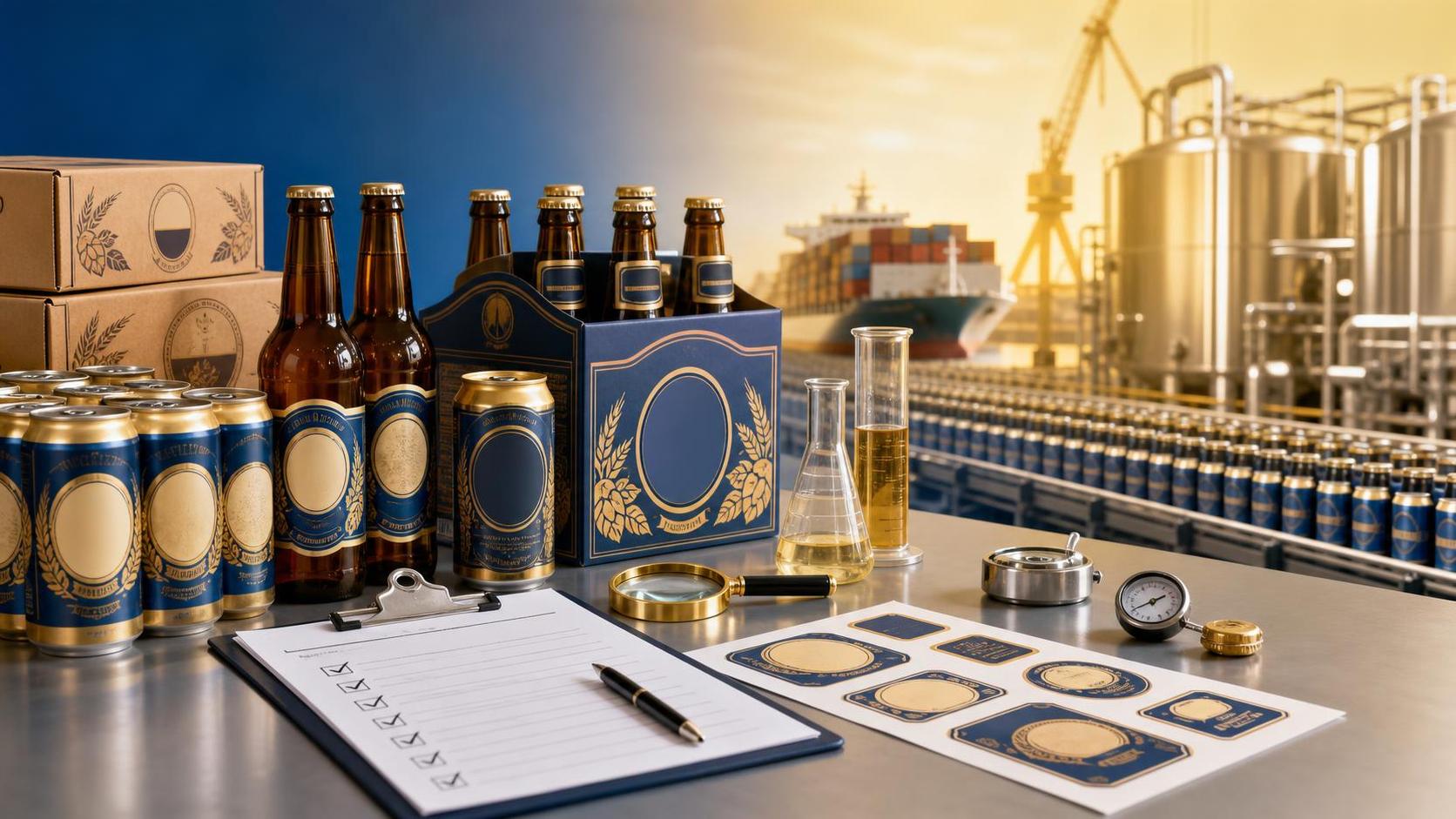
Start with the risk map, not the sample box
Working with a Chinese beer factory can give you better cost control, room for OEM or ODM development, and a faster route into market. It can also go sideways in very ordinary ways: a pilot sample tastes right but the production batch does not, lead times look fine until packaging materials slip, or the beer clears customs in one market but gets held in another because the label file was treated as an afterthought.
For project managers, the real job is not just finding a supplier. It is building a sourcing process that catches trouble before money is tied up in stock, freight, and launch commitments. If you are evaluating a Chinese beer factory, this is the checklist worth using.
Check whether the factory matches your product type
A common mistake is assuming that any brewery can reliably make any beer style. That is not how production risk works. A factory that runs stable volume on classic lager may not be the right partner for fruit beer, sugar-free low-calorie beer, or functional specialty beer if your formula depends on sensitive ingredients, precise sweetness control, or extra filtration discipline.
Ask for a product list that reflects actual manufacturing scope, not just sales ambition. Then look at what matters for your SKU:
- Does the factory already produce beers in the same style category?
- Are your required pack formats part of routine production or a one-off arrangement?
- If the recipe includes fruit, sweeteners, or functional ingredients, who controls sourcing and compatibility testing?
If the answers stay general, treat that as a risk signal. Capability in beer manufacturing is narrower than many buyers assume.
Do not approve a sample until the approval standard is written down
The most expensive sentence in beverage sourcing is, “The sample was good.” Good in what way? Taste, aroma, color, carbonation, foam retention, shelf stability, can seam integrity, carton strength, and label adhesion are different checkpoints, handled by different teams, at different stages.
Before sample sign-off, lock the commercial specification and the quality specification together. Your internal approval sheet should cover:
- Beer style and target sensory profile.
- Pack format, fill volume, and closure type.
- Artwork version and language version.
- Shelf-life expectation and storage assumptions.
- The exact sample reference that mass production must follow.
Without that, the factory may believe the sample only proves formulation, while your sales team believes it covers the final retail product. That gap causes arguments later, usually when the shipment is already on the water.
Treat label compliance as a project track of its own
For imported beer, label mistakes are one of the easiest ways to lose time and margin. The issue is not only whether the Chinese beer factory can print what you send. The issue is whether the file reflects the destination market’s rules for beer category naming, ingredient declaration, allergen presentation, alcohol statement, net content, importer details, barcode setup, and any required language format.
Do not leave this to the final week. Build a simple approval chain:
If the beer is going into more than one country, avoid assuming one export label will cover all destinations. It often will not.
Look past brewery capacity and ask about packaging dependency
Production delays are often blamed on the brewery, but the bottleneck may sit with cans, glass, crowns, trays, cartons, or printed labels. Custom packaging is where schedules start to drift. A beer can be ready to fill and still miss shipment because one packaging component is late or out of spec.
When reviewing lead time, split it into separate clocks: formula confirmation, packaging artwork approval, packaging procurement, brewing, conditioning, filling, inspection, and export document release. If a supplier gives you one total number without breaking it down, you do not yet have a dependable schedule.
This matters even more when you are launching seasonally or tying stock arrival to retail promotions. Beer lead time failure is often packaging lead time failure wearing a different name.
Get clear on who owns the formula, artwork, and changes
OEM and ODM projects can become messy when the product evolves over several sample rounds. You need written control over version history. Which recipe is approved? Which sweetness level? Which fruit base? Which can artwork revision? Which carton mark belongs to which market?
A basic document register solves more problems than long email threads. At minimum, assign a version code to every approved item and make sure the purchase order references those exact codes. If the factory changes a raw material source, a flavor component, or packaging board grade after approval, that should trigger a formal review, not an informal message in a chat group.
Test communication discipline before you place the first real order
Communication problems rarely show up as total silence. More often, everything sounds positive until you ask for a date, a file, a batch record, or a correction plan. That is where execution quality becomes visible.
Use the trial phase to measure operating discipline:
- How fast do they answer technical questions?
- Do they summarize decisions clearly after meetings?
- When a document is revised, do they mark the latest version correctly?
- If a risk appears, do they raise it early or only after you ask?
A Chinese beer factory can be technically capable and still become hard to manage if project communication is loose. For cross-border beverage work, that is not a minor issue. It is a cost issue.
Plan quality control around failure points, not generic inspection
“We will inspect before shipment” sounds responsible but is too late if the problem is formulation drift or unstable packaging. Inspection only works when it is tied to known failure points.
For beer sourcing, the risk points usually include raw material consistency, brewing and fermentation control, carbonation stability, filling accuracy, seam or cap integrity, print accuracy, and final pack-out. The exact control plan depends on the product, but the logic is the same: define which records or samples must be checked before the next stage begins.
If your SKU is more sensitive than standard lager, tighten the gate. Fruit-flavored or specialty products usually need closer review because flavor balance, haze, sediment behavior, or sweetness perception can shift more easily between sample and full batch.
Do not treat export documents as admin work
Documentation issues can delay shipment just as easily as a production hold. Project managers should know which documents are part of their import process and who provides each one. The list depends on destination market, importer role, product type, and trade term, so the practical move is to match your import requirement list to the factory’s document set before production closes.
Check document consistency carefully. Product name, pack size, quantity, batch details, and shipper information should align across commercial paperwork, shipping marks, and label files. Small mismatches are the kind that burn days.
Watch minimum order quantity and stock aging together
Low unit cost can hide a bad inventory decision. If the minimum order quantity is high and your route to market is still uncertain, you may solve a factory pricing problem and create a sell-through problem instead. This is especially relevant for new branded SKUs, niche flavors, and multi-market launches where demand may split unevenly.
Run the order model against realistic depletion timing, not optimistic launch plans. Beer is not just another shelf item; freshness expectations and channel turnover matter. A project that looks efficient on the purchase order can become expensive once discounting, storage, and replacement shipments enter the picture.
Audit the problem-solving process, not just the factory presentation
Most suppliers can present equipment, product categories, and export experience well. The better test is simpler: ask how nonconforming product is identified, separated, reported, and dispositioned. Ask what happens if packaging arrives wrong. Ask who approves a deviation. Ask how rework decisions are documented.
You are looking for process maturity. Clear answers usually come with named records, decision points, and responsible roles. Vague answers usually mean the real system depends on improvisation.
Use a staged first order instead of a full-risk launch
If the supplier passes commercial review, resist the urge to compress the first project. A staged approach usually costs less than cleaning up a rushed rollout. Start with one SKU, one market label version, and a packaging format the factory already runs well. Add complexity after the workflow proves stable.
The strongest first-order sequence is usually this: confirm factory-product fit, freeze sample and spec, approve label files, lock packaging lead times, align document requirements, then place the production order with version-controlled references. That sequence catches most avoidable failures before they become landed-cost problems.
When sourcing from a Chinese beer factory, the biggest gains do not come from pushing the lowest quote. They come from reducing avoidable variation. If you make the project easier to control, the supply relationship usually becomes easier to scale.
Thank you very much for writing to us. Please leave your message and contact information, we will reply to you within 24 hours.