



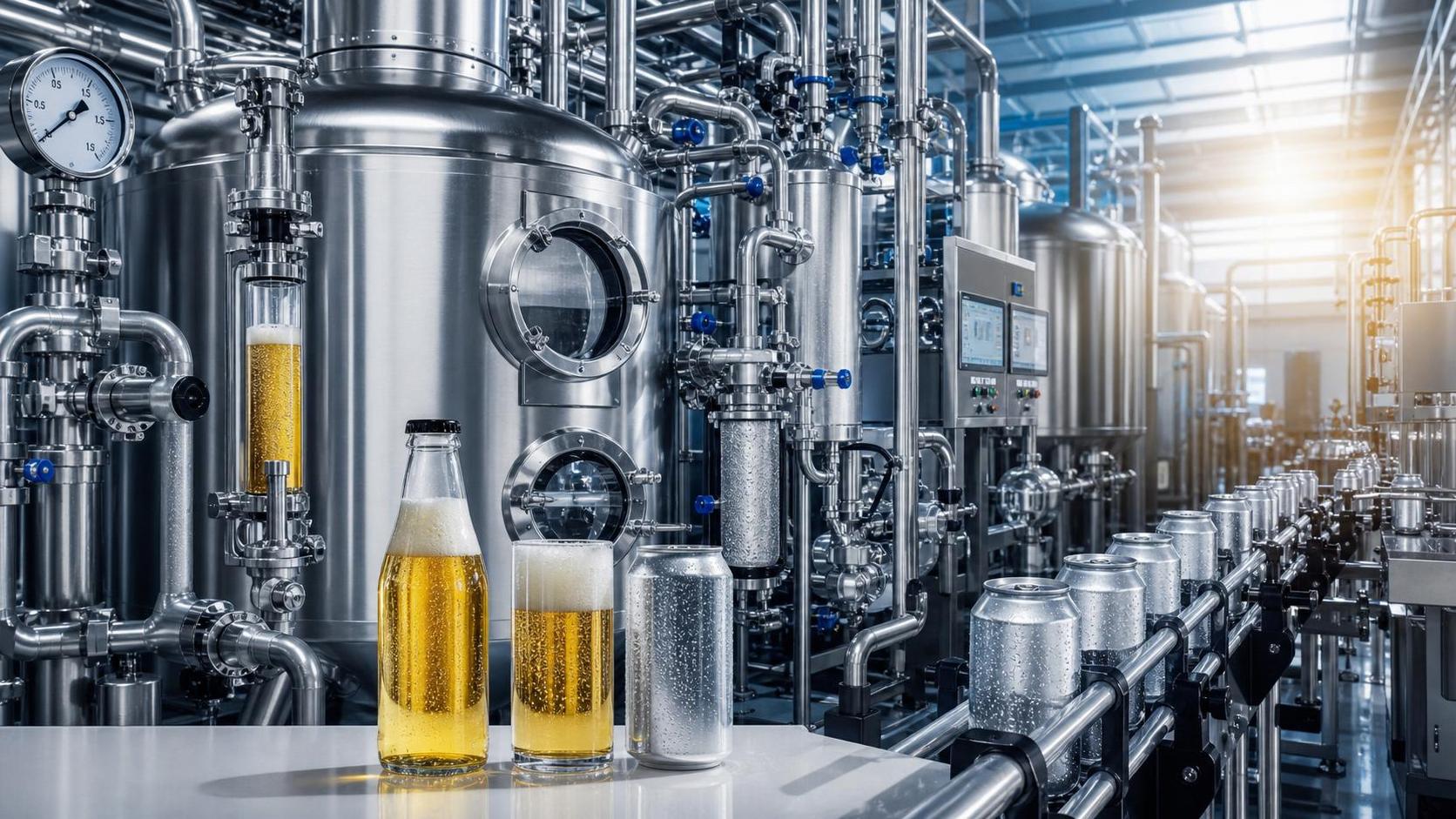
Why does a strong lager beer factory face more process risk than a standard lager line?
A strong lager beer factory works with higher original gravity, heavier yeast stress, and tighter control windows.
That means a small deviation in fermentation, filtration, or packaging can show up quickly in taste, foam, or shelf life.
In practical production, the challenge is not only alcohol level. It is keeping the beer clean, stable, and repeatable from batch to batch.
This matters even more when a brewery serves different channels, private label projects, and multiple beer styles at the same site.
Jinpai Beer operates across craft beer R&D, manufacturing, and global supply, so process discipline is not a theoretical issue.
It directly affects whether classic lager, low-calorie beer, fruit variants, and OEM batches stay consistent in different markets.
A useful way to read common problems in a strong lager beer factory is simple: look for points where stress, oxygen, temperature, and hygiene meet.
When fermentation goes off target, what usually caused it?
Most fermentation trouble starts before the tank looks abnormal.
The early warning signs are often slow gravity drop, uneven attenuation, rising diacetyl, sulfur retention, or harsh alcohol notes.
In a strong lager beer factory, yeast is asked to perform under higher osmotic pressure and increasing alcohol stress.
If pitching rate is low, oxygenation is unstable, or yeast vitality is weak, the result is usually incomplete or dirty fermentation.
Temperature drift adds another layer. A warm start may accelerate growth, but it can also lift esters and fusel alcohols above target.
A cold start can protect flavor, yet it may extend the cycle and leave unwanted compounds behind.
The better approach is not chasing symptoms. It is controlling the full yeast management loop.
- Verify pitching rate against wort gravity, not against a fixed house number.
- Measure dissolved oxygen after aeration, not only airflow or setpoint.
- Track yeast generation count, viability, and contamination risk before reuse.
- Use a defined temperature profile with a planned diacetyl rest.
- Compare real attenuation history across tanks, not just final alcohol data.
More often than not, prevention depends on disciplined records. A strong lager beer factory cannot rely on operator memory alone.
Why do haze, flavor instability, or short shelf life still appear after filtration?
Filtration is often blamed when the actual problem began earlier.
Protein-polyphenol imbalance, immature beer, poor cold conditioning, or oxygen pickup can all create haze and stale flavor later.
Still, filtration itself brings several common risks in a strong lager beer factory.
One is overloading the filter because upstream clarification was inconsistent. Another is using a filtration rate that strips body and foam stability.
The most expensive issue is oxygen ingress during transfer, filtration, or bright beer holding.
Even if microbiology passes, oxidative notes can appear as cardboard, sweetness imbalance, or dull hop character after distribution.
A useful checkpoint table can help narrow the likely source before product release.
The table works best when paired with routine sensory review, laboratory checks, and release standards that match the target market.
Packaging problems look minor at first, so why do they create major losses?
Because packaging defects multiply after the beer leaves the site.
A small fill variation, weak seam, cap leak, or poor can purge may not stop the line. It can still ruin product performance later.
In a strong lager beer factory, packaging control is especially sensitive because the beer often travels through wider distribution conditions.
OEM and export supply also increase the need for stable shelf life, transport resistance, and batch traceability.
The most common packaging failures include dissolved oxygen spikes, microbial contamination from filler hygiene, and pressure inconsistency.
Those issues are usually prevented through routine line verification, not occasional troubleshooting.
- Confirm package oxygen by container type and line speed.
- Check crown, seam, or closure performance with scheduled destructive tests.
- Validate CIP and sanitation contact time at the filler and product path.
- Separate startup product, changeover product, and release product clearly.
- Review code printing and traceability before full lot release.
What matters here is consistency. A strong lager beer factory needs packaging data that can explain both quality complaints and process drift.
How can contamination be prevented when the plant handles multiple beer styles?
This is where many breweries underestimate complexity.
A site that produces classic lager alongside wheat beer, fruit beer, low-calorie beer, or functional specialty products faces more cross-process risk.
In a strong lager beer factory, contamination does not always mean obvious spoilage. It may appear as flavor carryover, residual sweetness shift, or unstable fermentation behavior.
The prevention strategy should cover both microbiological safety and product separation.
In actual operations, the highest-risk moments are changeovers, hose routing, yeast handling, and tank allocation under schedule pressure.
A stronger system usually includes these controls:
- Dedicated procedures for allergen or flavor-bearing products.
- Tank zoning based on beer family and microbiological status.
- Swab tests and rinse verification after product changeover.
- Clear line clearance records before the next brew enters process.
- Trend review of contamination events by area, not only by batch.
This is one reason integrated breweries with R&D and customized production tend to invest heavily in standardization.
Without it, flexibility becomes a source of hidden defects instead of a business advantage.
What signs show that efficiency problems are becoming quality problems?
The warning sign is usually repeated “small exceptions” that become normal.
Extended fermentation time, frequent filter change, unplanned tank waiting, or repeated packaging adjustment often look like scheduling issues first.
In a strong lager beer factory, those delays can push beer outside its ideal process window.
Then quality starts moving with efficiency losses.
A delayed transfer may increase oxygen risk. A rushed turnaround may weaken sanitation. Holding packaged beer too long in warm conditions may shorten shelf life.
A practical way to judge this is to compare process KPIs with product KPIs on the same timeline.
If dissolved oxygen, haze complaints, flavor variation, or rework rates rise after line slowdowns, the link is already there.
At that point, the best response is not more inspection alone. It is a review of bottlenecks, cleaning windows, tank use, and preventive maintenance discipline.
What is the most practical prevention plan for a strong lager beer factory?
A workable plan is usually built around a few non-negotiable controls, then adjusted by product style and channel needs.
That matters for breweries supplying domestic retail, bars, restaurants, and export partners at the same time.
The prevention plan should include raw material consistency, yeast management, oxygen control, validated sanitation, and release testing.
Just as important, each control point needs a limit, a record, and a response action.
When that structure is missing, the strong lager beer factory depends too much on individual experience.
When it is present, troubleshooting becomes faster and scale-up becomes safer.
To move from reactive fixes to stable production, focus on these next steps:
- Map the top three recurring defects by process stage.
- Set review points for fermentation, filtration, and package oxygen.
- Align laboratory data with sensory results and customer feedback.
- Check whether changeovers and customized batches need tighter controls.
- Update standard operating limits before the next production cycle.
In the end, a strong lager beer factory stays reliable when quality prevention is built into daily decisions, not added after a complaint.
That is the right starting point for evaluating process gaps, refining standards, and supporting consistent beer supply across different markets.
Thank you very much for writing to us. Please leave your message and contact information, we will reply to you within 24 hours.