



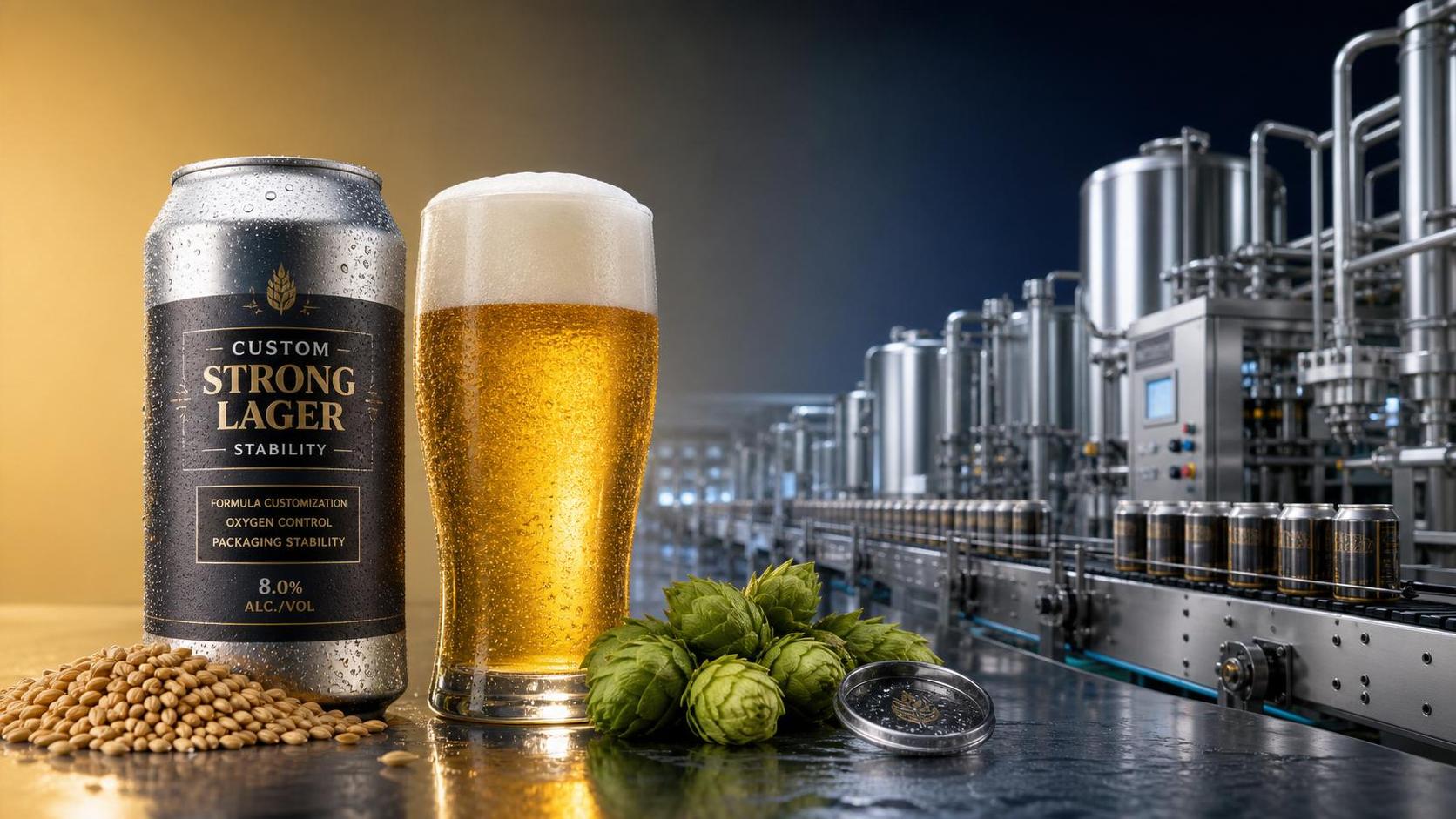
Customized Strong Lager Beer Formulation: What Impacts Taste Stability
Customized strong lager beer development requires more than raising alcohol content. Taste stability depends on formulation logic, process control, oxygen management, and packaging discipline.
In technical review, a strong lager should taste consistent from filling to the end of shelf life. That means flavor balance must survive transport, storage, and retail display.
For customized strong lager beer, the challenge is sharper. Higher gravity, stronger malt load, and longer flavor persistence can also magnify oxidation, sweetness drift, and harsh aftertaste.
This is why taste stability should be assessed as a system. Raw materials, yeast performance, dissolved oxygen, and storage temperature all shape the final result.
Why Taste Stability Matters in Customized Strong Lager Beer
Taste stability is the ability of beer to retain intended aroma, mouthfeel, and finish over time. In customized strong lager beer, stability directly affects commercial reliability.
A formulation may taste excellent at tank release, yet fail after several weeks. Common signs include cardboard notes, syrupy sweetness, thinning bitterness, or rough alcoholic warmth.
From a technical standpoint, strong lager customization usually targets a defined profile. That may include fuller body, stronger aroma retention, cleaner finish, or better tropical-market shelf performance.
These goals require measurable standards. Sensory targets alone are not enough. Stable customized strong lager beer also needs repeatable data across pilot, scale-up, and finished goods.
Raw Material Selection Sets the Stability Baseline
The first stability decision happens before brewing starts. Malt, adjuncts, hops, water profile, and functional additions define oxidation sensitivity and flavor resilience.
Malt Composition and Wort Character
Customized strong lager beer often uses a richer grist to support body and alcohol. Yet more intense malt character can increase sweet heaviness if attenuation is not well controlled.
High-color malts may add depth, but they can also push stale caramel notes during storage. Cleaner base malt programs usually preserve a fresher lager profile longer.
Adjunct Strategy and Fermentability
Rice, corn, sugars, or specialty carbohydrates change body and attenuation. Used well, they can lighten finish and improve drinkability in customized strong lager beer.
Used poorly, they create imbalance. A beer may start smooth, then become hollow, hot, or oddly sweet as flavor compounds shift in storage.
Hop Type and Stability Risk
Hop oils are highly vulnerable. In customized strong lager beer, aggressive late hopping can add appeal, but aroma collapse may happen faster than expected.
Many stable formulations rely on firm bitterness, restrained late additions, and hop products with better consistency. The target is not maximum aroma, but durable balance.
Fermentation Performance Drives Flavor Retention
Fermentation is where customized strong lager beer either gains long-term precision or builds hidden instability. Stronger wort places more stress on yeast and process timing.
Yeast Health and Pitching Rate
Underpitched yeast can increase fusel alcohols, sulfur carryover, and unfinished fermentation character. Over time, these faults become more noticeable, especially in stronger lager formats.
Healthy pitching, correct oxygenation before fermentation, and strict viability checks support cleaner profiles. That is a core requirement in customized strong lager beer evaluation.
Temperature Control and Maturation
Temperature swings can create ester drift or rough alcohol expression. Even when fresh beer seems acceptable, poor control often shortens flavor stability later.
Longer, well-managed lagering helps strong beer integrate. It reduces sharp edges and improves flavor cohesion, especially when the alcohol level is intentionally elevated.
Final Attenuation and Residual Extract
Residual extract plays a major role in how customized strong lager beer ages. Too much residual sweetness can become cloying. Too little can expose alcohol harshness.
A stable formulation usually lands in a narrow window. It keeps body present while leaving a dry enough finish to resist flavor fatigue.
Oxidation Is Still the Main Stability Threat
In real production, oxidation remains the clearest reason a customized strong lager beer loses value. Higher alcohol does not protect freshness. In some cases, it exposes stale notes faster.
Oxidation damages hop brightness, dulls malt definition, and builds papery or sherry-like impressions. Once this happens, no packaging claim can recover the intended profile.
Critical Oxygen Control Points
- Transfer from fermenter to bright tank
- Filtration or clarification steps
- Carbonation and blending operations
- Filler bowl management and seam integrity
- Headspace oxygen in cans, bottles, or kegs
For customized strong lager beer, low dissolved oxygen targets should be defined before commercial launch. Without those limits, sensory review becomes subjective and incomplete.
Antioxidant Logic in Formulation
Some brewers support stability through recipe design. That can include selecting less oxidation-prone ingredients, adjusting polyphenol load, or reducing unstable aroma fractions.
The practical point is simple. Customized strong lager beer should be designed for distribution conditions, not only for the tasting room.
Packaging Choice Shapes Shelf-Life Performance
Packaging is not a final detail. It is part of the formulation system. Strong lager that performs well in one format may degrade faster in another.
Can, Bottle, and Keg Differences
Cans usually offer strong light protection and good oxygen control when filling quality is high. Bottles may face greater light risk, depending on glass color and retail conditions.
Kegs can protect flavor well, yet line hygiene and turnover matter. For customized strong lager beer, packaging must match the intended sales channel and consumption cycle.
Closure, Liner, and Barrier Performance
Technical evaluation should include closure quality, oxygen ingress risk, and barrier consistency over time. Small variations here can create major flavor differences at the shelf edge.
This becomes more important for export projects. Longer transit and warmer climates put customized strong lager beer under more stress than domestic cold-chain distribution.
Storage Conditions Can Redefine the Result
Even a well-built customized strong lager beer can fail under poor storage. Heat, light, vibration, and long warehouse dwell time accelerate flavor breakdown.
A useful technical review compares fresh samples with aged samples under realistic conditions. Accelerated aging alone is helpful, but not sufficient for market prediction.
Key Storage Stress Factors
- High ambient temperature during shipping
- Repeated temperature cycling in distribution
- Extended display time in retail outlets
- Light exposure in transparent packaging environments
More recent market changes make this more relevant. Customized projects increasingly serve mixed channels, where storage discipline differs widely between bars, supermarkets, and online fulfillment.
How to Evaluate Customized Strong Lager Beer More Effectively
A solid review framework combines formulation data, process records, sensory panels, and shelf-life checks. Looking at only alcohol level and initial taste gives an incomplete answer.
In actual business settings, suppliers that support OEM, ODM, and formulation customization should also provide process transparency. That includes target specifications, trial feedback, and stability testing logic.
Jinpai Beer works across classic lager, wheat beer, sugar-free low-calorie beer, fruit beer, and functional specialty styles. For customized strong lager beer, integrated R&D and production support can shorten validation cycles and reduce reformulation risk.
A Practical Standard for Better Formulation Decisions
The best customized strong lager beer is not simply stronger. It stays clean, balanced, and recognizable through its intended shelf life.
That outcome depends on disciplined choices at every stage. Ingredient selection, yeast management, oxidation control, packaging format, and storage planning all influence taste stability.
For formulation review, the more useful question is not whether a sample tastes good today. It is whether the customized strong lager beer can hold its profile under real channel conditions.
Using that standard leads to better decisions, clearer supplier comparison, and stronger long-term product performance in customized strong lager beer projects.
Thank you very much for writing to us. Please leave your message and contact information, we will reply to you within 24 hours.