



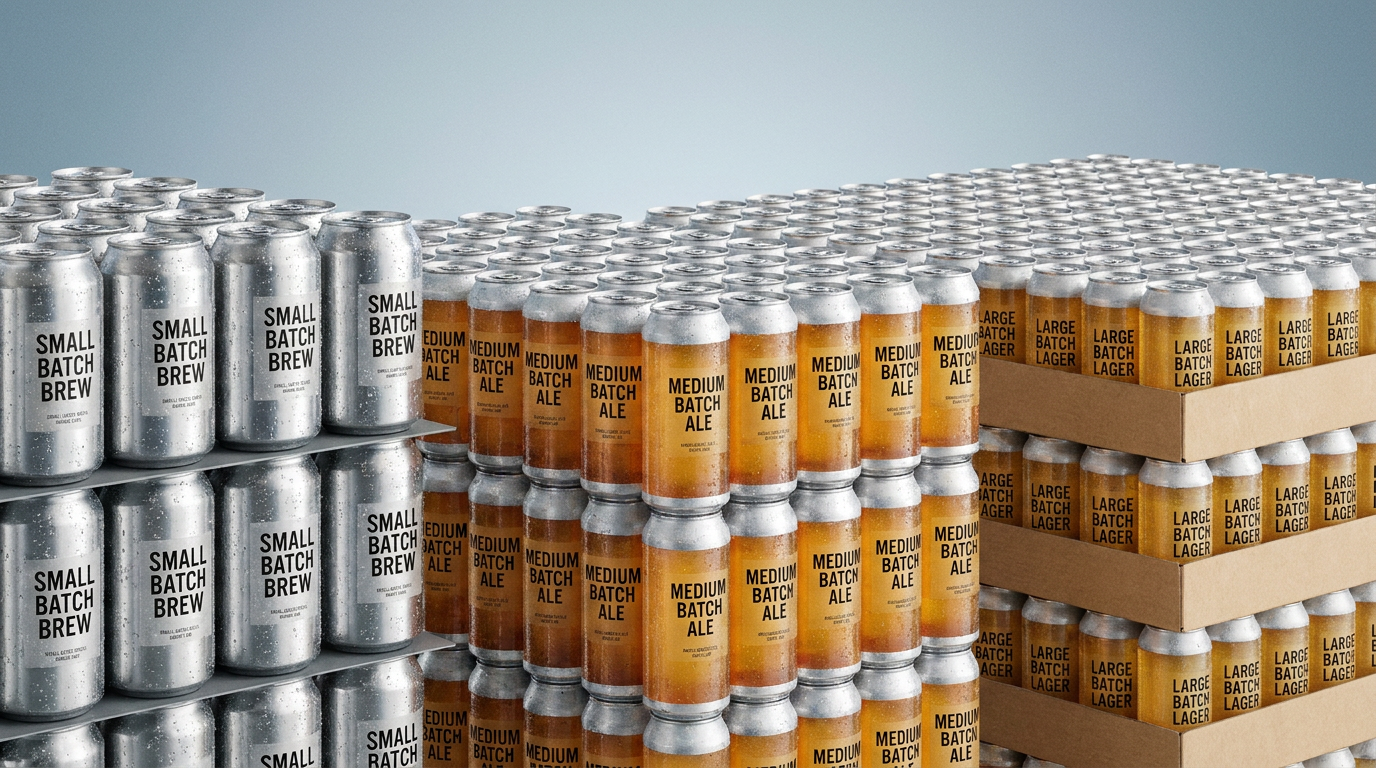
How long is the lead time for China beer OEM orders? At Jinpai Beer, it’s not a one-size-fits-all answer — it scales directly with your MOQ. As a financial decision-maker, you need predictability without overcommitting capital or inventory. Our flexible OEM model lets you adjust order volume to align with cash flow, demand forecasts, and market testing goals — and your delivery timeline shifts accordingly. No hidden delays, no rigid schedules: just transparent, MOQ-driven lead times backed by in-house R&D, brewing, and global logistics. Let’s optimize your procurement cycle — starting with the right order size.
Understanding Lead Time in China Beer OEM Production
Lead time refers to the total duration from confirmed order placement to ready-for-shipment completion. For craft beer OEM in China, this includes formulation finalization, label design approval, raw material sourcing, brewing, filtration, carbonation, packaging, quality control, and documentation preparation.
Unlike standardized FMCG items, craft beer OEM involves batch-specific variables: yeast propagation cycles, cold conditioning periods, canning line changeover time, and regulatory labeling compliance per destination market.
At Jinpai Beer, lead time is not preset. It is dynamically calculated based on three interdependent inputs: MOQ, product complexity, and destination certification requirements.
How MOQ Directly Influences Your Delivery Timeline
Minimum Order Quantity (MOQ) serves as the primary lever for timeline calibration. Here’s how it works:
- Orders under 5,000 units trigger priority small-batch scheduling — lead time: 35–42 days.
- Orders between 5,001–20,000 units use optimized production blocks — lead time: 28–34 days.
- Orders above 20,000 units qualify for dedicated line allocation and bulk ingredient pre-stocking — lead time: 21–27 days.
- Repeat SKUs with unchanged specs reduce timeline by 5–7 days across all tiers via process reuse.
This structure reflects real operational capacity — not theoretical best-case estimates. Smaller MOQs require more setup time per unit. Larger volumes amortize fixed prep costs and enable parallel workflows (e.g., simultaneous label printing and fermentation).
What Drives Variability Beyond MOQ?
While MOQ is the dominant factor, four secondary variables fine-tune the final schedule:
Why Fixed Lead Times Mislead Buyers
Many suppliers quote “45-day lead time” as a blanket figure. This creates three tangible risks:
- Underestimation of resource constraints during peak season (Q3–Q4), causing unplanned extensions;
- Over-allocation of buffer stock due to worst-case assumptions, tying up working capital;
- Inability to accelerate timelines when urgent market windows open (e.g., festival launches).
Jinpai’s MOQ-linked model eliminates guesswork. You receive an exact date upon MOQ confirmation — backed by live production calendar visibility.
Practical Scenarios: Matching MOQ to Business Goals
Your ideal MOQ depends on strategic intent:
- Market entry testing: Start with 3,000–5,000 units. Accept slightly longer lead time for low-risk validation.
- Channel rollout (e.g., supermarket chain): Target 10,000–15,000 units. Balance speed, shelf presence, and logistics efficiency.
- Annual contract fulfillment: Optimize at 25,000+ units. Lock in shortest timeline and strongest landed cost.
All scenarios retain full customization rights — from ABV adjustment and hop profiles to functional additives like L-theanine or vitamin B12.
How to Secure Your Timeline Accurately
Follow these four steps to lock in a precise, actionable lead time:
- Share your target MOQ, preferred format (can/bottle), and destination country.
- Select from Jinpai’s certified base recipes — or submit technical specs for custom development.
- Approve artwork and labeling within 3 business days to avoid calendar slippage.
- Confirm order with 30% deposit — production slot is reserved immediately.
We provide weekly milestone updates: fermentation start, packaging commencement, QC clearance, and ETD confirmation.
Optimize Now — Not After the Deadline
How long is the lead time for China beer OEM orders? The answer begins with your MOQ — and ends with your confidence in execution. Jinpai Beer delivers transparency where others offer ambiguity.
Whether launching sugar-free low-calorie lager in Scandinavia or German wheat with local botanicals in Japan, our integrated brewery-to-logistics infrastructure ensures your timeline reflects reality — not rhetoric.
Ready to align your next OEM order with predictable timing and zero compromise on quality? Contact Jinpai Beer today for a personalized MOQ-to-lead-time assessment — including free sample batches and digital proofing support.
Thank you very much for writing to us. Please leave your message and contact information, we will reply to you within 24 hours.