



What Technical Evaluators Actually Need to Know When Comparing Brewing Capabilities Across Geographies
When a technical evaluator—say, a global beverage procurement lead or an R&D director at a multinational F&B group—searches for “China beer factory vs. German beer factory,” they’re rarely asking for a textbook comparison of national brewing traditions. What they’re really assessing is operational viability: Can this facility deliver *our* spec, *our* timeline, *our* compliance framework—and under what conditions? The headline triad—process rigidity, ingredient traceability, and Reinheitsgebot compliance—isn’t academic. It maps directly to three concrete decision vectors: production predictability, supply chain auditability, and regulatory portability.
Rigidity Isn’t Just About Discipline—It’s About Interface Design
In German breweries operating under strict Reinheitsgebot interpretation, process rigidity functions as a built-in quality gate—but also as an interface constraint. Batch scheduling, yeast propagation cycles, filtration parameters, and even tank cleaning protocols are often locked into multi-decade validation pathways. That delivers repeatability for classic lagers. But it also means introducing a new adjunct (e.g., cold-pressed citrus pulp for a functional variant) or shifting from 100% barley malt to a gluten-reduced enzymatic blend may require re-validation across multiple GMP modules—not just lab testing, but full-scale pilot runs with documented deviation logs.
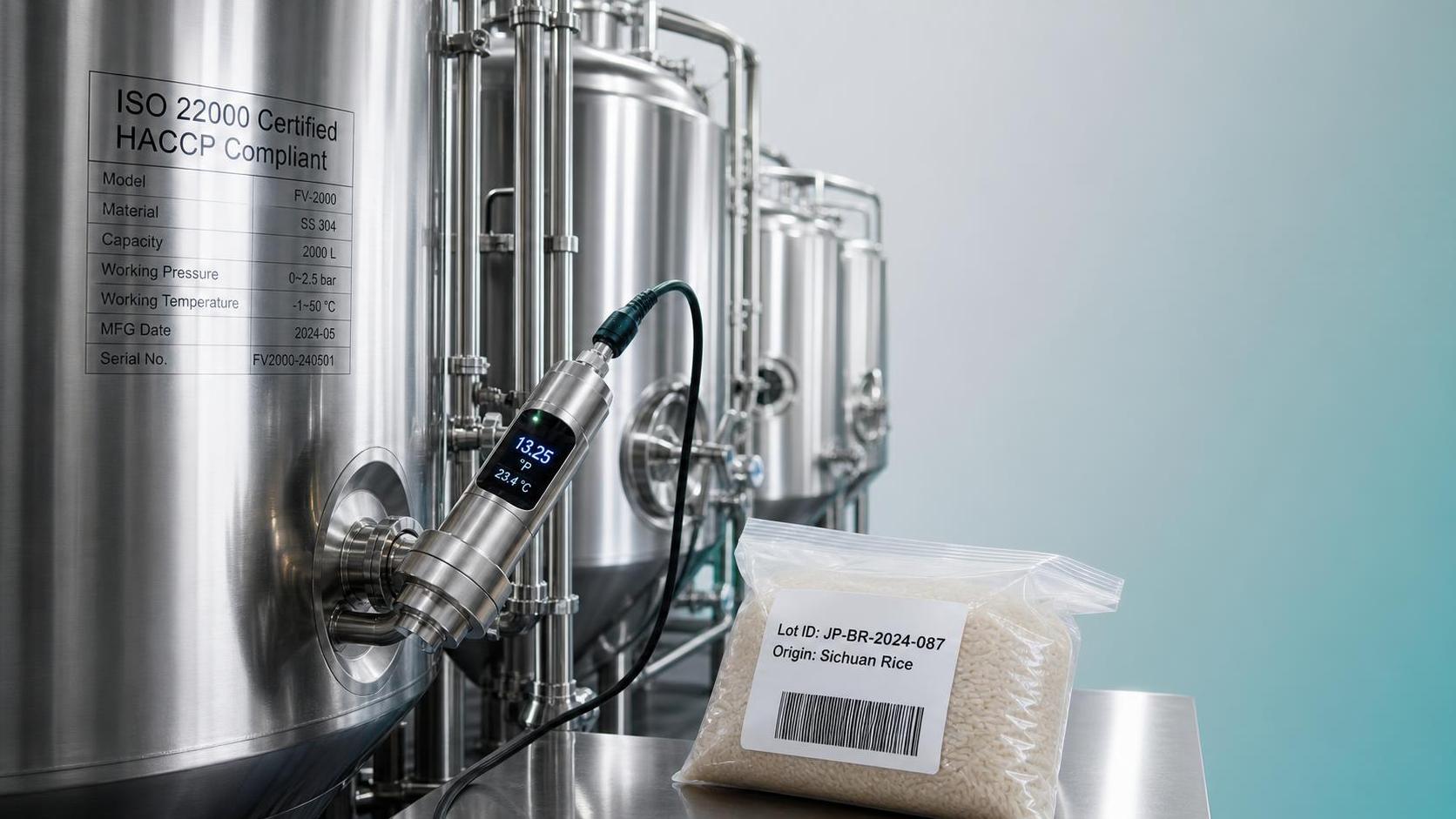
A certified China beer factory like Jinpai operates under a different architecture: ISO 22000 and HACCP-certified infrastructure, yes—but with modular process lines designed for formulation switching. Their lager line can be repurposed for wheat beer in under 48 hours, not weeks. Why? Because the control logic isn’t baked into legacy hardware; it’s embedded in programmable logic controllers calibrated to *spec-driven thresholds*, not tradition-bound defaults. This isn’t “looser” quality—it’s *parameterized* quality. The trade-off? Less inherent stability for single-product scale-up; greater adaptability for multi-SKU, low-volume, high-variability portfolios.
Traceability: From Paper Trail to Real-Time Chain-of-Custody
Ingredient traceability is where assumptions break down most sharply. Many assume Germany leads by default—yet EU-wide traceability requirements (Regulation (EC) No 178/2002) mandate only “one step forward, one step back.” A German contract brewer may track malt from mill to mash tun, but unless explicitly contracted, may not retain granular lot-level data for hops sourced via third-party distributors—or hold that data beyond 5 years.
In contrast, Jinpai’s traceability system was engineered for OEM/ODM clients requiring full-chain visibility: raw material certificates of analysis (CoA), harvest dates, pesticide screening reports, and fermentation batch logs are all digitized and linked to individual pallet IDs. Crucially, their ERP integrates with domestic agricultural platforms (e.g., China’s National Agricultural Products Quality Traceability Platform), enabling real-time verification of rice or sorghum origin—critical when sourcing non-barley bases for sugar-free or functional variants. This doesn’t mean German facilities lack rigor; it means their traceability architecture serves a different primary use case: food safety incident containment, not formulation IP protection or retail compliance reporting.
Reinheitsgebot: A Regulatory Anchor—or a Strategic Boundary?
This is the most misunderstood lever. Reinheitsgebot compliance isn’t binary—it’s contextual. A German brewery exporting to the U.S. may produce a “Reinheitsgebot-compliant” lager for domestic branding, while simultaneously brewing a fruit-infused IPA for export under §3 of the German Food Code (which permits additives for “non-traditional beer types”). Similarly, Jinpai does not claim Reinheitsgebot adherence—and rightly so. Their sugar-free low-calorie beers use enzymatic starch hydrolysis and selective yeast strains; their fruit-flavored variants integrate cold-kettle infusion to preserve volatile aromatics. These processes are fully compliant with Chinese GB 4927-2008 (brewed beverages standard) and meet FDA 21 CFR Part 101 labeling requirements—but they sit outside Reinheitsgebot’s 1516-defined scope.
The strategic implication? If your target market demands Reinheitsgebot certification for shelf presence (e.g., premium on-trade in Germany or Austria), no amount of technical equivalence matters—you need the designation. But if your priority is functional efficacy (e.g., clinically validated probiotic strains in a post-fermentation addition), label transparency (e.g., “0g added sugar” with full carbohydrate breakdown), or rapid SKU iteration (e.g., seasonal fruit variants every 8 weeks), then Reinheitsgebot becomes a limiting factor—not a quality proxy.
Three Decision Filters for Technical Evaluators
Before requesting a capability deck or initiating a trial batch, ask these questions—not of the supplier, but of your own product roadmap:
- Is your formulation chemically stable across >6 months of ambient storage? If yes, German rigidity may reduce long-term QC overhead. If no (e.g., heat-sensitive botanicals, live cultures), Jinpai’s controlled cold-infusion and nitrogen-flushed bottling lines offer tighter parameter control over shelf-life-critical variables.
- Do you require batch-level ingredient provenance for regulatory filings (e.g., EU Novel Food dossiers, Health Canada NHP submissions)? Then prioritize digital traceability depth—not just origin country, but cultivar, harvest window, and analytical batch matching.
- How many SKUs do you plan to launch in the next 18 months—and what % will deviate from traditional malt/hop/yeast/water composition? If >30%, rigid-process environments introduce hidden cost drag: extended changeover downtime, validation delays, and incremental lab resource allocation.
None of this invalidates either model. It reframes the choice: German breweries excel where historical continuity, brand authenticity, and single-product excellence converge. Jinpai and peers in China’s certified craft manufacturing tier solve for a different problem set—where speed-to-market, formulation agility, and end-to-end data integrity outweigh ceremonial compliance. The right decision isn’t about “which is better,” but which architecture aligns with your next 3 product cycles—not your last 3 decades.
That alignment rarely appears in brochures. It lives in the tolerance stack-up of your spec sheet, the retention period of your CoAs, and the time-to-first-batch clock on your innovation calendar. Measure there first.
Thank you very much for writing to us. Please leave your message and contact information, we will reply to you within 24 hours.